By Marc Jones
LONDON, Jan 22 (Reuters) – World stocks nudged higher, the dollar was steady and gold softened on Thursday after U.S. President Donald Trump ruled out seizing Greenland by force and dropped tariff threats against eight European countries.
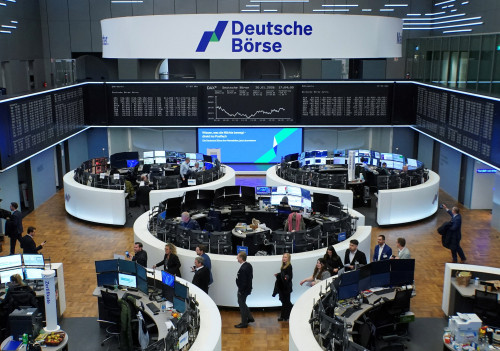
Relief at Trump’s change of tune pushed Europe’s STOXX 600 index up over 1%. Wall Street was also pointing higher again after its initial rally on Wednesday had been its best day in two months. [.EU][.N]
“I don’t have to use force, I don’t want to use force, I won’t use force,” Trump had said at Davos about securing Greenland, adding that he would not be imposing 10% import tariffs he had threatened on goods from eight European allies.
On Thursday he followed that up, saying he had secured a deal with the NATO military alliance that amounted to complete and permanent U.S. access to Greenland. “Essentially it’s total access,” Trump told the Fox Business Network in an interview.
The dollar had bounced following the walkback but sagged again in Europe. The euro climbed back above $1.17, Denmark’s crown was steady against both the dollar and the euro while gold was off its recent record high at $4,829 an ounce. [FRX/][GOL/]
“The lesson from last year was that actually markets are able to look through this (geopolitical headline-driven volatility),” State Street’s Michael Metcalfe said, adding that U.S. interest rate cuts and economic fundamentals should start to dominate focus again.
Data published ahead of the Wall Street open showed the number of Americans filing new applications for unemployment benefits increased less than expected last week, suggesting the labour market maintained a steady pace of job growth in January.
The VIX index, nicknamed Wall Street’s fear gauge, had already fallen back sharply as U.S. Treasuries, where a sell-off had pushed benchmark 10-year yields to their highest since August, also caught a bid. [/US]
Germany’s 10-year yields hovered around 2.87%, while Japanese 30-year yields, which have spiked on worries about the country’s finances and a snap election next month, eased back to 3.67%.
Ukraine’s bonds also saw a strong rebound after U.S. envoy Steve Witkoff said “a lot of progress” had been made in peace talks ahead of a meeting between Trump and his Ukrainian counterpart Volodymyr Zelenskiy in Davos later.
CAUTIOUS INVESTORS KEEP EYE ON GOLD
The 1% rise in European stocks roughly halved the drop they had seen since Trump’s tariff threats had reignited investors’ trade war jitters.
U.S. earnings season is also picking up pace. GE shares slipped marginally in premarket trading despite forecasting its above-estimate profits while McCormick and Procter & Gamble slipped nearly 6% and 1% respectively on their results.
Overnight, MSCI’s broadest index of Asia-Pacific shares outside Japan had closed up 1% as chipmaker gains in South Korea carried its KOSPI index above 5,000 points for the first time.
“The TACO, as they call it, is certainly real,” said Damian Rooney, director of institutional sales at Argonaut, a resources-focused broker in Perth, referring to a Wall Street acronym for “Trump Always Chickens Out”.
There was still little concrete detail on Trump’s Greenland agreement. NATO Secretary General Mark Rutte told Reuters that the first results of allies stepping up their Arctic security efforts would be seen later this year.
“I have no doubt we can do this quite fast. Certainly I would hope for 2026, I hope even early in 2026,” he said.
And investors were wary of completely unwinding some of the safe-haven bets made this week.
“Our mood here is it’s been fabulous fun being a gold bull for the last year and a half,” said Argonaut’s Rooney, “and with gold you never throw the baby out with the bathwater because (Trump) can’t help himself doing or saying some crazy things, whether he’s going to carry through or not.”
AUSSIE LEAPS ON JOBS BEAT
The erratic rebound in Japanese government bonds came as the Bank of Japan began a two-day meeting where it expected to send a hawkish message about possible further rate hikes.
[JP/]
The yen was steady at 158.24 per dollar, but remained under some pressure on crosses, with the euro not far from a record high on the yen and the Australian dollar scaling an 18-month top of 107.96 yen. [FRX/]
The Aussie also hit a 15-month high of $0.6810 on the U.S. dollar after a stronger-than-expected rise in Australian jobs data that had investors scrambling to price in the risk of a February 3 rate hike.
In the commodity markets, Brent crude was down $1.25 cents, or 1.92%, at $63.99 a barrel and West Texas Intermediate fell $1.24 cents, or 2.05%, to $59.38 a barrel.
“There is a deflation of risk premium related to the Greenland debacle and Iran supply risk has also been reduced,” said Ole Hansen, chief commodity analyst at Saxo Bank.
(Reporting by Marc Jones; Editing by Andrew Cawthorne)