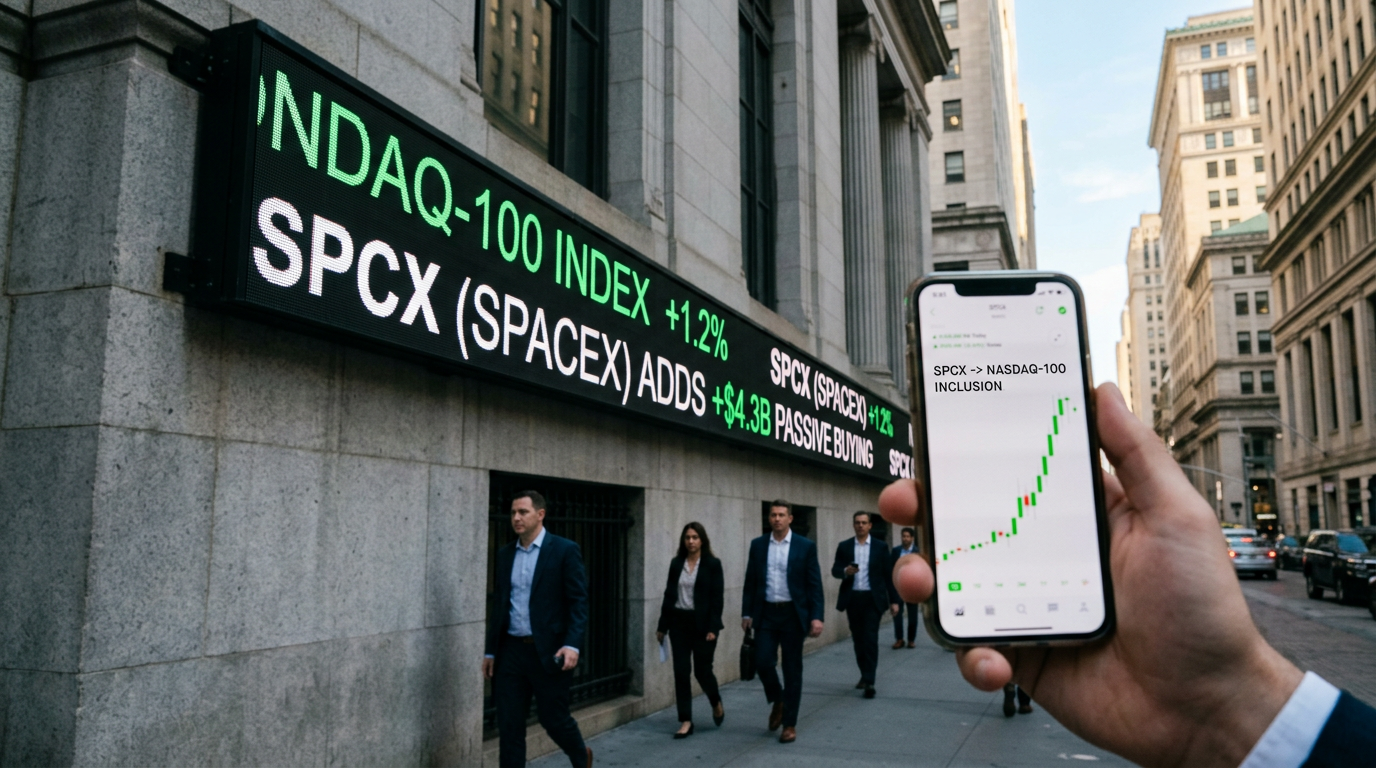
The index event is real. J.P. Morgan estimates roughly $4.3 billion in forced passive buying will hit SPCX around the July 6 close and July 7 open, when every fund tracking the Nasdaq-100 has to add SpaceX to match the new benchmark. That’s not discretionary demand. That’s a rulebook telling fund managers to buy at whatever price clears the market.
But here’s the thing — this kind of event gets front-run. Hard.
The question most investors are glossing over isn’t whether the index buying happens. It’s what SPCX does after the flow dries up.
How We Got Here
SpaceX completed the largest IPO in history on June 12, pricing at $135 per share and opening at $150 — an 11% pop at the open on day one. The company raised approximately $85.7 billion after underwriters exercised the overallotment option. At peak, shares briefly touched $225.64 intraday before pulling back sharply. As of Friday, SPCX was trading around $169, well below that high but still above its IPO price.
The speed of the index entry is unusual. Nasdaq changed its fast-track eligibility rules effective May 1, 2026, allowing large newly listed companies to qualify after just 15 trading days, provided they rank within the top 40 current constituents by full market cap. SpaceX fits. Under the old rules, it likely would have had to wait substantially longer before being eligible for inclusion.
More than $800 billion is benchmarked to Nasdaq-100 products. That forced buying pool is mechanical — once it’s done, it stops. What sustains the stock from there is entirely up to the business.
What You’re Actually Buying
Three businesses. One ticker.
- Starlink: $11.4 billion in 2025 revenue, roughly 61% of total company sales, $4.4 billion in operating profit. Had approximately 10.3 million active subscribers across 160+ countries as of Q1 2026.
- Launch Services: Around $4.1 billion in 2025 revenue, including government contracts. Solid but slow-growing — SpaceX completed 165 Falcon 9 launches in 2025, and most were internal Starlink missions.
- xAI: Acquired by SpaceX in an all-stock transaction announced February 2, 2026. Burning significant cash. Reporting indicates many of xAI’s original co-founders have departed, including reporting in late March 2026 that the last co-founder had left. SpaceX has also pursued a major AI push via Cursor: after announcing an option in April 2026, SpaceX disclosed in mid-June 2026 that it would acquire Cursor in an all-stock deal valued at $60 billion (expected to close in Q3 2026). Separately, SpaceX disclosed a major compute deal with Google valued at $920 million per month that is set to begin in October 2026.
The GAAP picture is less flattering: SpaceX reported total 2025 revenue of about $18.7 billion in its IPO filing. I could not verify the specific claim that SpaceX posted a GAAP net loss of nearly $5 billion in 2025 from a primary source in the time available, so that figure has been removed here. At a $2 trillion-plus valuation, the stock’s revenue multiple is extremely high relative to 2025 revenue.
The Part People Skip
History on index inclusions is pretty clear, and it’s not the bull case investors want to hear. When Palantir, MicroStrategy, and Axon joined the Nasdaq-100 in December 2024, all three actually declined in the 10 days following inclusion. The anticipation tends to do more work than the event itself.
Slight tangent, but it matters: Peloton joined the Nasdaq-100 in December 2020 near its all-time high. You know how that ended. Index inclusion reflects what a company has already achieved, not what it will deliver next.
That said, SPCX has a structural advantage Peloton didn’t: a genuinely defensible core business in Starlink, a low float that amplifies price moves in both directions, and a lockup calendar that keeps insider supply off the market until at least early August.
Bull / Base / Bear
Bull: xAI becomes a real revenue engine. The Google compute deal ($920M/month) scales (starting in October). Starlink hits 15 million subscribers by year-end and raises pricing further. Stock reclaims $200.
Base: Nasdaq-100 inclusion provides a temporary lift. Stock stabilizes in the $160–$175 range through summer. The company’s first earnings report as a public company becomes the next real catalyst. Analysts come off quiet periods and begin formal coverage — moving the consensus from a handful of analysts to a broader set, which changes how institutional allocators treat the position.
Bear: Forced buying dries up after July 7, momentum traders exit, and SPCX drifts below $150. Insider lockup expirations in August add supply. xAI burn rate accelerates without clear revenue traction. Stock revisits $140 or lower before earnings.
Technical Overlay
The stock has been stuck in a sideways channel between roughly $149.66 support and $163.27 resistance since the bridge loan risk cleared in late June. Current RSI is neutral around 42. The July 7 rebalance is the most likely catalyst to break that range. A sustained close above $163 opens a target near $172. A break below $149 opens downside toward $140.
What to Watch
- Post-inclusion price action on July 8 and 9 — does SPCX hold, or does the forced-buying bid immediately fade?
- The first quarterly earnings report as a public company: first hard fundamental checkpoint
- Insider lockup calendar: added supply in August as restrictions begin to lift
- Any Starlink pricing updates or subscriber milestone announcements
- xAI revenue disclosures — this is where the real valuation debate lives
Bottom Line
Buying SPCX at current levels is three separate bets inside one ticker: Starlink holding its lead, Starship eventually reducing launch costs enough to create new markets, and xAI becoming a real AI revenue business. The index inclusion is this week’s story. What determines whether SPCX is worth owning a year from now has nothing to do with the Nasdaq-100 rulebook.
For informational purposes only.