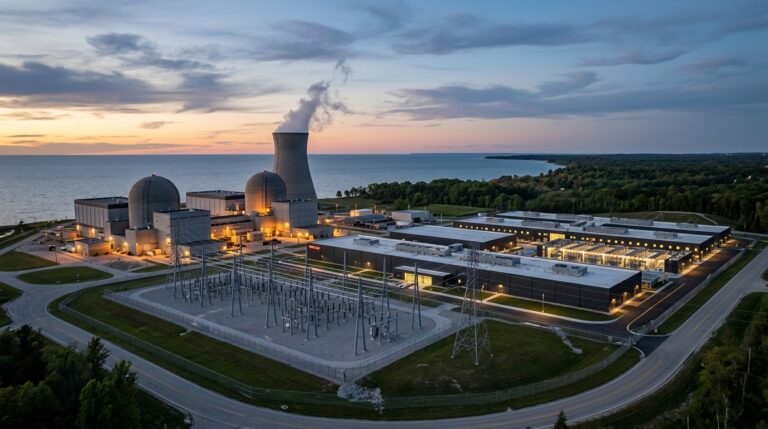
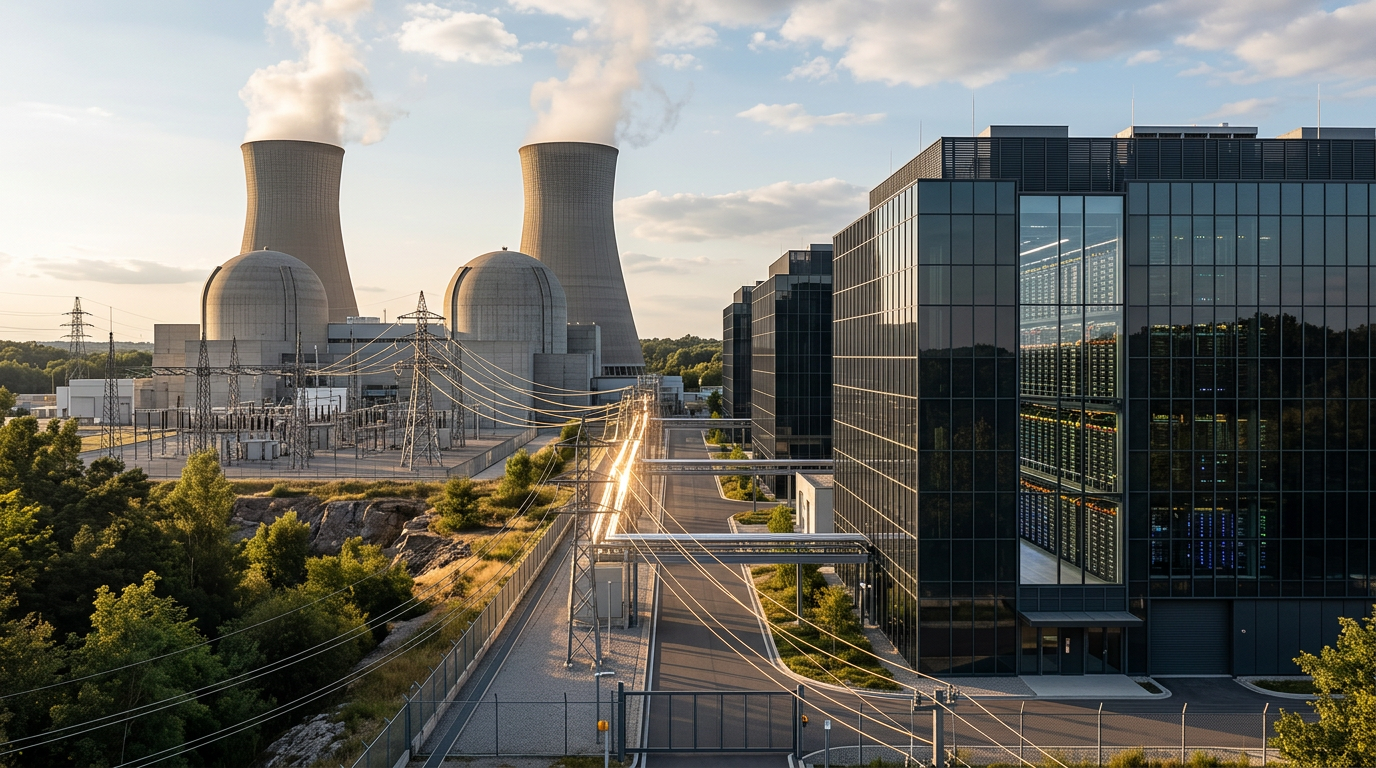
Here’s something that doesn’t get talked about enough. The real bottleneck in AI right now isn’t chips. It’s not memory, it’s not cooling. It’s power.
Actual, reliable, always-on electricity.
Data centers training the next generation of AI models need baseload power – the kind that runs 24/7 regardless of weather. Solar goes dark. Wind stops blowing. And as it turns out, batteries are still too expensive to support gigawatt-scale operations for extended periods. That reality has quietly forced one of the biggest capital reallocations in energy markets in years. And it’s pointing squarely at nuclear.
Which brings us to Cameco (NYSE: CCJ).
What the Numbers Say
Cameco is the world’s largest publicly traded uranium company. It doesn’t just mine uranium – it covers key parts of the nuclear fuel cycle, including uranium mining, refining, and conversion services through its fuel services business.
And in Q1 2026, it posted adjusted EBITDA of $509 million, with the uranium segment contributing $423 million of that figure.
Net earnings attributable to equity holders rose 87% year over year. That’s not a rounding error. That’s a structural shift showing up in the income statement.
The supply picture is arguably even more interesting. Cameco reaffirmed full-year 2026 production guidance of 19.5 to 21.5 million pounds of U3O8 (its share), while its average annual delivery commitments run to roughly 28 million pounds per year over the next five years. That gap between what it produces and what it’s contractually obligated to deliver tells you everything about how tight the market is becoming.
And the contract book keeps growing. As of December 31, 2025, Cameco had executed contracts to sell about 230 million pounds of U3O8 in its uranium segment. That’s not speculative demand. That’s locked-in revenue visibility stretching years into the future.
The Part Most Investors Are Missing
The AI-to-nuclear connection isn’t theoretical anymore. Michigan’s Palisades Nuclear Plant is undergoing what regulators and the Department of Energy have described as a first-of-its-kind effort to restart a retired commercial nuclear plant in U.S. history. Pennsylvania’s Three Mile Island Unit 1 secured a 20-year supply deal with Microsoft to restore the dormant unit and provide approximately 835 megawatts of carbon-free energy for Microsoft’s data centers. Companies like Microsoft are signing long-term agreements directly tied to nuclear generation, creating a demand source that simply didn’t exist five years ago.
Now layer in the government side. The Trump administration announced a conditional $17.5 billion loan commitment to support long-lead equipment for 10 new Westinghouse AP1000 reactors. The stated goal is for those projects to begin construction by 2030, with reactors expected to become operational in the mid-2030s (not completed by 2030). Cameco beneficially owns 49% of Westinghouse. So it participates directly in both the fuel supply and the reactor build-out.
Slight tangent, but it matters: the Strait of Hormuz situation has added a layer of energy security urgency that nobody fully priced in at the start of the year. When geopolitical risk makes fossil fuel supply unpredictable, the appeal of domestic nuclear power compounds quickly. Cameco’s CEO has said publicly that risks to global energy supply can amplify nuclear power’s competitive advantages.
What’s Happened to the Stock
CCJ hit an all-time closing high of $134.09 on January 28, 2026. As of early July, shares are trading below that level – a meaningful pullback from the peak.
Part of that is a near-term operational hiccup: Cameco temporarily suspended mining at its Cigar Lake operation after operational challenges at Orano’s McClean Lake mill – including an issue at its sulfuric acid plant – forced a shutdown for repairs. That’s a real disruption, not just noise. But it’s also the kind of temporary operational issue that has historically created entry points in otherwise structurally sound businesses.
The analyst community hasn’t blinked. RBC Capital has been reported as raising its price target to C$175. William Blair initiated coverage with an Outperform rating, but did not publish a $165 fair value estimate in its public initiation note. Broadly, Wall Street targets still cluster well above recent prices.
The Risks Worth Understanding
- Valuation: CCJ trades at a significant earnings multiple. That’s partly a function of lumpy uranium delivery schedules and timing of contract recognition – not necessarily a sign the underlying business is overpriced, but worth watching.
- Operational disruptions: The Cigar Lake suspension is a live risk. If the McClean Lake mill takes longer to come back online than expected, near-term production could fall short of guidance.
- Uranium spot price lag: Uranium stocks have run ahead of the commodity price itself. If utility contracting doesn’t pick back up quickly, the spread between equity prices and spot uranium could compress in the wrong direction.
- Geopolitical supply: A significant portion of global uranium supply runs through Kazakhstan. Any normalization of supply there could ease price pressure.
The Bigger Picture
What’s interesting is that the pipeline of conditional offtake agreements between data center operators and small modular reactor (SMR) projects has been reported as growing from 25 GW at the end of 2024 to 45 GW by April 2026. Data center electricity consumption has been estimated by one policy analysis to potentially approach 1,050 TWh by 2026. That demand isn’t going away. It’s accelerating.
And the uranium supply shortfall is real. But specific figures like an annual global shortfall of 30 million pounds and exactly 70 gigawatts of new reactor capacity being built worldwide aren’t consistently supported by a single authoritative, up-to-date source, so they should be treated as directional rather than precise. What is verifiable: global reactor build activity remains substantial, with the World Nuclear Association reporting about 80 reactors under construction worldwide as of mid-June 2026.
Cameco doesn’t need uranium prices to spike tomorrow to make this work. Its long-term contracts already lock in pricing well above historical averages. What it needs is for the world to keep building reactors. And right now, that’s exactly what’s happening.
The pullback may be worth watching closely.
This article is for informational purposes only and does not constitute investment advice. All investing involves risk, including possible loss of principal. Past performance does not guarantee future results. Always conduct your own due diligence before making any investment decisions.