
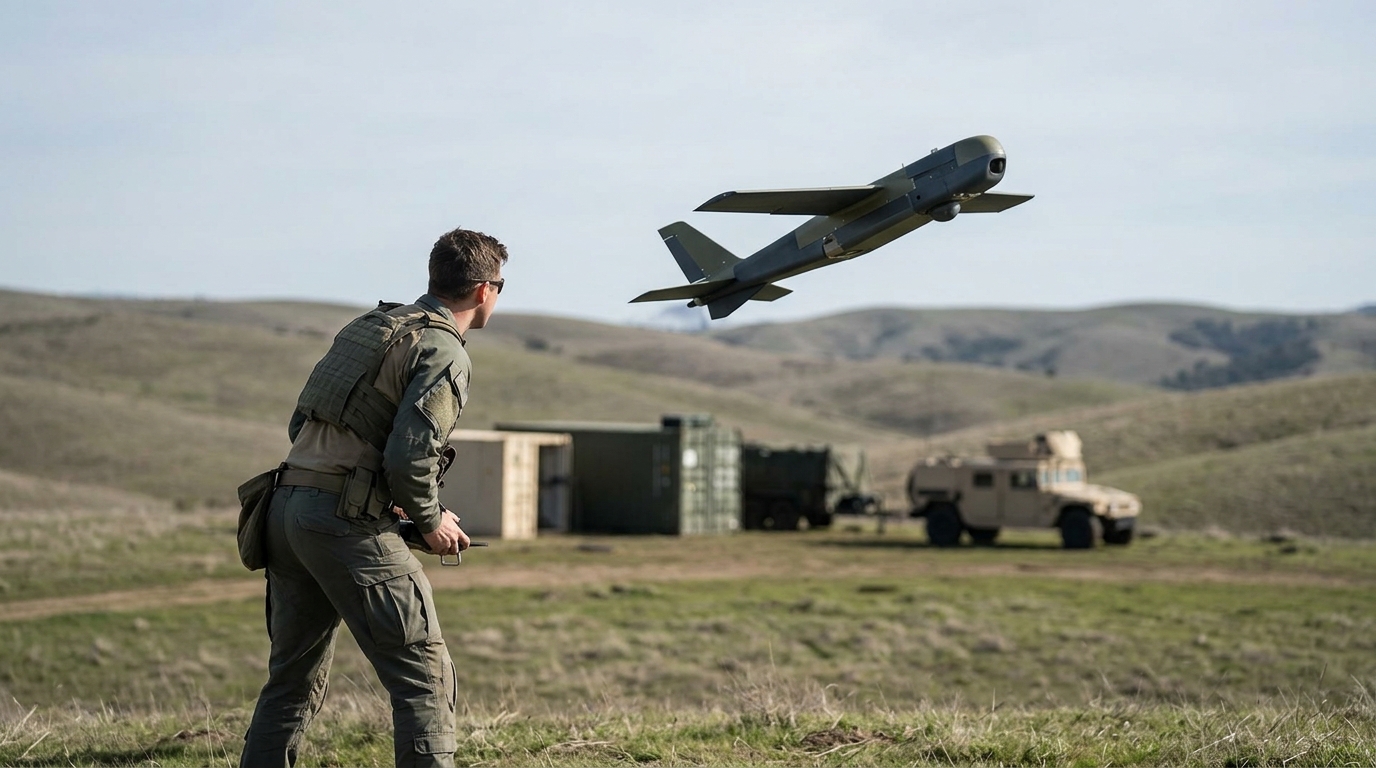
Most investors know drones are having a moment. Fewer are paying attention to who’s actually building the systems that matter most in the field right now.
AeroVironment just reported its fiscal fourth quarter. Revenue hit $641.6 million — up 133% year over year — beating analyst estimates of about $557 million by roughly 15%. Adjusted EPS came in at $1.84. Full-year fiscal 2026 revenue landed at $1.98 billion (often rounded to $2.0 billion), which CEO Wahid Nawabi called “the strongest financial performance in our history.”
The stock jumped nearly 19% on the news. It’s still down roughly 34% year to date.
That gap is worth thinking about carefully.
What’s Actually Driving the Revenue
Two acquisitions changed the scale of AVAV’s business fast. The BlueHalo and Empirical Systems Aerospace deals added $282.3 million in revenue to Q4 alone. BlueHalo brings counter-UAS capabilities, space, cyber, and electronic warfare systems. Empirical adds aerospace manufacturing scale. Neither is a bolt-on distraction — both expand directly into the highest-priority areas of modern defense spending.
The counter-UAS segment generated roughly $200 million in fiscal 2026 and is described by management as still early in its adoption curve — with the potential to eventually match or outgrow the company’s core drone business. That’s a big statement if you believe it.
Operating margin improved to 8.9%, up from 5% a year earlier. Free cash flow flipped from negative $8.79 million to positive $55.43 million in the same period. That shift matters. It suggests the acquisition-heavy growth story is starting to generate real cash, not just revenue.
The $500 Million Army Contract
Just days after earnings, AeroVironment announced a potential $500 million U.S. Army contract for its Titan radio-frequency (RF) counter-drone solution. This is meaningful beyond the dollar figure. Counter-drone — or counter-UAS — is one of the fastest-growing areas of modern military spending, driven directly by lessons learned in Ukraine and other recent conflicts.
Nawabi told CNBC that the U.S. and its allies are “playing catch-up” in adopting drone tech, adding that recent conflicts have brought autonomous systems to the forefront of military strategy. That’s not marketing language. That’s the budget environment AVAV is operating in.
The broader backdrop is genuinely historic. The fiscal 2027 National Defense Authorization Act is moving through Congress with an authorization topline of about $1.1 trillion. Europe is rearmament at full speed — NATO allies are rapidly moving toward a 5% of GDP defense spending benchmark. The top five defense primes ended fiscal 2025 with a combined backlog of $1.36 trillion, up 23.7% year over year.
Capital is flowing hard into defense technology right now. AVAV is directly in the path of it.
The Wrinkle
Here’s where it gets complicated. Despite the revenue explosion, AVAV posted a GAAP net loss of $265.1 million for fiscal 2026, driven by $240.7 million of goodwill impairment and significant depreciation and amortization (including acquired intangible amortization) from the acquisitions. The gap between GAAP and non-GAAP performance is wide. That’s worth acknowledging honestly.
Management’s guidance for fiscal 2027 — revenue of $2.125 billion to $2.225 billion and adjusted EPS of $3.02 to $3.34 — came in below what Wall Street had modeled. That’s why some analysts trimmed price targets even while maintaining Buy ratings. The consensus price target currently sits around $259, against a stock that recently traded around $190, implying roughly 35% additional upside if the analysts are right.
AVAV is also holding its 2026 Investor Day in New York on July 8 — this week. Management is expected to outline its autonomous systems strategy, integration timelines for BlueHalo and Empirical, and visibility into future contracts. That event could move the stock meaningfully in either direction.
Revenue forecasts project 19% annualized growth over the next three years, compared to an 8.7% industry average. The company has delivered 32% annual share price growth over the past three years on average. The question now is whether the integration complexity and guidance conservatism are priced in — or whether the market is still adjusting to how much this business has transformed in twelve months.
Drone warfare is no longer a niche conversation. It’s the central one. And AVAV is building the platforms at the core of it.
This article is for informational purposes only and does not constitute investment advice or a recommendation to buy or sell any security. Investing involves risk, including the possible loss of principal. Always conduct your own research and consult a qualified financial professional before making any investment decision.