
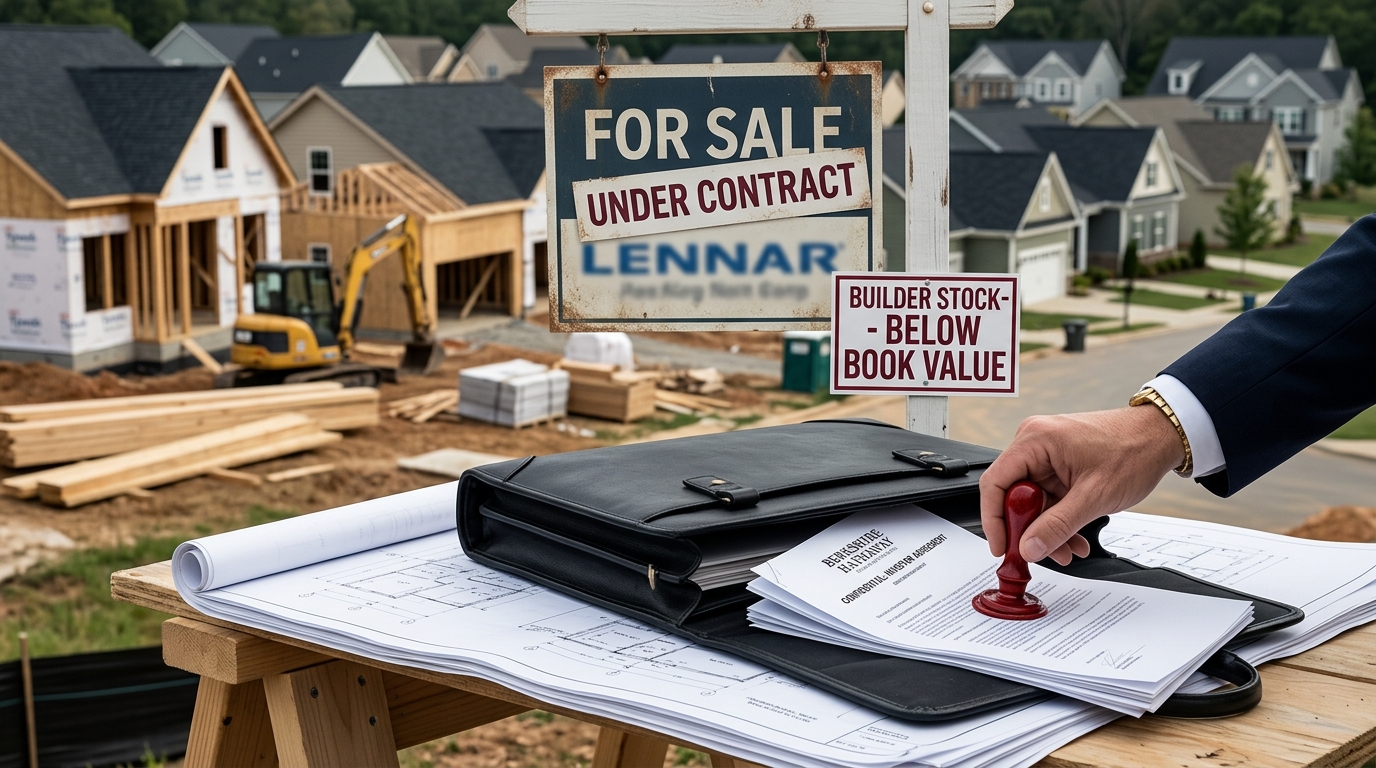
When a company reports earnings per share of $1.19 against a consensus of $1.29, cuts its full-year delivery target, and watches its stock fall the following day, most institutional buyers stay away. Berkshire Hathaway filed a Form 3 disclosing it became a 10% owner of Lennar on September 17, 2026, one day after those results landed, and then kept buying through September 21. The Form 4 shows more than 2.7 million Class A and Class B shares acquired at weighted-average prices ranging from $74.80 to $79.41. Total cost: $212.4 million. The position now stands at 23,719,109 Class A shares plus 528,217 Class B shares, each carrying 10 times the votes of Class A stock.
Lennar surged as much as 6.6% on Tuesday to a high of $83.24. That combination, a stock near multi-year lows, bought by Berkshire during a miss, is what makes this worth examining closely. This is not a speculative entry. It is a deliberate, size-able commitment to a business Greg Abel can underwrite on fundamentals alone.
What Abel Is Actually Buying
Lennar’s structure is the first thing to understand. Of roughly 488,000 homesites owned and controlled, about 11,800 were owned at quarter end, with the rest controlled through options and land-banking arrangements. That is the asset-light land model the company has spent years building: control land through options and third-party arrangements, avoid carrying it at cost. Book value was about $91.26 per share at the end of fiscal Q3 2026. Before Tuesday’s bounce, the stock was trading below that level, which means Abel was buying at a meaningful discount to the net asset value the balance sheet reports.
During Q3, Lennar itself repurchased 3 million shares for $256 million at an average price of $85.49. The company is buying back stock at $85 while Berkshire is adding around the high $70s. Both signals point the same direction: management and the largest outside shareholder believe the stock is priced below what the underlying business is worth.
The Quarter Was Bad. The Business Is Not Broken.
Q3 net earnings came in at $284 million, or $1.19 per diluted share, down from $591 million and $2.29 a year earlier. Excluding mark-to-market losses on technology investments and one-time items, adjusted EPS was $1.23. Total revenues were $8.0 billion, and gross margin compressed to 15.8% from 17.5% as the company leaned on incentives and pricing adjustments to move inventory. New orders fell 9% to 20,879 homes, and Lennar lowered its 2026 delivery forecast to between 80,000 and 81,000 homes.
The pressure is real. CEO Stuart Miller said on the conference call that 30-year mortgage rates near 7% constrain affordability and reduce the pool of qualified buyers. Resale listings are particularly high in Texas and Florida, Lennar’s two largest markets, and sellers there are cutting prices. That is the operating environment Berkshire walked into and kept buying.
Abel’s Bigger Housing Bet
This purchase did not arrive in isolation. Berkshire has been deploying more capital into housing-linked businesses in 2026. The company completed its acquisition of homebuilder Taylor Morrison in July 2026 for $72.50 per share in cash, valuing the equity at about $6.8 billion. Berkshire also owns building material companies including Benjamin Moore and Johns Manville, and acquired Clayton Homes for $1.7 billion in 2003. Housing is not a new Berkshire theme; Abel is enlarging it at a moment of sector stress.
Bull Case, Bear Case
The bull case rests on three things: a stock trading below book value, a company buying back its own shares aggressively, and a world in which mortgage rates eventually come down and release pent-up demand. Construction cycle time is at a record low of 116 days, which means Lennar can respond quickly when volume returns.
The bear case is less comfortable. Land cost inflation has been a headwind, and margin recovery runs through land. Management has been explicit that holding price and selling fewer homes can mean carrying expensive land for longer and generating less cash. Analysts covering the stock remain broadly cautious even as Berkshire adds to its position.
What to Watch
The Q4 2026 report is the next hard data point. Lennar guided for 22,000 to 23,000 deliveries and a gross margin of 15.5% to 16.0%. If margins stabilize there rather than continuing to compress, the thesis holds. If cancellation rates rise or order growth declines further into Q4, the land problem gets more expensive to work through. Berkshire’s 10% ownership now triggers Section 16 reporting, so every subsequent buy or sell will be visible almost immediately. That transparency cuts both ways, but for now Abel is sending a clear signal: the market’s price on Lennar is wrong.