
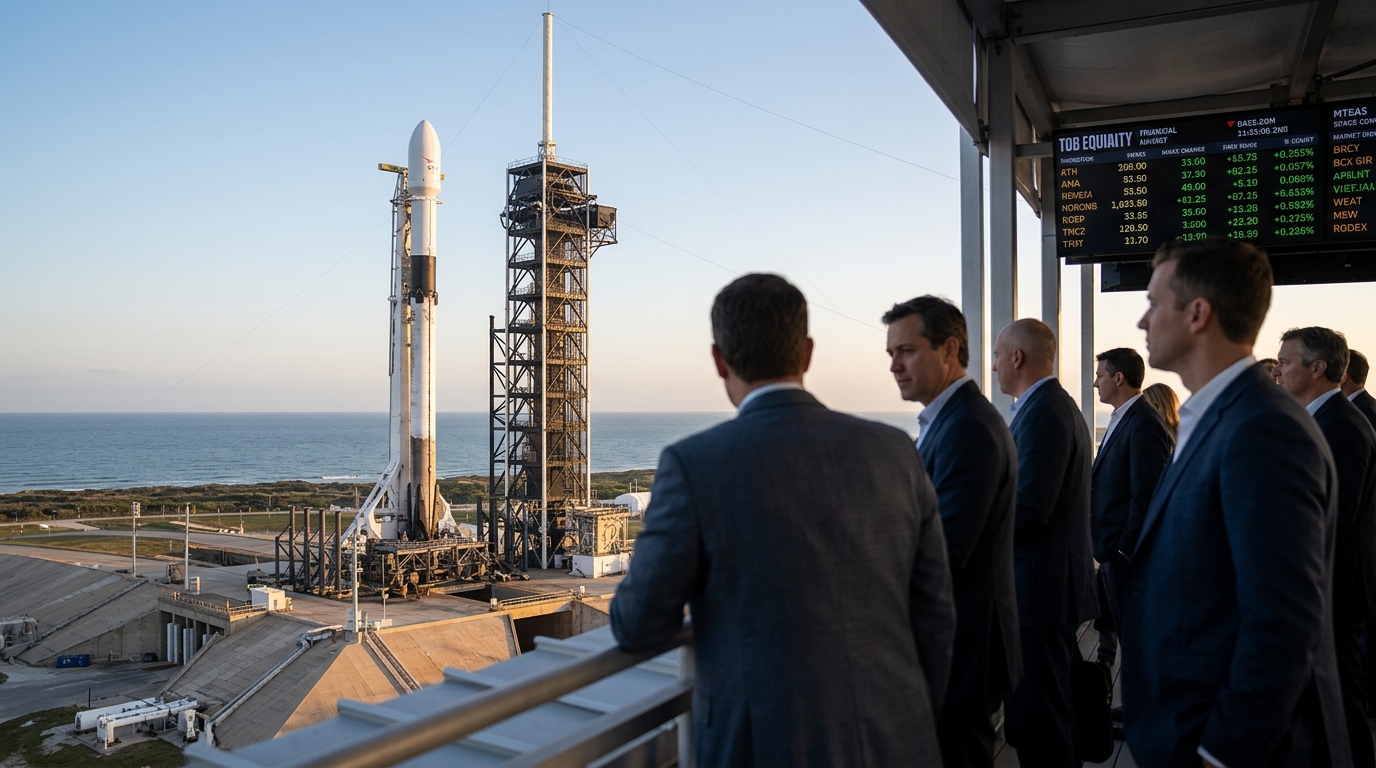
The roadshow starts this week. Pricing is June 11. And on June 12, the stock that retail investors have been asking about for nearly a decade finally trades on a public exchange.
SpaceX — ticker SPCX, Nasdaq — is targeting a $1.75 trillion valuation in what would be the largest initial public offering in capital markets history. Not by a little. The deal aims to raise roughly $75 billion, more than double Saudi Aramco’s 2019 record. That number is hard to absorb the first time you see it.
What SpaceX Actually Is
The company is three businesses stacked inside one prospectus. There’s the core aerospace and defense operation — NASA’s biggest launch partner, reusable rockets, Starship R&D. There’s Starlink, the satellite broadband network now crossing 10 million subscribers, which is the only segment generating a profit: $1.19 billion last quarter. And then there’s xAI, the artificial intelligence unit that merged with SpaceX in February 2026 in a $250 billion all-stock deal, folding in X (formerly Twitter) and the Grok assistant.
That’s a lot of moving parts for one IPO price to absorb.
The Numbers
- 2025 Revenue: $18.67 billion — Starlink accounted for $11.4 billion of that, or roughly 61% of total
- 2025 Net Loss: $4.9 billion — driven by $3 billion in Starship R&D and xAI integration costs
- Q1 2026 Net Loss: $4.28 billion — losses are accelerating, not stabilizing
- Accumulated Deficit: $41.3 billion
- Valuation Multiple: 109–116x trailing revenue at the $1.75 trillion target
- Voting Control: Elon Musk retains 85.1% through a super-voting share structure
The Structural Quirk Retail Investors Need to Know
SpaceX is routing roughly 30% of the offering directly to retail brokerage platforms — Robinhood, Fidelity, and Charles Schwab. That’s three times the standard mega-cap norm. It inverts a decades-old IPO allocation model. In theory, individual investors have more access here than they would typically expect. In practice, demand is expected to far exceed supply, so most retail traders should expect a partial fill at best, and to buy in the open market starting June 12.
Goldman Sachs is leading the deal alongside Morgan Stanley, Bank of America, Citigroup, and JPMorgan.
Bull / Base / Bear
Bull: Starlink’s profitability compounds, orbital AI compute becomes a real revenue line by 2028, and index inclusion triggers forced institutional buying within 90 days of listing. The Starlink moat — nearly 10,000 satellites and global spectrum rights — is genuinely difficult to replicate.
Base: SPCX trades like a high-beta growth name. First-day euphoria fades. The stock finds a range 20–30% below its open-print as the market digests a $4.28 billion quarterly net loss and a governance structure that gives public shareholders virtually no real say.
Bear: The xAI integration burns cash faster than Starlink generates it, the Starship program hits another regulatory or technical delay, and the valuation multiple compresses hard. At 109x trailing revenue, there is no margin for disappointment. None.
What to Watch
The first earnings call as a public company is expected in September 2026. Lockup expiration falls in the December 2026 window — that’s when early institutional holders can exit, and it’s the next meaningful catalyst for volatility either way.
Slight tangent, but it matters: Tesla stock has historically sold off on SpaceX IPO milestone dates as Musk-focused capital splits between the two. That pattern is worth tracking through the week of June 8.
Bottom Line
This is a once-in-a-decade listing event — and also one of the most aggressively valued IPOs ever filed. The business is real. The Starlink moat is real. What isn’t settled is whether a $1.75 trillion price tag leaves any room for the story to get better from here. The valuation is the risk. Everything else is just narrative.
For informational purposes only.