Hey there, bargain hunter.
Let me tell you what happened in the last 72 hours, because it moves fast with this one.
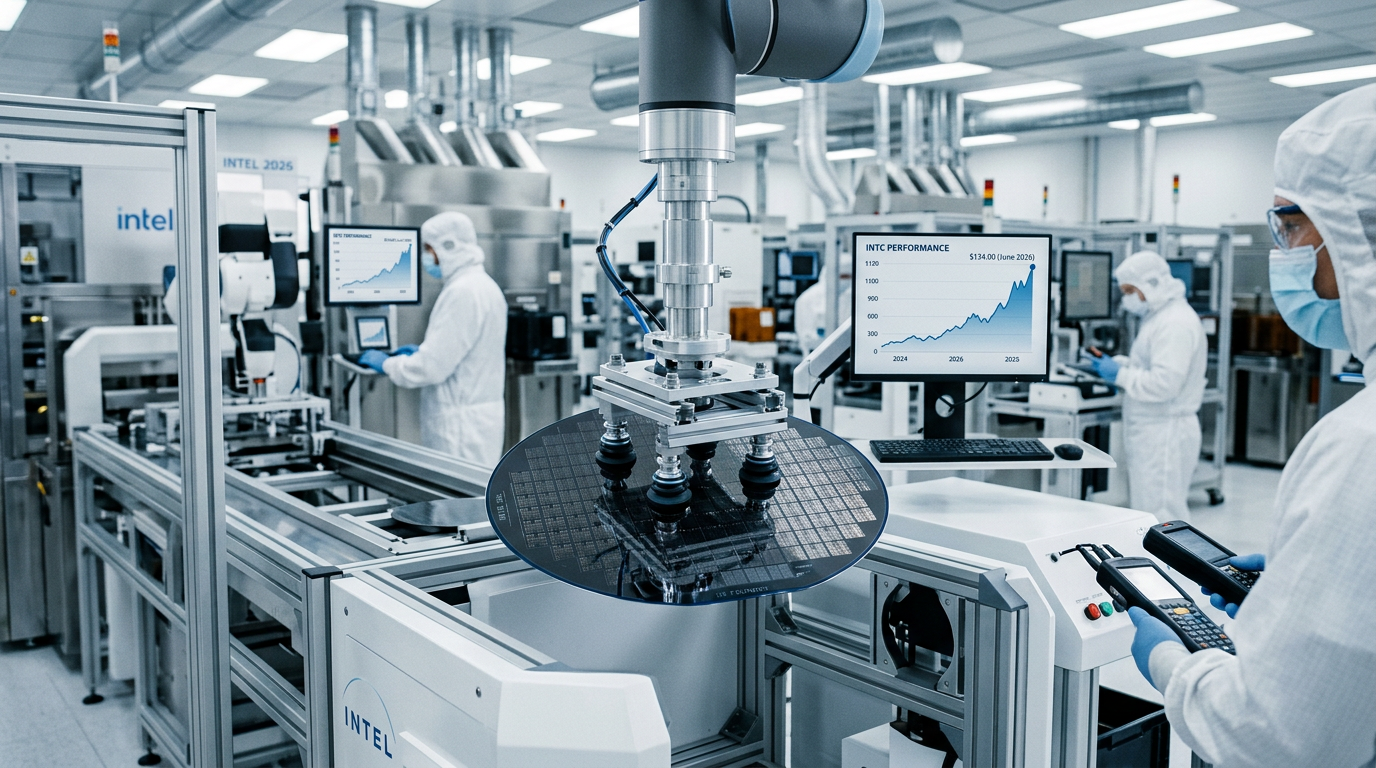
On June 18, President Trump posted on Truth Social that Apple had agreed to work with Intel to design and manufacture chips in the United States. Intel stock jumped roughly 11% that day alone. The stock started 2026 at $36.90. It is now trading near $134. That is a 263% gain in under six months — in a large-cap name that most people had written off as a legacy chipmaker slowly fading into irrelevance.
This is not a meme stock. Something real is happening here. The question worth asking is whether the market has already priced the good news, or whether you’re still early enough to care.
What Actually Happened
Three catalysts stacked on top of each other since January. First, Intel locked in expanded CHIPS Act grants tied to its Ohio and Arizona fabs, de-risking billions in capex through 2027.
Second, Q1 2026 earnings came in clean — revenue grew about 7% year-over-year to roughly $13.6 billion, Data Center and AI revenue was up 22%, and non-GAAP operating margin expanded to 12.3% from 5.4% a year earlier. CEO Lip-Bu Tan called it the sixth consecutive quarter of beating financial expectations.
Third, the Apple foundry deal materialized — initially as reporting about talks between the companies, then amplified (sort of) by Trump on social media.
Neither company officially confirmed the partnership publicly by market close on June 18. But the market didn’t wait.
The foundry side is worth understanding. Intel Foundry posted $5.4 billion in revenue in Q1, up 20% sequentially. The operating loss narrowed to $2.4 billion, improving by $72 million quarter-over-quarter. DCAI signed multiple long-term agreements during the quarter, including one with Google. Xeon 6 was selected as the host CPU for NVIDIA’s DGX Rubin NVL8 systems. ASIC revenue nearly doubled year-over-year.
Slight tangent, but it matters: the foundry business has a backlog in the billions of dollars. That’s not a promise, but it’s not nothing either.
The Numbers
- Q1 2026 revenue: ~$13.6 billion (+~7% Y/Y)
- DCAI revenue: $5.1 billion (+22% Y/Y)
- DCAI operating profit: $1.5 billion (31% margin)
- Non-GAAP EPS: $0.29 vs. ~$0.01 consensus
- Non-GAAP operating margin: 12.3% vs. 5.4% a year ago
- Intel Foundry revenue: $5.4 billion (+20% sequentially)
- Q2 guidance: $13.8B–$14.8B revenue; Intel has said it expects DCAI up double digits sequentially
Is It Cheap at $134?
Honestly? This is the harder part of the story.
At current prices, Intel is not cheap by traditional metrics. The forward P/E sits above 100x, which leaves almost no room for operational disappointment. The average analyst price target from 48 analysts is $93.97 — nearly 30% below where the stock is trading today. Bank of America double-upgraded INTC to Buy with a $135 target and projected $6+ EPS potential by 2030, but even that upgrade came with a caveat: clean execution on products and foundry remains essential.
The bull case requires reframing Intel as a foundry business, not a PC chip company. If you compare it to where TSMC traded during its own growth phase, the multiple looks more defensible. If 18A yields hit guidance, gross margins climb toward 50% by late 2027. If they don’t, the stock looks expensive from here.
Bull / Base / Bear
Bull: Apple becomes a real foundry customer. Nvidia’s TeraFab deal materializes. 18A yields exceed 60% by Q3 2026. DCAI continues compounding at 20%+. The stock re-rates as a foundry-plus-AI-infrastructure hybrid. Room to run further.
Base: The Apple deal is real but small near-term. DCAI holds double-digit growth. Foundry losses continue narrowing. Stock consolidates in the $100–$130 range while execution catches up to the valuation.
Bear: 18A yields disappoint. AMD’s Venice launch and Nvidia’s Vera Rubin shipments eat into DCAI share in H2 2026. The Apple deal turns out to be more political theater than revenue. The stock corrects 30%+ back toward analyst consensus targets.
Action Plan
If you already own INTC and are sitting on a 200% gain, the honest answer is to think about position sizing. A trim here — not a full exit — is a reasonable move. If you’re considering a new position, the framework is simple: the risk-reward favors smaller entries on dips rather than chasing the all-time high. Q2 earnings on July 23 will be the next real test. Watch DCAI growth and 18A yield disclosures closely.
Add on weakness if you believe 18A ships on schedule. Hold if you want Q3 confirmation. Trim if you need to rebalance after a triple-digit gain.
The Cheap Investor Scorecard
- Q2 DCAI revenue growth above 20% sequentially: watch July 23
- 18A yield disclosures above 60% by Q3 2026
- Apple foundry deal formally confirmed with revenue contribution timeline
- Intel Foundry operating loss continuing to narrow quarter-over-quarter
- Non-GAAP gross margin holding above 39% through the 18A ramp
- CHIPS Act funding disbursements on schedule
- No major customer cancellations in the foundry backlog
- Analyst consensus targets catching up to the current price
The turnaround story has real teeth. What’s less clear is whether the stock at $134 still offers a margin of safety — or whether it’s already priced the happy ending.
Worth watching. Not worth chasing blind.