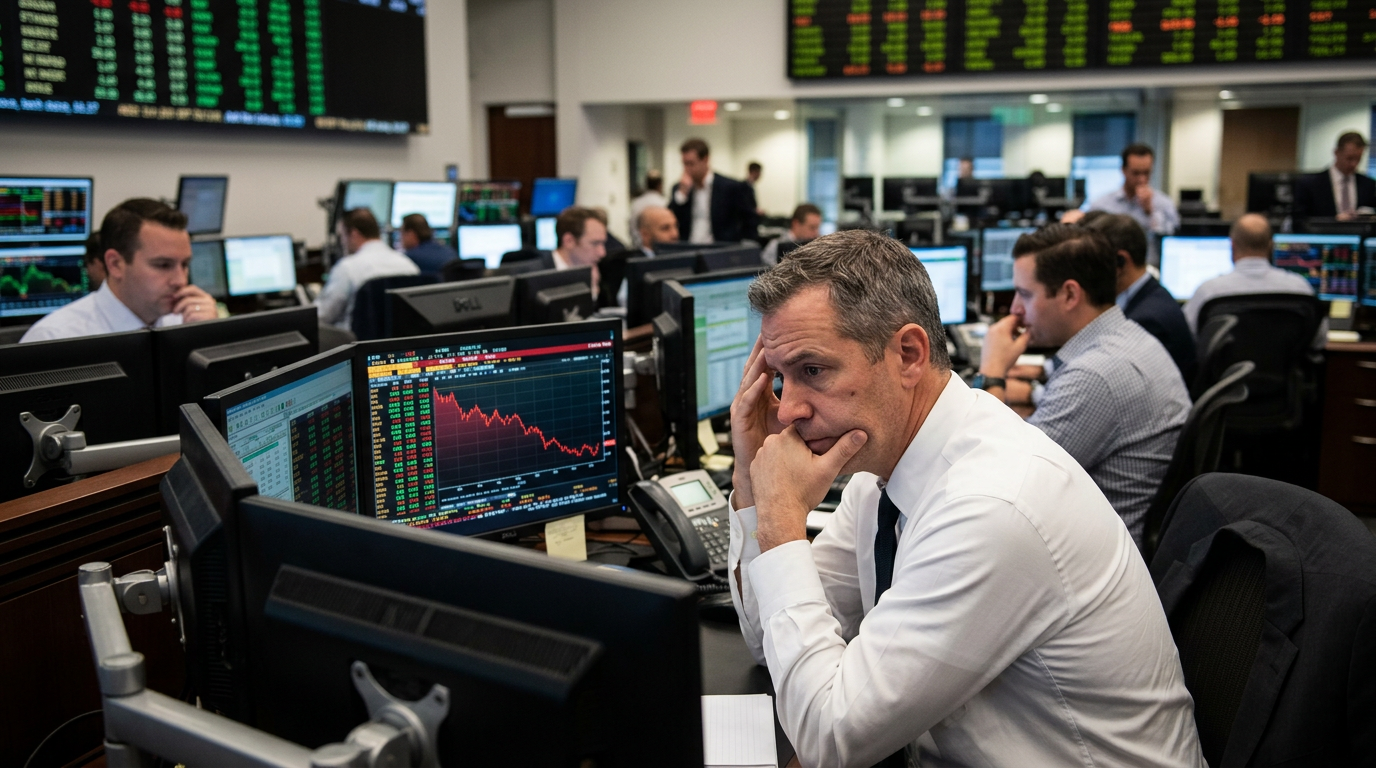
Tuesday’s session was instructive in a way that the headline number doesn’t fully capture. The Nasdaq shed 2.21%, the S&P 500 fell 1.44%, and semiconductor stocks lost more than $1.3 trillion in market value in a single session. Micron dropped more than 10%. AMD fell 6%. Marvell, which had been up more than 300% year-to-date entering June, shed 8% in a single afternoon.
And yet — only five of the eleven S&P 500 sectors closed lower that day. Consumer staples climbed 1.7%. Real estate led gainers. Energy and healthcare both finished positive. Market breadth on the NYSE actually improved, with advancing shares leading declining ones.
That divergence is the whole story.
What Actually Happened
The tech selloff wasn’t a reflection of deteriorating fundamentals. Earnings growth for the semiconductor sector remains robust — S&P 500 technology earnings are projected to rise more than 22% in 2026. Both Nvidia and AMD exceeded revenue and earnings estimates in their most recent quarters, with forward guidance remaining strong. The Nasdaq 100 had been riding a nine-week winning streak before this started. The S&P 500 tech sector was up 27% over the last three months — the only sector to surpass the broader index’s 9.8% gain over that stretch.
That kind of concentration eventually produces its own undoing. Morgan Stanley’s Andrew Slimmon said it directly on CNBC Tuesday: “The AI beneficiaries are the sell-off, and I don’t think they’re expensive, but they’re crowded. It’s captured kind of the zeitgeist of the momentum traders and when that happens, you’re going to have sharp sell-offs like we’re having.”
Crowded trades don’t reverse because the thesis breaks. They reverse because positioning becomes the risk.
The Breadth Signal Everyone Is Underreading
Here’s what’s more interesting than the selloff itself. The equal-weighted S&P 500 has been outperforming the cap-weighted version in 2026. RSP has been beating SPX on both a year-to-date and 12-month basis. Smaller and mid-cap stocks have shown even more pronounced strength relative to the mega-cap index. The percentage of S&P 500 stocks above their 50-day moving average actually rose during Tuesday’s selloff — from near 50% to 58% — driven by rotation into names that hadn’t participated in the AI momentum trade.
That’s not how broad market breakdowns behave. That’s how rotation behaves.
The data behind this matters. In May, the tech sector gained 16% and was the only sector to outperform the index, while eight of eleven sectors traded lower and ten of eleven underperformed. Large-cap growth returned 7.2% versus 2.9% for large-cap value over that same window. The divergence was extreme. When positioning becomes that one-sided, even minor disappointments can trigger cascading liquidations as algorithms and risk management systems automatically reduce exposure.
The June correction was not a surprise to anyone watching positioning data. It was a mathematical inevitability waiting on a catalyst.
The Sector That Just Passed Its First Test
Consumer staples has been quietly building a case all year. XLP, the sector benchmark ETF, advanced approximately 13% year-to-date through early February — one of its strongest starts in over a decade — while the technology sector declined roughly 3% over the same period. That early-year divergence set the tone. And Tuesday’s session validated it in real time: consumer staples climbed 1.7% on the day tech imploded, making it the best performing sector in the S&P 500 while the Nasdaq posted its worst day in months.
The appeal isn’t complicated. Valuations for many staples names sit at forward P/E ratios in the high teens to low twenties, against tech multiples that were running well above 50x in some cases — with certain names above 100x when factoring in future growth expectations. Dividends in the staples sector frequently run 3 to 4%. The business models are durable by definition: consumers don’t stop buying food, household products, and personal care items because yields move 12 basis points.
Fidelity’s sector team has flagged valuation dispersion as a specific opportunity within staples — names like Mondelez International, Keurig Dr Pepper, and Kenvue are trading below historical ranges relative to the sector, with mean-reversion potential if and when defensive inflows continue. Philip Morris has been the standout performer, transitioning its business toward smoke-free products like IQOS and Zyn, posting Q4 EPS of $1.70, up 9.7% year-over-year, with 2026 full-year consensus around $8.34.
Who Wins in Broadening Markets
The historical pattern is fairly consistent. Academic research from Fidelity and S&P Global shows that sector rotation strategies delivered 11.8% to 14.3% annualized returns from 1962 to 2024, compared to 10.2% for a static buy-and-hold approach. The alpha comes from identifying inflection points early — specifically, when a crowded leadership sector starts to crack and the next sector hasn’t yet been bid up.
That window is open right now.
Industrials continue to draw institutional support from capital spending in electricity capacity, AI infrastructure construction, and defense. Healthcare is drawing in capital on improved operational efficiency and reduced regulatory headwinds. Real estate — specifically REITs with durable rent rolls — has started to outperform as investors rotate toward assets with near-term cash flows when rates become a concern.
The broader market breadth story is worth watching carefully. When RSP outperforms SPX, it signals that gains are broadening rather than concentrating in a few giants. The S&P 500 has historically produced stronger forward returns from periods of broadening breadth than from periods of mega-cap dominance — partly because the marginal dollar moving into underowned sectors has more room to run, and partly because concentrated markets carry higher single-point failure risk.
Options Market Framework
IV rank across tech and semiconductor names spiked materially on Tuesday. The VIX jumped nearly 13% to 19.49, while tech-specific volatility rose more sharply than broad-market volatility — confirming that the hedging activity was sector-specific rather than systemic. For traders expecting continued rotation pressure on tech over the next 30 to 60 days: defined-risk bear put spreads on the most crowded AI names — where IV has risen but not yet peaked — offer asymmetric exposure to downside without unlimited risk.
For traders positioned for the rotation thesis: long exposure to XLP, XLV, or XLI with a covered call overlay against any existing tech positions captures the rotation while managing cost basis. It’s not a headline trade. It’s a portfolio positioning trade that reflects where the weight of evidence is pointing.
What to Watch
- RSP vs. SPX performance — sustained equal-weight outperformance is the clearest confirmation signal for a real rotation
- Friday’s University of Michigan consumer sentiment — at 56.4 entering June, sentiment is in recessionary territory; a further drop accelerates defensive rotation
- Tech sector put/call ratios — elevated hedging demand confirms institutional caution, not just retail profit-taking
- Consumer staples earnings revisions — if guidance holds, the multiple expansion case strengthens materially
- 10-year Treasury yield direction — yields at or above 4.5% historically send investors back toward tech; yields pulling back accelerate rotation into cyclicals and defensives
The AI infrastructure thesis is not broken. The earnings, the backlogs, the hyperscaler capex commitments — none of that has changed. What changed is the price paid for that thesis, and the degree to which every momentum-following fund on the planet had crowded into the same names at the same time.
Rotation out of tech has been, as one Schwab strategist noted this week, “a bumpy affair, with spurts of selling followed by fresh rallies as retail investors remain bullish about AI.” That’s not a stable equilibrium. It’s a slow-motion rebalancing that plays out over months, not days.
The question isn’t whether AI matters. The question is whether your portfolio is priced for the part of the market that hasn’t been crowded yet.