
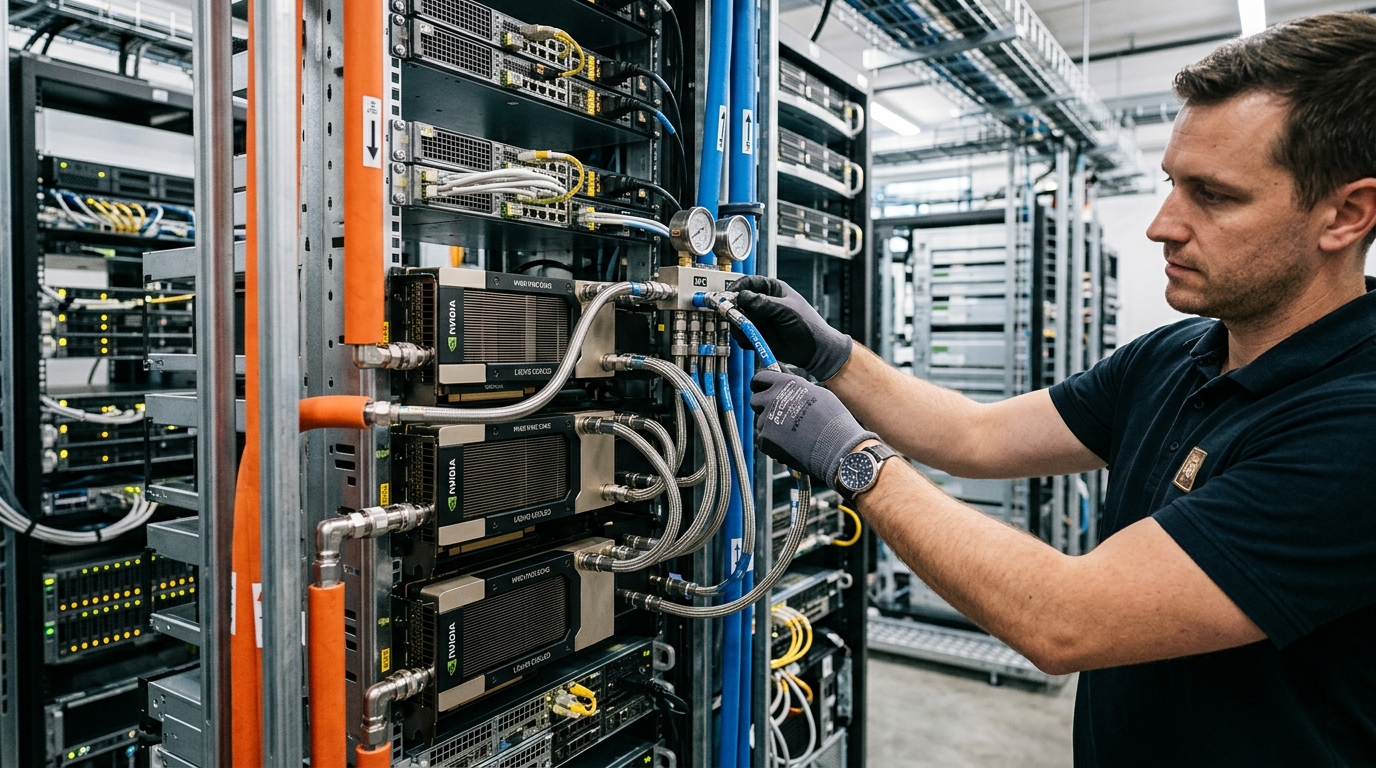
Start with physics, not a ticker.
When you pack 700 watts of thermal output into a single GPU chip — and then stack eight of them into one server chassis — you create a heat problem that air conditioning fundamentally cannot solve. A single NVIDIA H100 GPU consumes 700 watts. A 256-GPU AI training cluster requires more than 180 kilowatts of power and generates heat that would overwhelm any conventional cooling system. The next generation is worse: the B200 platform exceeds 1,000 watts per chip, and the GB200 Superchip, combining two B200s with a Grace CPU, consumes 2,700 watts per unit. Air cooling isn’t a suboptimal option at these densities. It’s physically impossible.
This is where the obvious trade ends and the interesting one begins.
Most investors tracking the AI buildout are watching chip companies and power utilities. Those are real trades. But they’re first-derivative plays on a trend the entire market already sees. The second and third-order effects haven’t been fully priced. And one of the clearest expressions of that gap sits inside a 100-year-old Wisconsin industrial company that CNBC hasn’t put on TV.
The Thermal Inflection Nobody Modeled
The data center cooling market doesn’t get the headlines that chips and transformers do. It probably should. TrendForce estimates that liquid-cooled server racks will account for approximately 47% of deployments by 2026, up from a negligible share just a few years ago. The market itself is projected to grow from roughly $6.7 billion this year to nearly $29 billion by 2033 — a sustained 20%-plus compounding rate driven almost entirely by the AI chip thermal problem getting worse every product cycle.
Here’s the chain of causality most investors skip past: AI spending drives GPU demand. GPU demand drives rack power density. Rack power density drives a thermal crisis. The thermal crisis drives a massive capital reallocation toward liquid cooling infrastructure. And liquid cooling infrastructure requires something every AI factory has to buy before a single inference query can run.
Chillers. Coolant distribution units. Heat exchangers. Industrial-grade thermal management systems at scale.
Slight tangent, but it matters: when engineers say “liquid cooling is mandatory” for GB200 NVL72 racks, they don’t mean it’s a nice-to-have upgrade. They mean the rack physically cannot operate without it. Facilities deploying Blackwell-generation hardware must install direct-to-chip liquid cooling infrastructure, including coolant distribution units, leak detection, and compatible rack designs. Air cooling isn’t an option. It’s an architectural failure mode at this power density.
So every hyperscale AI data center being built right now needs industrial-grade thermal infrastructure. Lots of it. Urgently.
Who Actually Builds This Stuff
The obvious names in data center cooling — Vertiv, Schneider Electric — are well-covered and reasonably well-valued. Vertiv has been written about extensively. What hasn’t been written about nearly enough is the company several steps further down the industrial supply chain that just crossed $1.1 billion in data center revenue and locked in a $4 billion long-term customer agreement to supply a major hyperscale cloud operator from 2027 through 2029.
Modine Manufacturing. Ticker: MOD. Based in Racine, Wisconsin. Founded in 1916.
This is not a startup. It’s not a pure-play AI story yet. It’s a century-old industrial manufacturer that spent years building heat transfer and thermal management products for trucks, agricultural equipment, and commercial HVAC systems. What Wall Street is still working through is the speed at which Modine is transforming its revenue base — and how durable that transformation actually is.
In fiscal 2026, Modine’s data center business surged 73% to cross the $1.1 billion mark. That single segment drove the company’s Climate Solutions division to record revenues with 43% growth for the full year. Total company net sales hit $3.18 billion, up 23% from the prior year. Adjusted EBITDA climbed 20% to $471 million.
That’s four consecutive years of record revenue and adjusted EBITDA. Most people in financial media have not noticed.
The $4 Billion Contract That Changes the Math
Here’s the part that should be getting more attention. In May 2026, Modine announced a landmark long-term capacity agreement with a major hyperscale customer to supply more than $4 billion of data center cooling products — specifically Airedale chiller systems — during calendar years 2027 through 2029. The customer paid Modine an upfront $165 million payment to fund capacity expansion. That’s not a letter of intent. That’s a hyperscale operator writing a nine-figure check to ensure supply.
Think about what that signals. The customer doesn’t trust the spot market to deliver. They’re pre-purchasing capacity three years out, in advance, with capital commitment. That’s the behavior of a buyer who believes cooling infrastructure will be constrained. And they’re right to think so.
Modine’s data center business grew at a 93% compound annual rate over the past two years. Management guided fiscal 2027 data center revenue growth of 60% to 80%, which puts the segment on track to approach $2 billion in revenue within 12 months. Total company guidance for fiscal 2027 calls for net sales growth of 20% to 35% and adjusted EBITDA of $650 to $680 million — implying more than 40% EBITDA growth from the fiscal 2026 baseline.
Q4 fiscal 2026 results were telling. Net sales hit $954 million, up 47% year over year. Adjusted EPS came in at $1.71, beating the consensus estimate of $1.51 by 13.2%. Data Center revenues alone exceeded $400 million in the quarter — even after severe weather reduced production time across multiple facilities. That last detail is important. The company is already capacity-constrained on the upside.
The Derivative Structure of This Trade
Let’s be precise about where Modine sits in the AI value chain, because the depth matters.
- First derivative: Chip companies (NVIDIA, AMD, Broadcom)
- Second derivative: Power companies, utilities, transformer manufacturers
- Third derivative: Data center operators, hyperscale real estate
- Fourth derivative: Thermal management suppliers, cooling infrastructure manufacturers
Modine is a fourth-derivative play on AI spending. That’s precisely why it’s underowned. It doesn’t show up in any AI ETF. It doesn’t appear on AI infrastructure stock screens. It registers in industrial sector databases as a diversified manufacturer — because that’s what it was for the past 100 years. The re-rating hasn’t finished yet.
Every analyst currently covering MOD has a Buy rating. Zero Holds. Zero Sells. The average 12-month price target sits near $340, with high estimates reaching $370. KeyBanc’s updated sum-of-the-parts valuation pegs the stock at $370. UBS lifted its view to $355. DA Davidson maintained its Buy rating with a $330 target as recently as late June 2026.
The bullish case from Roth Capital is worth reading carefully: they expect Modine’s data center business to grow 64% from fiscal 2025 to 2027, approaching $2 billion in data center revenue, and see EBITDA margins expanding toward 17% in fiscal 2027 as capacity expansion costs normalize and revenue leverage kicks in.
What Wall Street Is Still Missing
The margin story is where the analysis gets complicated. Modine is currently spending aggressively to expand manufacturing capacity — a new 155,000 square foot data center cooling facility in Franklin, Wisconsin, is part of a multi-year $100 million expansion. That spending is compressing near-term gross margins, which came in around 23% for fiscal 2026 versus prior-year levels. The headline margin number is what trips up short-term screens.
But this is a deliberate investment in operating leverage. When the capacity expansion is complete and revenue from the $4 billion LTA begins flowing through in 2027, the fixed-cost absorption math changes materially. Management has targeted EBITDA margins above 17% for the Climate Solutions segment in fiscal 2027, up from where it sits today. If data center revenue grows 60% to 80% into a partially built-out cost structure, the operating leverage is significant.
The other thing worth flagging: Modine is simplifying its business through a planned spin-off of its Performance Technologies automotive segment, merging it with Gentherm in a Reverse Morris Trust transaction expected to close before year-end. When that closes, what remains is a near-pure-play climate solutions company with data centers as its largest and fastest-growing segment. That’s a different valuation conversation.
Technical and Positioning Framework
MOD has delivered total returns of more than 500% over the past three years, yet the stock has pulled back from recent highs as margin compression headlines temporarily dominated earnings reads. The market is doing what it often does with high-operating-leverage industrial companies: penalizing investment spend before the revenue it purchases arrives.
Key levels traders are watching: the $240 to $260 range has acted as intermediate support following the post-earnings consolidation. The longer-term moving average structure remains intact, and the fundamental trajectory — a $4 billion LTA, 60% to 80% projected data center revenue growth, and a portfolio simplification event — provides multiple rerating catalysts over the next 12 months.
Volume patterns following the Q4 earnings report in late May 2026 showed institutional accumulation on pullbacks, a behavior consistent with large funds building positions into a narrative that is still clarifying rather than fully consensus.
Scenario Modeling
Bull case: Data center revenue grows at the high end of guidance (80%), capacity expansion costs normalize faster than expected, EBITDA margins reach 17% or higher in fiscal 2027, and the Performance Technologies spin-off is received as a pure-play rerating event. Analyst price targets of $355 to $370 become the floor, not the ceiling. The $4 billion LTA customer extends or expands the agreement.
Base case: Data center revenue grows 60% to 70% in fiscal 2027, adjusted EBITDA reaches the midpoint of $650 to $680 million guidance, and the stock steadily re-rates as industrial investors recognize the transformation is structural, not cyclical. Shares track toward the $320 to $340 consensus target range as the Climate Solutions pure-play thesis gains credibility post-spin.
Bear case: Hyperscale capex spending pauses or gets delayed (possible if AI ROI scrutiny intensifies), chip thermal requirements improve faster than expected via architectural changes, or supply chain issues limit Modine’s ability to ramp capacity fast enough to capture the LTA revenue. Gross margin pressure persists longer than modeled. The stock remains range-bound or pulls back further while the market waits for cleaner operating results.
The bear case is real but requires multiple things to go wrong simultaneously — including a reversal of the structural GPU thermal trend that is, by physics, getting worse each chip generation, not better.
Active Trader Strategy Framework
For traders approaching this as a catalyst-driven position, the Performance Technologies spin-off closing represents the most significant near-term inflection point. When it completes, Modine’s reported financials will reflect the Climate Solutions business alone — and the market will see the data center growth rate without the noise of the automotive segment alongside it. That re-filing and reclassification event tends to attract institutional attention that was previously deterred by the conglomerate structure.
Key levels to monitor: $240 as meaningful support, $285 to $300 as the zone that has produced selling pressure, and a break above $300 on volume as a potential signal that the larger institutional thesis is accelerating. Implied volatility on MOD options remains elevated relative to historical norms, reflecting genuine uncertainty around the capacity ramp timeline and margin recovery pace. Position sizing should reflect that volatility environment.
Risk management consideration: the $4 billion LTA customer is undisclosed. Any publicly visible shift in hyperscale capex from that operator would create headline risk even if Modine’s contractual position is protected.
What CNBC Has Missed About This Story
The thermal problem isn’t going away. It’s actually getting worse. The B300 generation coming after B200 is expected to exceed 1,400 watts per chip. The AI chip roadmap is a one-way escalator toward higher thermal density, and every point on that escalator requires more cooling infrastructure than the last.
Modine didn’t invent this trend. It didn’t cause it. It just spent a century building the engineering capability to address it — and then found itself sitting at the intersection of an industrial skill set and the most urgent infrastructure buildout in modern technology history.
The $4 billion long-term agreement isn’t a bet on Modine’s potential. It’s a hyperscale operator acknowledging that the thermal infrastructure problem is real, urgent, and supply-constrained enough to warrant locking in capacity years in advance with a nine-figure upfront payment.
Wall Street is slowly catching up. The analyst consensus just got there. The institutional position hasn’t fully built. That gap — between what the data says and what is priced in — is the part worth paying attention to.
For informational and educational purposes only. Not investment advice. Trading involves risk, including loss of principal.