
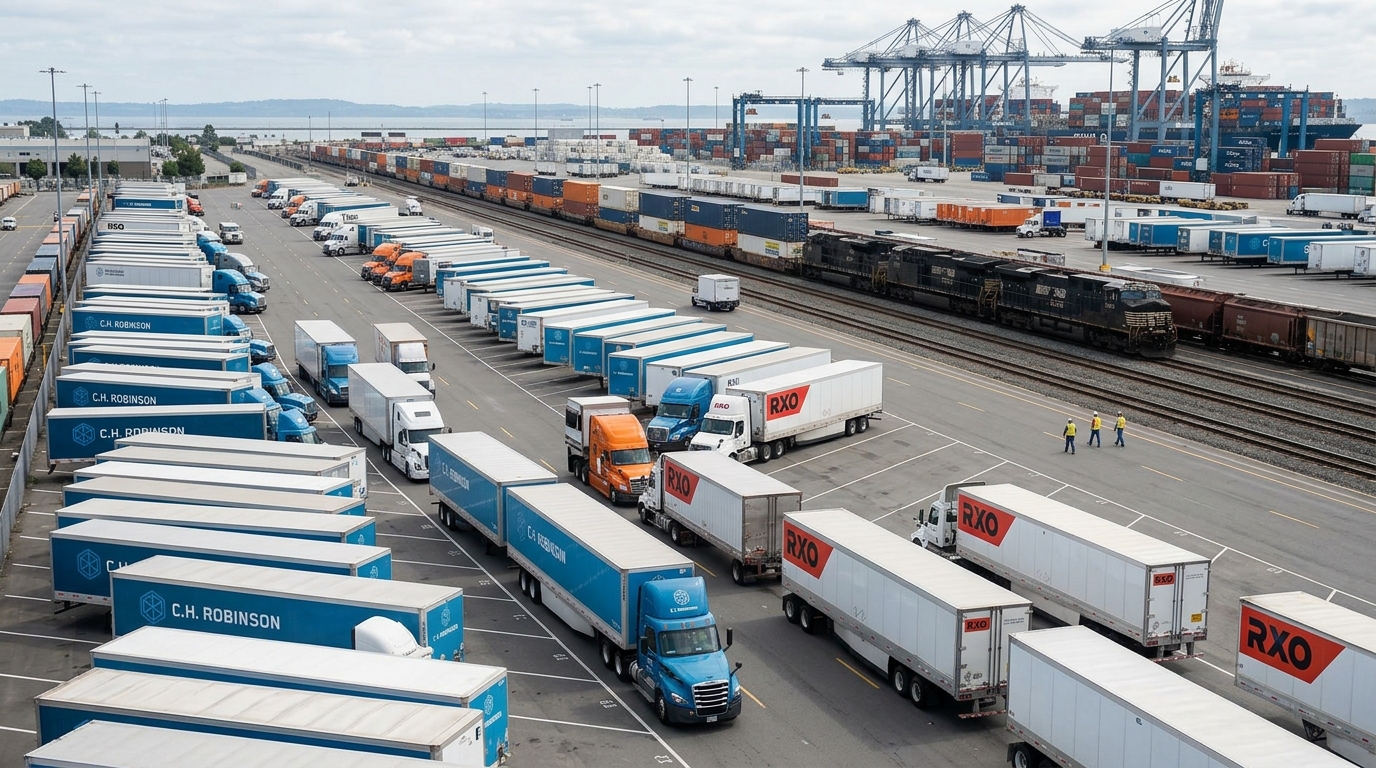
The best time to buy a business is when everyone hates the industry. C.H. Robinson (CHRW) announced on October 5 that it will acquire RXO in a cash-and-stock deal valued at $5.8 billion, folding the third-largest North American freight broker into the largest one. The stock dropped about 9% that day on deal-dilution fears and has been rebuilding ever since, sitting near $142 as of October 9. That reaction created the entry point. This is the most compelling stock to own right now.
The Business
C.H. Robinson is a pure intermediary. It owns no trucks. It connects shippers and carriers as an asset-light transportation broker, and this acquisition will create a combined company with an enterprise value of over $25 billion. That scale matters in brokerage: more freight volume means better carrier relationships, tighter pricing, and more data to feed the matching algorithms that determine who wins load auctions. RXO, spun out of XPO Logistics in November 2022, brought expedited and last-mile capabilities that Robinson lacked at scale. Combining both companies’ trucking brokerage and managed transportation businesses, along with Robinson’s global forwarding and RXO’s strengths in expedited and last-mile, will create a more comprehensive offering across a larger, denser network.
Why Wall Street Is Paying Attention
Robinson has already done the hardest part of this deal before signing it: proving the cost model works on its own business. The company delivered higher second-quarter 2026 earnings and wider adjusted operating margins despite a freight market that management still describes as being in the trough of the demand cycle. Revenues rose 19.3% year over year to $4.93 billion, while adjusted income from operations climbed 19.5% to $263.2 million, and adjusted earnings increased 24.8% to $1.61 per share. The company achieved mid-cycle operating margin targets in both North American Surface Transportation and Global Forwarding, with over 60% productivity improvement since 2022 from Lean AI initiatives. Combined truckload and less-than-truckload volume rose 1.5% year over year compared with a 3.3% decline in the Cass Freight Shipment Index, marking the 13th consecutive quarter of market outgrowth.
Truist Securities analyst Lucas Servera noted that Robinson has demonstrated meaningful productivity and margin improvement through its lean AI operating model, and that the RXO acquisition gives the company an opportunity to apply that operating framework across the substantially larger logistics platform.
What’s Driving the Opportunity
The $300 million synergy target is not speculative overhead bundling. The financial case rests on cost cuts. Robinson expects about $300 million in net run-rate cost synergies within two years of closing, which it plans to achieve by running RXO through its Lean AI operating model, lowering cost-to-serve, consolidating shared services, and swapping RXO’s outside vendors for Robinson’s existing ones. Real estate and insurance purchasing are also on the list. The transaction is expected to be accretive to adjusted EPS within nine months of close, with mid-teens accretion expected by end of fiscal 2028.
The freight market itself may be cooperating. Capacity has been tightening off the lows in parts of the market, which is the kind of setup that can expand brokerage volumes and margins. Robinson is consolidating at the bottom and will harvest the upside on a much larger base if pricing power returns.
Both boards approved the agreement unanimously. The companies expect to close in the first half of 2027, pending regulatory approval and a vote by RXO stockholders. MFN Partners, which holds about 17% of RXO, has agreed to vote its shares in favor, and Orbis Investments, RXO’s largest shareholder, also backs the deal.
What Could Go Wrong
The deal carries real risks. Executives stressed that the deal’s rationale does not rely on a near-term freight market recovery, which is the right framing, but antitrust scrutiny of combining two of the largest asset-light brokers in North America could introduce delays or conditions. The up to $4.5 billion in committed bridge financing Robinson secured adds leverage at a moment when the freight market is still recovering, and a demand setback would pressure cash flow and slow the promised deleveraging. Integration is never free: RXO runs its own systems and culture, and the timeline to realize $300 million in synergies across two recently independent organizations is ambitious. CHRW’s 52-week range of $123.64 to $210.33 reflects how violently the market can reprice this stock when the freight outlook shifts.
The Bottom Line
Robinson is doing what dominant companies do when a cycle punishes weaker competitors: buying scale at a discount before the recovery arrives. This is the most consequential consolidation move in the third-party logistics sector in decades. The Lean AI model has already proven it can expand margins in a downturn. Applying it to a business with $300 million in identifiable costs, with a freight market that is no longer getting worse at the same pace, produces a compelling risk-reward profile. Q3 earnings arrive October 28, offering the next catalyst. CHRW at $142 is the stock to own today.