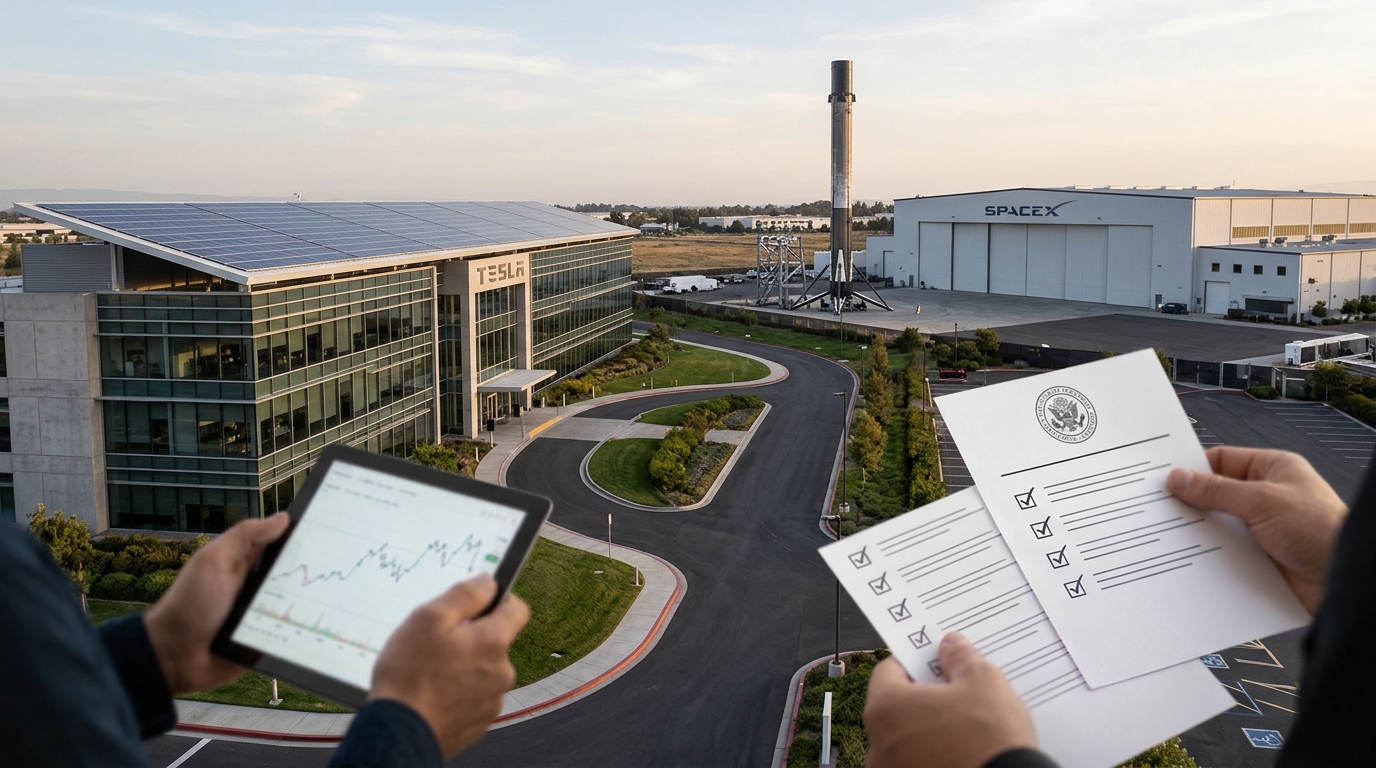
Elon Musk said it plainly on SpaceX’s October 20, 2026 earnings call: a Tesla-SpaceX merger is a good idea. Then he explained why it might never happen. On the Tesla side, he said, it would take “a 50% vote of all shares, not just those who vote,” and he called that “quite a high hurdle.”
That single sentence contains the most important thing a Tesla shareholder can understand about this situation. The threshold is not a majority of ballots cast. It is a majority of every share that exists.
How the Vote Actually Works
Musk endorsed the merger as “a good idea” but warned that Tesla needs yes votes representing 50% of all outstanding shares to approve a deal. With roughly 3.95 billion Tesla shares outstanding, that works out to about 2.0 billion yes votes.
At Tesla’s 2025 annual meeting, a management proposal that required this kind of majority-of-outstanding-shares support drew about 73.6% shareholder participation, but only about 39.4% of total outstanding shares supported it, and it failed. If a merger vote had similar participation, it would require well over two-thirds of the votes actually cast to be yes.
The practical effect is severe. When a proposal requires approval by a majority of outstanding shares, shares that are not voted function like votes against, because they do not add to the yes total. Every shareholder who ignores the ballot, loses the proxy card, or simply does not engage is casting a functional no. Retail-heavy registers, and Tesla’s shareholder base skews retail, tend to have lower participation than institutional-only votes, which makes the bar even harder to clear in practice.
Tesla’s Q3 2026 10-Q says the board formed a special committee of disinterested directors “to explore deepening Tesla’s relationship with SpaceX,” including a possible business combination. It also says there is no assurance any transaction will be consummated, and that any deal would be subject to, among other things, the committee’s affirmative recommendation and, if agreed upon, any necessary shareholder approval.
The December 3 annual meeting carries no merger vote. Tesla’s 2026 proxy statement sets the annual meeting for December 3, 2026, and lists three company proposals, none of them a merger vote, so any deal would go to shareholders at a later meeting.
What Tesla Shareholders Would Be Giving Up
The ownership math runs against Tesla holders at current valuations. A recent Barclays note estimated SpaceX at about $2.1 trillion and Tesla at about $1.5 trillion. Based on that same analysis, Tesla shareholders could receive about 0.7 SpaceX shares for each Tesla share in an all-stock deal, before any acquisition premium.
The governance picture is starker. SpaceX’s share structure gives Musk far more voting control there than he has at Tesla. In a combined company where SpaceX is the acquirer and its voting structure dominates, Tesla shareholders could be moving into a setup where the founder has more durable control than Tesla investors are accustomed to today. That is a meaningful concession for anyone who values Tesla as an independently governed asset.
What They Would Be Gaining
SpaceX reported $4.4 billion in quarterly net income in its most recent quarter. Tesla’s free cash flow has been volatile: it was negative in Q2 2026, then positive again in Q3 2026. Folding SpaceX’s earnings into a combined entity would give Tesla shareholders direct exposure to a faster-growing business. Starlink’s recurring revenue model, satellite scale, and the early-stage Terafab chip effort represent genuine long-run growth vectors that Tesla’s pure automotive and energy operations do not currently offer.
A group of Tesla retail shareholders pressing the board to fast-track a deal said it gathered 6,493 signers holding more than 17.5 million shares in less than 48 hours. That enthusiasm is real, but 17.5 million shares is still less than 0.5% of the outstanding total needed to clear the 50% threshold.
The Wealth-Building Takeaway
Musk has said he is a conflicted party and is not part of the committee discussions. That recusal is meaningful: it means no deal reaches shareholders until independent directors on both sides say the terms are fair.
If a proposal does arrive, your ballot will carry more weight than usual. Do not leave it in the mailbox.