
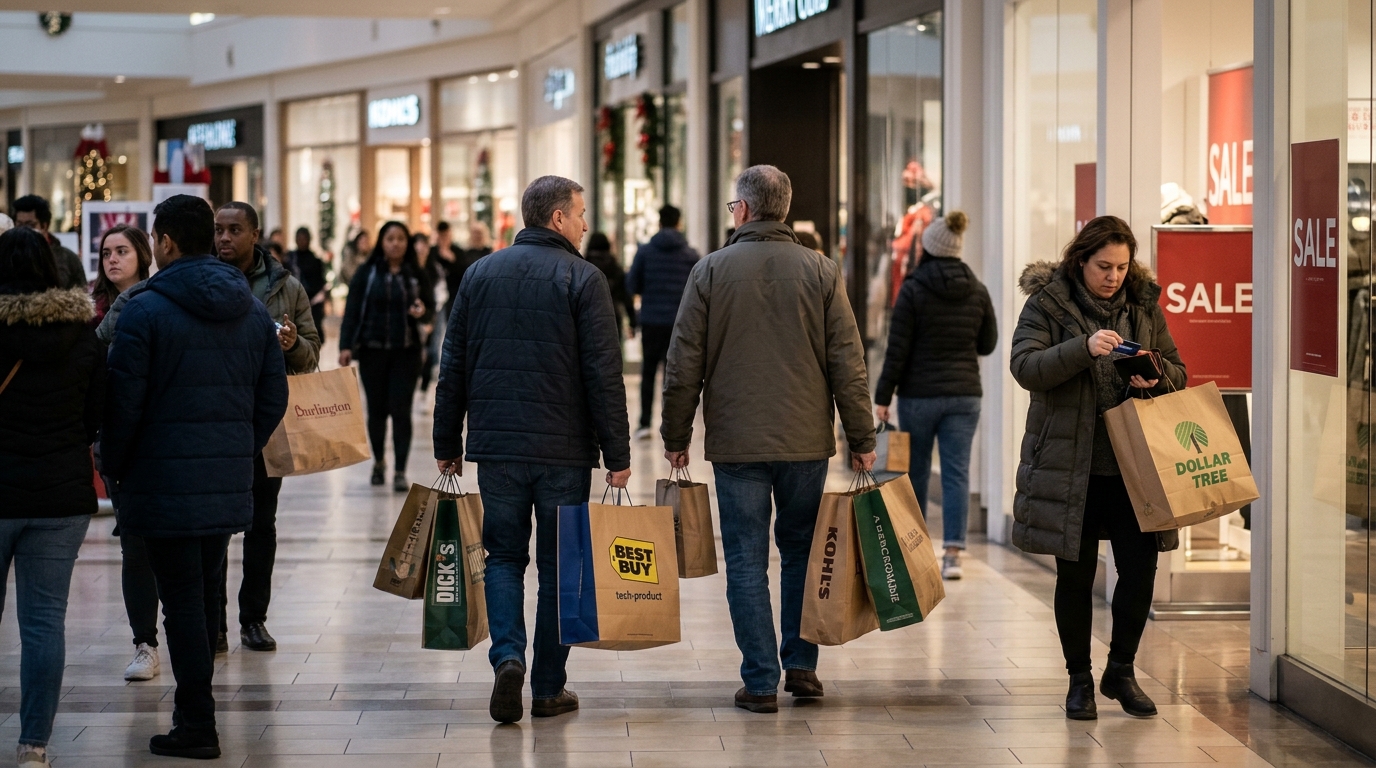
Six major retailers report earnings Tuesday morning, 72 hours before Black Friday. Best Buy, Abercrombie & Fitch, Dick’s Sporting Goods, Kohl’s, Burlington, and Dollar Tree will collectively offer the clearest snapshot of household spending power the market will get before the holiday’s opening bell. But the numbers analysts are watching tell only half the story. The other half is a forecast war that exposes something uncomfortable about where the American consumer actually stands.
The Bigger Trend
Two of the most credible voices in retail research cannot agree on the direction of holiday spending, and the gap between them runs to tens of billions of dollars. Adobe forecasts $275.1 billion in US online holiday spending for November through December, while Deloitte forecasts US holiday e-commerce of $316.1 billion to $318.9 billion for November through January. The two figures are built from different data and cover different windows.
At the individual shopper level, the signal is less ambiguous. The average Black Friday shopper plans to spend $488, down from an estimated $594 in 2025, according to Finder’s survey. Finder also found that 71% of Americans ages 18 to 64 plan to shop the pre-holiday sales, up from an estimated 66% in 2025, but they plan to spend less. More participants, smaller carts: that is the picture of a consumer under financial pressure who still wants to participate.
Bain’s view cuts the other direction at the aggregate level. According to Bain & Company’s forecast, retail sales over the Black Friday through Cyber Monday weekend are expected to top $85 billion, accounting for 8.5% of 2026 US holiday sales, with sales growth of 8.75% year over year, outpacing Bain’s overall holiday season growth forecast of 4.5%. Both things can be true: aggregate dollars rise when more shoppers show up, even if each one spends less. The mix of who actually shops, and where, matters enormously.
The Investment Case
Tuesday’s earnings will begin resolving the ambiguity. Consensus EPS estimates for the morning: Best Buy at $1.49 and Burlington at $1.73. Dick’s Sporting Goods is expected to earn about $1.41, and Dollar Tree consensus sits around $0.92.
Best Buy carries the most interpretive weight for investors thinking about electronics spending. The company is expected to post earnings of $1.49 per share on revenue of about $9.89 billion, against $1.40 per share on $9.67 billion in the same quarter a year earlier. The company guided for Q3 comparable sales of 1.0% to 3.0%. Adobe expects electronics to carry the deepest Black Friday discounts, peaking at 30% off. If Best Buy’s results land at the low end of the comp range, it complicates the case for a strong electronics holiday.
Abercrombie is a different kind of read. ANF reports Q3 results on November 24, with the consensus revenue estimate around $1.36 billion, implying mid-single-digit growth from the year-ago quarter. Apparel is where Finder’s budget compression shows up most directly, and Adobe’s forecast expects online sales of clothing basics to run 210% above their September level during Cyber Week. A strong Abercrombie result would suggest the trade-down is more selective than broad.
Building Wealth Around This Idea
The divergence between aggregate forecasts and per-shopper budget data creates a positioning challenge. Investors tempted to buy retail broadly ahead of the holiday weekend should recognize they are effectively betting on which forecast is right. A more defensible approach is to weight toward off-price and value-oriented names. Bain has said higher prices are a major reason consumers plan to change their holiday spending this year. That favors Burlington and Dollar Tree structurally, whatever Tuesday’s specific numbers show.
Williams-Sonoma, which reported Thursday before the bell, offered a preview of what a slight revenue miss can do: the company reported revenue of $1.991 billion. With stocks priced for a decent holiday, execution risk is real.
Risks to Monitor
The core risk is that budget compression at the individual level proves more powerful than aggregate participation gains. One widely cited 2026 survey found that 18% of Black Friday shoppers typically spend $1,000 or more on holiday shopping, down from 24% in 2025. The high-end shopper pulling back matters more per transaction than any gain in lower-spend participation. Retailers with exposure to aspirational or big-ticket categories, Best Buy and Dick’s among them, face that headwind most directly.
Daily Wealth Takeaway
When forecasters disagree by this much, the disagreement itself is the signal. Consumer health is not uniform across income levels, categories, or channels. Investors who treat “the consumer” as a single variable will consistently misread retail. Build positions around the specific behavior the data actually supports: more shoppers, smaller budgets, and a clear preference for value. That is not a Black Friday trade. That is a durable portfolio principle.