Hey there, bargain hunter.
Something structural is happening in the energy market. It doesn’t have the drama of a earnings miss or a CEO blowup. It’s quieter than that. But it may be one of the most durable multi-year trades in the market right now.
AI data centers are consuming electricity at a pace the existing U.S. grid simply cannot absorb. The Federal Energy Regulatory Commission projects that U.S. data center electricity demand climbs to 35 gigawatts by 2030, up from 19 GW in 2023. Every time someone runs an AI query, it uses roughly 10 times more electricity than a traditional search. Multiply that by billions of daily queries and you have a power crisis hiding in plain sight.
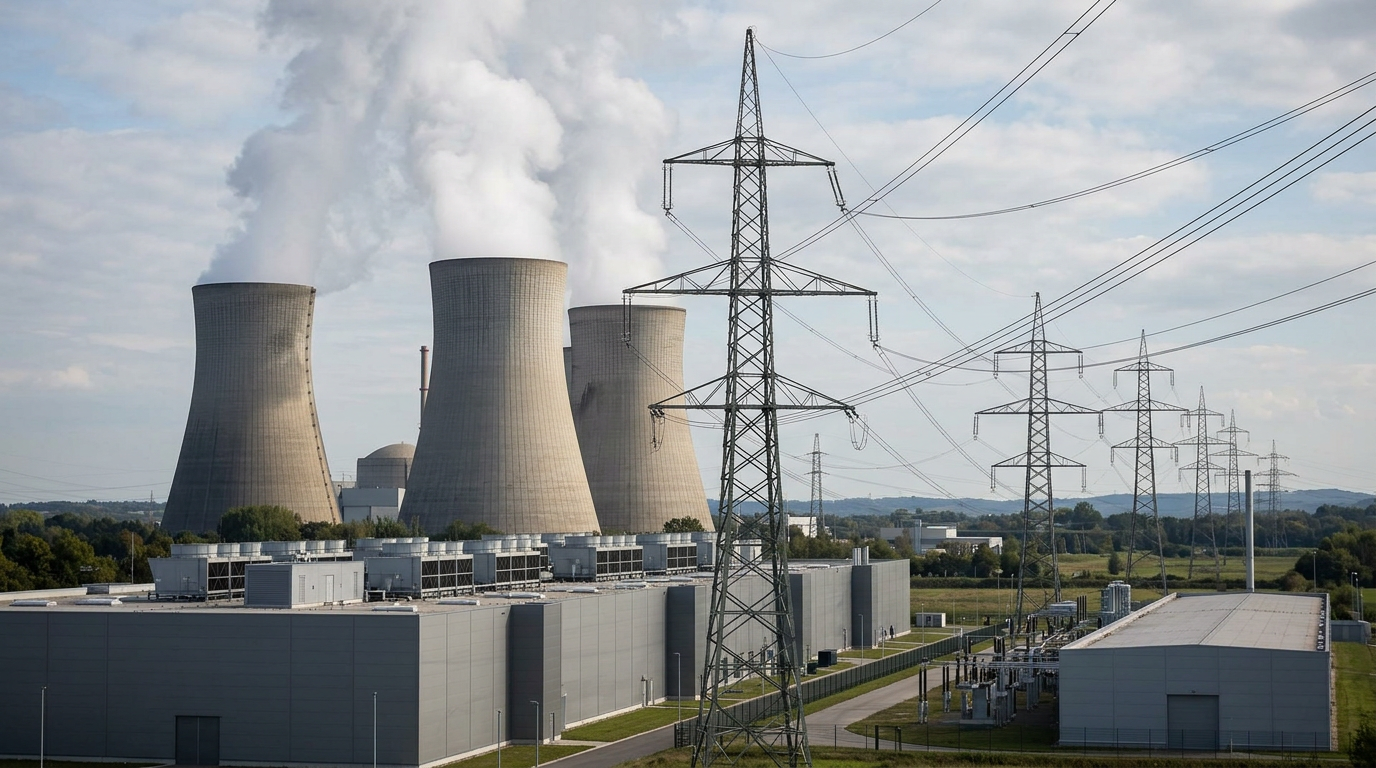
Wind and solar can’t solve it – they’re intermittent. Natural gas helps near-term but carries fuel-cost volatility and emissions commitments most hyperscalers don’t want. Nuclear can deliver dense, reliable, carbon-free baseload power at industrial scale, 24 hours a day, 365 days a year. That’s exactly what a data center needs.
The market figured this out fast. The Tema Electrification ETF – a broad basket of companies tied to the power grid buildout – is up more than 40% year-to-date through early May 2026, versus roughly 5% for the S&P 500.
The players
Constellation Energy (CEG) is the clearest pure-play. It operates the largest fleet of nuclear reactors in the U.S. – 21 reactors across 16 facilities – and recently completed its $16.4 billion acquisition of Calpine, making it the largest private-sector power producer in the world. Q1 2026 revenue came in at $11.12 billion, a 64% year-over-year surge. Adjusted EPS beat at $2.74 vs. a $2.60 consensus. Management reaffirmed full-year 2026 EPS guidance of $11 to $12 per share – nearly 23% growth at the midpoint – and projects adjusted base EPS to compound at 20% annually through 2029. Free cash flow is guided at $8.4 billion across 2026-2027, rising to $11.5 to $13 billion in 2028-2029. Microsoft and Meta have each signed 20-year nuclear power purchase agreements with CEG. The stock is down roughly 14% year-to-date, trading at a P/E of about 39x – not cheap, but not absurd for what is now effectively an AI infrastructure company wearing a utility badge.
Cameco (CCJ) is the uranium angle. The Canadian miner is the world’s second-largest uranium producer and holds secured long-term contracts to deliver around 230 million pounds of uranium – with roughly 140 million pounds scheduled in 28 million-pound annual increments from 2026 through 2030. Spot uranium is currently trading near $86 per pound, with TradeTech’s long-term indicator marked at $93. Supply takes years to scale; new mines don’t flip on overnight. That structural tightness is a tailwind for both price and margins.
GE Vernova (GEV) brings the SMR angle. Its GE Hitachi unit is developing small modular reactors – factory-built, scalable, deployable in 3-4 years versus the decade-plus timeline of traditional plants. The stock has climbed over 50% in 2026 alone.
The part people skip
The U.S. government has announced up to $80 billion in funding to build new reactors on American soil for the first time in decades. Trump signed four executive orders targeting an increase in U.S. nuclear capacity from roughly 100 GW today to 400 GW by 2050. The IEA projects annual nuclear investment will need to triple – from $70 billion today to $210 billion by 2035 – to meet projected demand. Policy, capital, and corporate demand are all pointing the same direction at the same time. That rarely happens.
The risks are real: uranium price volatility, grid transmission constraints, regulatory timelines, and the premium already baked into some names. CEG is not a screaming value at current levels. But for investors who understand what the power bottleneck actually means for the next decade of AI infrastructure, the nuclear trade is far from over.
The question isn’t whether nuclear matters. It’s whether you own the right piece of it.