
Here’s something the energy headlines keep missing.
Everyone is focused on oil. The Brent chart, the geopolitical noise, the ceasefire rumors. And yes, crude matters. But the more durable story — the one with a longer runway and less headline risk — is happening in liquefied natural gas.
What actually changed in March 2026
When Iranian forces closed the Strait of Hormuz, the world didn’t just lose oil. It lost roughly 20% of its global LNG supply almost overnight. Qatar, which supplied nearly a fifth of the world’s LNG in 2025, was forced to declare force majeure after Iranian strikes damaged the Ras Laffan export facility. QatarEnergy has estimated repairs could take up to five years. Five years.
That’s not a supply disruption. That’s a structural vacancy in global energy markets.
Slight tangent, but it matters: the reason this hits so hard is that Europe spent years weaning itself off Russian pipeline gas. It replaced much of that supply with Qatari LNG. Now that source is damaged and constrained. Europe has to go somewhere else. Asia — already competing for cargoes — is facing the same scramble. The only country with the infrastructure, production capacity, and political alignment to fill that gap is the United States.
The numbers are already moving
U.S. LNG exports hit 17.9 billion cubic feet per day in March 2026 — the second-highest export volume on record. The EIA has raised its full-year 2026 forecast to 17.0 Bcf/d, up from its January estimate of 16.4 Bcf/d. Shipments to Asia more than doubled month-over-month in March. Nearly a quarter of all American LNG went to Asia in April, a sharp shift from where flows were just weeks earlier.
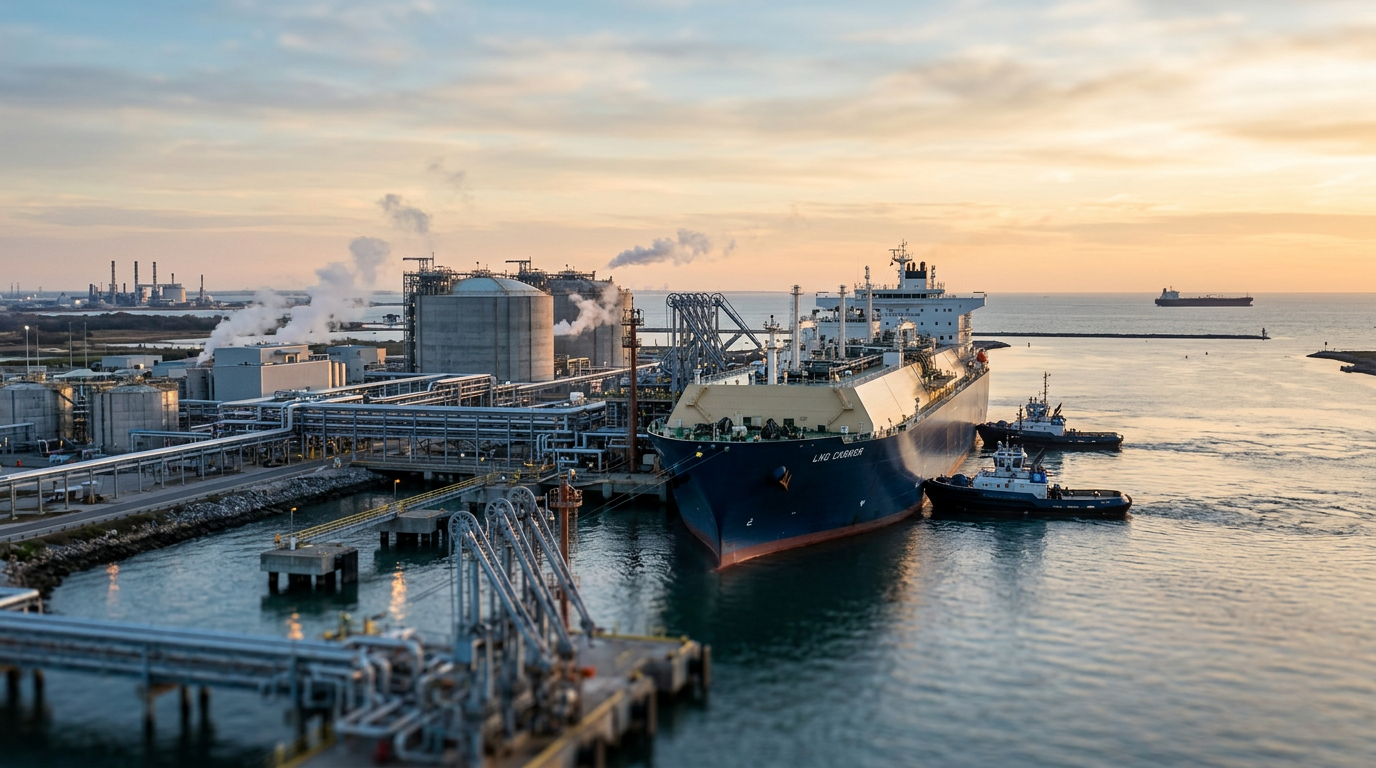
America is now the world’s largest LNG exporter. And it’s running terminals at close to maximum capacity to meet the demand that Qatar can no longer serve.
The part people skip: U.S. domestic gas prices remain depressed. Henry Hub is averaging around $3.10/MMBtu in the second and third quarters of 2026 — roughly flat with last year. Meanwhile, European and Asian benchmarks have surged. The spread between what it costs to produce gas in the U.S. and what the world will pay for it is near historic extremes. That spread is the profit margin for U.S. exporters. And right now, it’s extraordinarily wide.
The infrastructure play nobody is watching closely enough
Here’s where the opportunity gets interesting. Most investors thinking about LNG go straight to Cheniere Energy (LNG), which holds roughly 50% of U.S. LNG export capacity and accounts for about 11% of global supply. That’s a reasonable entry point — approximately 94% of its volume is sold under long-term fixed-fee contracts, providing earnings predictability, with spot exposure on uncommitted volumes that becomes enormously valuable when the TTF-Henry Hub spread is this wide.
But the infrastructure layer deserves equal attention. Kinder Morgan (KMI) controls the nation’s largest natural gas transmission network, moving 40% of all U.S.-produced natural gas through roughly 78,000 miles of pipeline as of mid-2026. About 96% of its cash flow comes from take-or-pay contracts and fee-based arrangements. When LNG terminals run at maximum capacity, the pipelines feeding them get busier and more valuable. The revenue doesn’t spike with commodity prices — it accretes steadily as throughput rises.
Energy Transfer (ET) is building the $2.7 billion Hugh Brinson Pipeline to move more Permian Basin gas to Gulf Coast terminals. That project is a direct bet on LNG export demand persisting — and the company made a deliberate choice to prioritize pipeline infrastructure over its Lake Charles LNG terminal project, which it suspended in late 2025.
The structural case, not the tactical one
U.S. LNG export capacity is set to double by 2031 from already-sanctioned projects alone. Goldman Sachs projects a 50% increase in global LNG supply by 2030, with the U.S. as the primary driver. Three new projects — Woodside Energy’s Louisiana LNG Phase 1, Cheniere’s Corpus Christi Midscale Trains 8 and 9, and Venture Global’s CP2 LNG Phase 1 — reached positive final investment decisions in 2025 with in-service dates between 2027 and 2029.
The cycle is extending, not ending. Even when the Hormuz situation stabilizes, the Ras Laffan damage takes years to repair. Europe has accelerated long-term supply agreements with U.S. exporters. China, which had largely stepped back from U.S. LNG, is reportedly set to receive its first shipments in over a year following Trump’s recent trip to Beijing. The market structure has shifted.
What the market is mispricing
Investors keep treating this as a geopolitical trade — one that ends when the shooting stops and prices normalize. That’s the wrong frame. The Qatari infrastructure damage is a five-year repair timeline, not a headline. The long-term supply agreements being signed right now will lock in U.S. export volumes for a decade. The pipeline infrastructure feeding those terminals is becoming more strategically valuable with each passing quarter.
What happened in March wasn’t just a crisis. It was a permanent realignment of who supplies the world’s energy. The companies sitting at the center of that realignment — exporters, pipeline operators, and upstream producers with Gulf Coast access — are still trading at valuations that don’t fully reflect what changed.
That gap may not stay open much longer.