Wednesday’s EIA report was supposed to be bearish. Commercial crude stockpiles grew by 3 million barrels to 426.4 million barrels. Instead, Brent rose to $101.61 on September 23, up about 2.4% from the previous day. The market looked past the crude build entirely. The reason is in the product data most traders scrolled past.
Gasoline stocks dropped about 1.7 million barrels and distillates fell about 400,000 barrels, leaving distillate supplies roughly 13% below the five-year average. The EIA forecasts U.S. distillate fuel oil inventories will drop below 100 million barrels in September and will remain below the five-year (2021-2025) low through much of 2027. That is not a near-term blip. It is a structural shortfall that was tightening before a single drone hit Saudi steel.
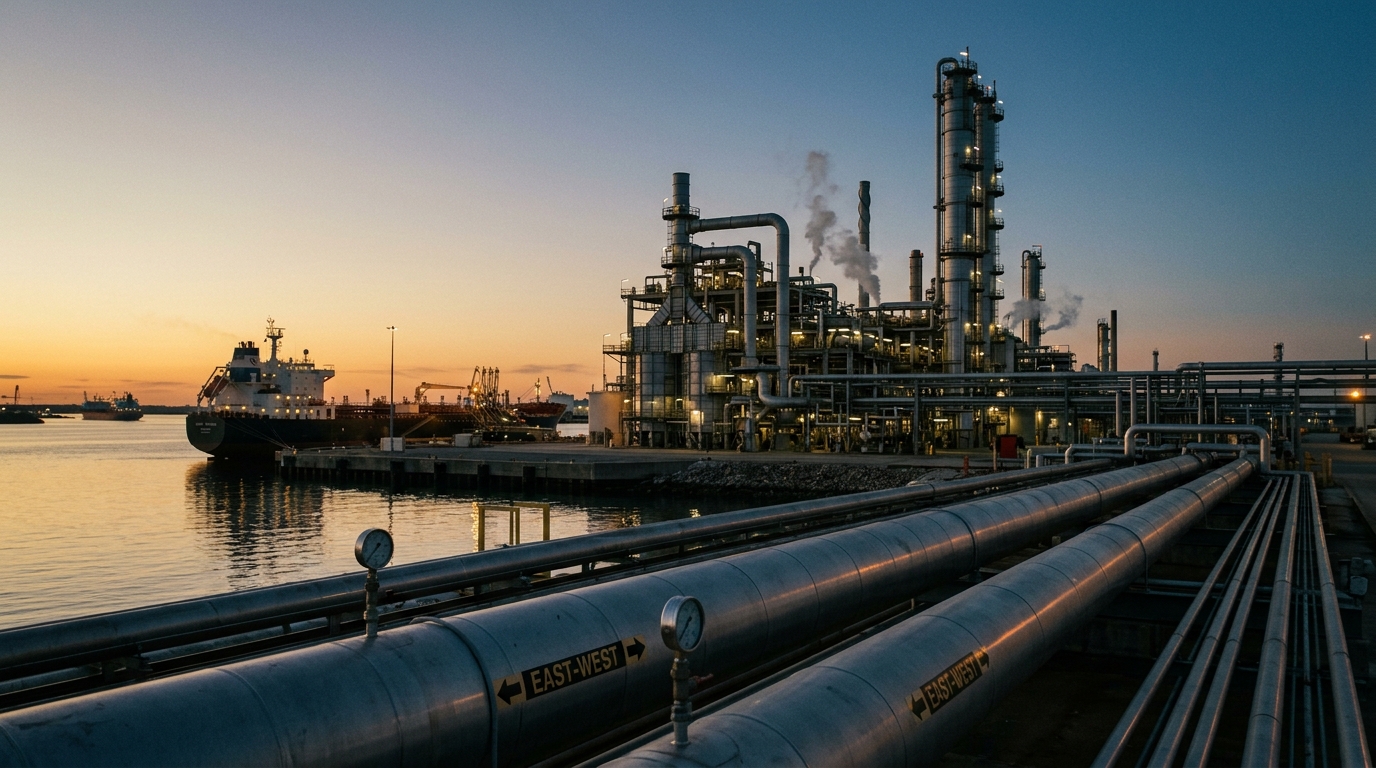
Drone attacks forced Saudi Arabia to shut its East-West Pipeline, halting crude loadings at Yanbu port. Since disruption to oil flows through the Strait of Hormuz following the U.S.-Israeli war on Iran, OPEC’s leading oil exporter has been using the pipeline to reroute around 4 million barrels per day to Yanbu. The pipeline has now restarted, but at a low rate. Reaching 40% of capacity will take a couple of days, and a full restart will take six to eight weeks, according to a security source. That slow ramp is the part worth tracking. Europe was already feeling the squeeze: industry reporting has said Aramco told some European term customers that October crude allocations would be zero after the pipeline outage interrupted supplies normally moved from Yanbu through Egypt’s SUMED system to the Mediterranean.
Where to Position
The clearest trade is not in crude itself. It sits one step downstream. Valero Energy (VLO) tagged a fresh 52-week high as the WTI 3-2-1 crack spread crossed $64 per barrel, its highest level since the disruptions of 2022. Marathon Petroleum (MPC) and Phillips 66 (PSX) logged fresh highs in the same session. With the 3-2-1 crack spread around $64 per barrel in September 2026, the backdrop for Q3 earnings remains strongly supportive.
Since launch, Marathon has delivered a total return of +56.82%, Valero +56.07%, and Phillips 66 +46.85%, all significantly outperforming the sector. The question is whether that run has legs or is running into mean reversion risk. The distillate shortage argues for legs. Barring a ceasefire that restores Hormuz flows and collapses the supply premium, Q3 2026 results for the independent refiner group are structurally positioned well above year-ago levels. VLO is the highest-conviction name given its distillate-heavy refining mix and a Q2 earnings beat that already showed the margin capture in real numbers.
For integrated majors, XOM and CVX benefit on the production side as Brent holds above $100, but their refining exposure is diluted by upstream hedging. The pure-play refiners remain the tighter expression of the distillate shortage thesis.
Risk Dashboard
The single biggest risk to this trade is a diplomatic breakthrough. Reuters reported September 23 that U.S. President Trump said American officials held a “very productive” meeting with Iranian envoys and indicated further talks were planned. Any agreement that meaningfully reopens Hormuz would push crack spreads sharply lower and pull the refiners with them. A full East-West pipeline restart compresses the Brent-WTI spread and reduces the European supply premium, trimming one layer of the thesis without eliminating it. Watch crude futures curve structure: a shift from backwardation toward contango would signal the physical tightness is fading.
Until then, the distillate deficit is not a headline. It is the trade. Crude built 3 million barrels last week and Brent still closed above $101. That is the market telling you where the shortage actually is.