Something shifted yesterday. Not gradually. Not quietly.
On June 29, Rocket Lab announced it will acquire Iridium Communications in an $8 billion cash-and-stock deal, paying the equivalent of $54 per Iridium share — $27 in cash, the rest in RKLB stock. That is about a 24% premium to where Iridium closed the prior Friday. By end of day, RKLB was up roughly 16% and Iridium had surged about 25%.
The move warrants real attention, because it isn’t just an acquisition. It’s a structural transformation of what Rocket Lab actually is.
What the Deal Actually Does
Here’s where it gets interesting. Up until yesterday, Rocket Lab was primarily a launch and space systems company. Strong execution, growing backlog, but still fundamentally a services business dependent on winning individual contracts. That model has real ceiling risk at scale.
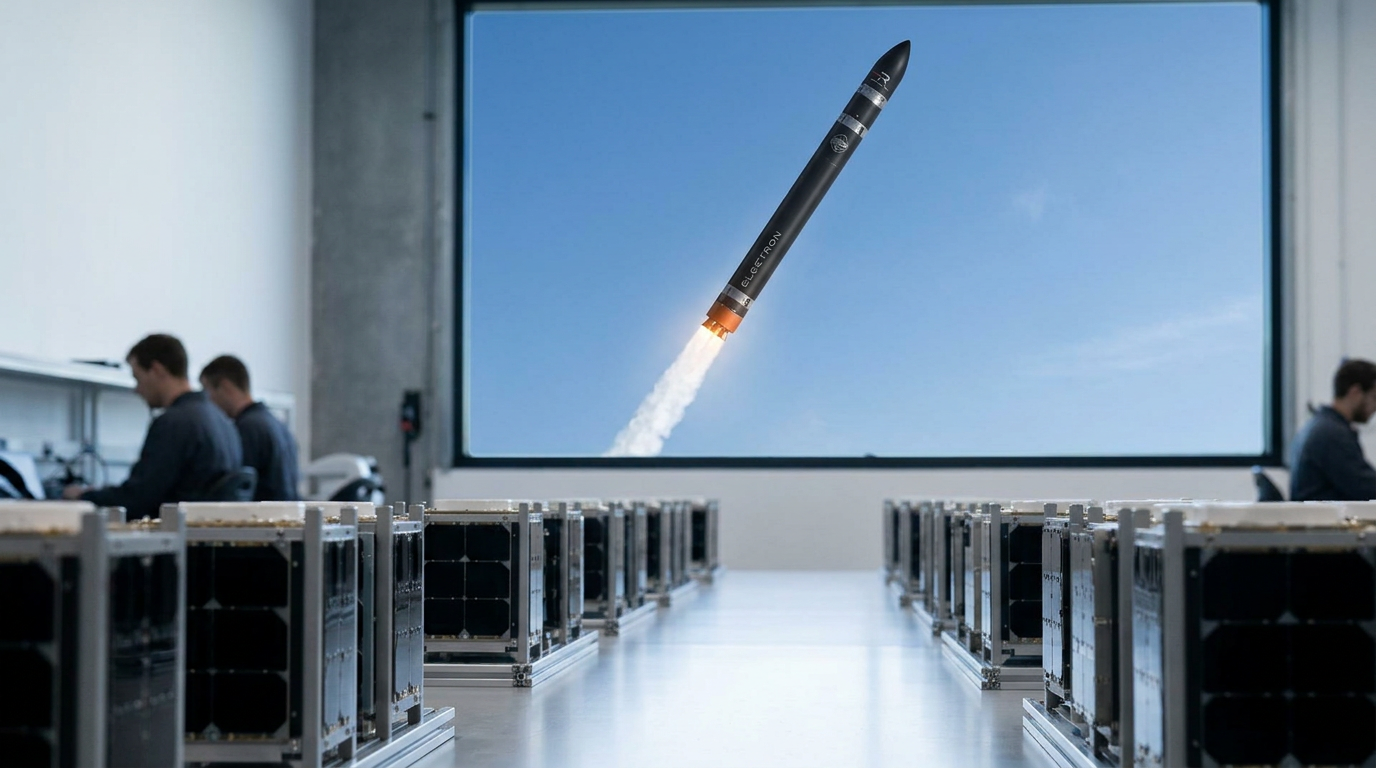
The Iridium acquisition changes the architecture entirely. Iridium brings a 66-satellite low-Earth orbit network, globally licensed L-band spectrum, and a subscriber base of more than 2.55 million users spanning government, defense, aviation, and maritime sectors. Rocket Lab gets to stop selling rides and start owning the rails.
What the combined company can now do — build the rockets, manufacture the satellites, launch them on its own vehicles, and operate the constellation — is exactly the playbook SpaceX runs with Starlink. It’s vertically integrated. And vertical integration in space is the only model that scales.
The Numbers Behind RKLB Right Now
Before the Iridium deal entered the picture, Rocket Lab was already posting some of the cleanest growth numbers in the sector. Q1 2026 revenue came in at $200.3 million, up 63.5% year over year. The company exited the quarter with a $2.2 billion backlog and Q2 guidance of $225 million to $240 million. For a company that posted $601.8 million in full-year 2025 revenue — itself a 38% jump from 2024 — that Q2 guide implies the annualized run rate is now approaching $1 billion.
Some of the market snapshot metrics frequently cited alongside these results (trailing-twelve-month revenue, gross margin, and net margin percentages) vary by data provider and definition, so treat those as directional rather than precise.
The median analyst price target before the Iridium announcement was around $105. At Monday’s close near $98, RKLB was already trading slightly below that consensus. The deal opens a new set of valuation questions entirely.
The Strategic Logic — and What Matters for Traders
The transaction adds material scale. Iridium itself is a profitable, cash-generative business. Rocket Lab framed the deal as strengthening its cash flow profile and accelerating its path toward profitability. That matters because RKLB’s biggest criticism has always been its path to sustainable free cash flow. Iridium, essentially, provides that anchor.
There’s also the competitive angle that shouldn’t be underestimated. Iridium has faced rising pressure from low-Earth-orbit broadband networks like SpaceX’s Starlink (even if the services and spectrum bands differ). Joining forces with a company that can build and launch its own next-generation constellation gives the combined entity a credible counterpunch.
Slight tangent, but worth noting: the deal also sent ripples through adjacent names. Moves in names like ViaSat and Gilat Satellite were discussed widely alongside the announcement, but intraday percentage jumps vary by tape, timing, and which “news window” you measure.
Key Levels and Trading Framework
RKLB closed the session at $98.01 on June 29 — the day of the announcement — after gaining nearly 16%. On an intraday basis, the stock had been consolidating near the $100 psychological level before the deal broke. That $100 level is now critical. A clean reclaim and hold above it on follow-through volume would suggest the market is pricing the deal constructively. A reversal back below the low-$90s would indicate the initial spike is being sold into.
The RKLB earnings date is currently estimated for August 5, 2026. Q2 results will be the first chance for management to address integration planning in detail. Between now and then, expect volatility to run elevated — there are a lot of unknowns around the cash component of the deal and regulatory approval (expected to close mid-2027).
On the technicals: the 50-day moving average had been declining during the recent pullback, and the consolidation at $100 showed bullish divergence in momentum indicators per multiple desk views. Whether the deal catalyst clears that overhang or just creates a new, higher range to trade is the question worth watching over the next few sessions.
Scenario Framework
Bull Case
Neutron executes on its next major milestones and first flight timing remains intact. The Iridium integration proceeds cleanly, adding meaningful cash flow by mid-2027. Q2 revenue comes in above the $240 million high end of guidance. RKLB moves back through $120–$130 and challenges previous highs. Analyst targets get revised materially higher as the combined entity’s addressable market expands into satellite IoT, direct-to-device, and government PNT services.
Base Case
RKLB consolidates in a range around $95–$115 through the rest of summer as investors wait for Q2 results and early Neutron milestones. The Iridium deal passes regulatory scrutiny without major conditions. Revenue continues compounding in the 50%+ range year over year on the legacy business. Deal accretion becomes clearer once Q3 guidance is issued alongside Q2 results.
Bear Case
Neutron’s debut slips into 2027. Integration costs come in higher than expected. The cash component of the Iridium deal pressures RKLB’s balance sheet (the company reported substantial liquidity exiting Q1, which partially offsets this). RKLB pulls back toward the $75–$80 area as execution risk is repriced. The deal’s mid-2027 close timeline introduces sustained uncertainty overhang.
What Active Traders Need to Watch
The immediate focus should be on whether RKLB can consolidate above $100 on normal volume over the next several sessions — or whether the spike was purely deal-driven and fades. The second thing to track is analyst reaction over the next week. Pre-announcement, the median target was around $105. If the street raises targets into the $120–$130 range to reflect the combined entity, that creates a new price anchor for institutional buyers.
Earnings on August 5 is the next hard catalyst. Any guidance update or commentary on Neutron progress between now and then should be treated as a meaningful data point. The deal doesn’t close until mid-2027, but the market will start pricing the combined business well before that.
The space economy consolidation trade that SpaceX’s IPO started is clearly not done. Rocket Lab just made the largest move in response to it. That’s either brilliant positioning or an overreach financed at the wrong time. The next 60 days should start to clarify which.
For informational and educational purposes only. Not investment advice. Trading involves risk, including loss of principal.