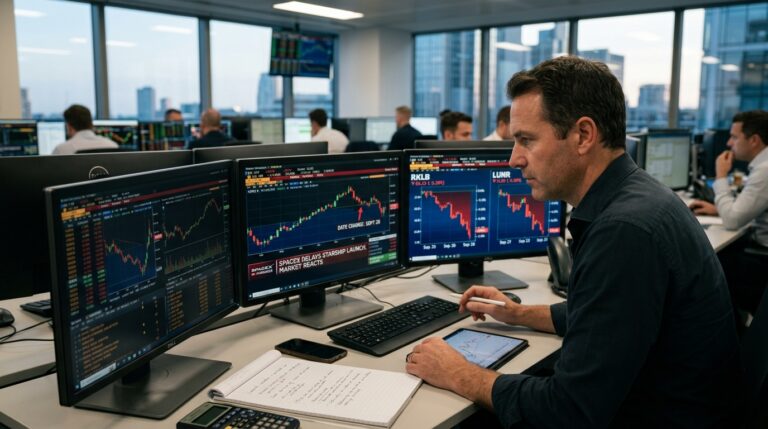

Something unusual happened this weekend. Two completely unrelated stories dropped within hours of each other, and together they are reshaping what the first Monday of August looks like for traders.
The bigger one first.
Trump called off what he described as a “massive” planned strike on Iran, pausing to negotiate. He posted on Truth Social early Monday: “Get to work, everybody, and get it DONE.” He told reporters that new talks with Iran would begin sometime Monday, with the focus on reviving stalled cargo traffic through the Strait of Hormuz before any nuclear discussions come next. Saudi Arabia, the UAE, and Qatar reportedly pushed hard for the diplomatic pause over the military option.
The market heard that loud and clear.
Brent crude slid more than 5% in early trade, touching around $83.51 a barrel. WTI dropped to near $79.87. That is a significant relief for an economy that has been absorbing an energy shock since late February, when the U.S.-Israel conflict with Iran erupted and traffic through Hormuz seized up. Oil at these levels is meaningfully below the peaks that hit north of $100 earlier this year, when BlackRock CEO Larry Fink warned crude could spike toward $150.
The equity futures reaction was measured but positive. S&P 500 futures gained around 0.6%, Dow contracts added about 1%, and Nasdaq-100 futures were up roughly 0.3%. Not a rip, but a consistent bid.
Slight tangent here, but it matters: Iran contradicted Trump’s Sunday announcement almost immediately, saying no talks were scheduled. That kind of friction has been the recurring pattern since this conflict started. The market keeps front-running a deal that keeps not quite closing. One analyst at Capital.com called it a “TACO” move, Trump always chickens out, and framed it as a familiar playbook. There is real risk that traders pricing in a smooth Hormuz reopening are running ahead of what the diplomacy can actually deliver.
The second story is the AstraZeneca-Bristol Myers Squibb situation. The Financial Times reported Sunday that the two companies have held preliminary talks over a potential combination that could be valued at nearly $400 billion. BMY shares popped around 8% in premarket. AZN dropped around 7%, the market reading AstraZeneca as the one writing the premium check. Analysts on CNBC were described as “perplexed” by both the news and the timing, given that AstraZeneca has been one of pharma’s cleaner growth stories. The deal would make the combined entity one of the world’s largest drugmakers by market cap. Antitrust scrutiny is almost certain given how central oncology is to both companies’ portfolios.
Worth noting: a deal “could materialize soon, but could also be delayed or fall apart,” per the FT sourcing. Neither company confirmed anything.
What the Rest of This Week Looks Like
- Palantir (PLTR) reports after the close today. Consensus sits at $1.81 billion revenue, up about 80% year over year, with $0.34 EPS. The stock is down roughly 40% from its November 2025 all-time high near $207. Eight straight earnings beats in the books, and the options market is pricing about a 12% swing. The Q1 beat was 18% above consensus EPS, and the stock still fell in the after-hours reaction. That dynamic is the core tension heading into this print.
- AMD (AMD) reports Tuesday. Consensus calls for $11.32 billion revenue, up about 47% year over year. Data center is the number everyone will watch, with the MI450 and Helios production updates flagged as the key reads for where the AI chip cycle actually stands.
- Disney, McDonald’s, Shopify, Pfizer and more round out the back half of the week. And Friday brings the July jobs report, with 10-year Treasury yields hovering near 4.7%-4.8% keeping rate sensitivity high.
Around 84% to 85% of the S&P 500 companies that have already reported beat estimates this cycle, with Q2 earnings growth tracking in the high 30% range year over year, according to FactSet’s blended growth rate. That is a strong earnings season by any measure. The question heading into this week is whether the AI infrastructure names can sustain that momentum after what already happened to Meta and Apple.
The Hormuz story is not resolved. It is paused. There is a real difference there, and the options market in crude has been pricing that distinction even when equity traders move on. Keep an eye on how Iran’s public posture develops through the trading day. If Tehran contradicts Washington again, the oil move reverses quickly and the risk-on tone in equities fades with it.
Gold was down slightly this morning near $4,105 an ounce, suggesting the market is taking the de-escalation at face value for now. Two-year Treasury yields dipped a few basis points, reflecting some relief on the short end.
The open looks green. Whether it stays green depends on what comes out of those Iran talks, if they happen at all.