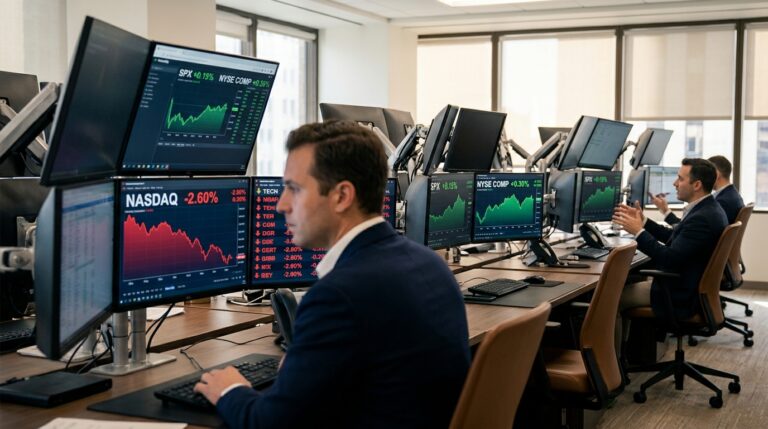

S&P Dow Jones Indices releases its September quarterly rebalancing changes this Friday, September 4. Pro-forma files go to clients that day, and the changes typically take effect prior to the open on Monday, September 21. That two-week window is one of the most predictable mechanical events in markets: nearly $28 trillion in assets are tied to tracking or benchmarking the S&P 500.
The reflex trade, buying rumored additions ahead of Friday’s announcement, is well-worn and increasingly crowded. Index reconstitution creates a systematic dynamic: the index tends to buy stocks near their relative peak, and the funds that track it cannot do otherwise. The March cohort proved the point. Vertiv Holdings, Lumentum, and Coherent were added effective March 23, 2026, but the specific post-inclusion percentage drops cited here are not consistently verifiable across standard reference prices and time windows.
That record reshapes the question. Rather than chasing the announcement, investors should ask: which eligible candidate is worth owning on business quality alone, so the index decision becomes a bonus rather than the entire investment case?
Alnylam Pharmaceuticals (ALNY) is that stock.
The Business
Alnylam is a biopharmaceutical company developing and commercializing therapeutics based on ribonucleic acid interference, or RNAi. The platform is not speculative science: the company’s flagship drug, AMVUTTRA (vutrisiran), is approved for ATTR amyloidosis with cardiomyopathy and for hereditary ATTR amyloidosis with polyneuropathy.
The revenue trajectory is exceptional by any measure. Alnylam achieved Q2 2026 global net product revenues of $1,172 million, representing 74% growth compared with Q2 2025, driven primarily by TTR revenues of $1,030 million, up 89% year over year. That follows Q1 2026, when the company generated just over $1.0 billion in quarterly net product revenues for the first time in its history. Full-year 2026 guidance calls for $4.2 billion to $4.5 billion in TTR net product revenues.
Why Wall Street Is Paying Attention
Analysts have been upgrading the stock with unusual consistency heading into September. Barclays reiterated Buy, Bernstein issued a Buy, BMO Capital initiated at Outperform, and Stifel Nicolaus added a Buy in August alone. The consensus 12-month price target sits at $435, representing a potential gain of roughly 75% from the current price near $246.
Alnylam appears on screens of larger U.S. companies that are not yet in the S&P 500. At a market cap near $34 billion and with four products generating product revenue, the company clears several quantitative thresholds S&P uses to evaluate eligibility. S&P 500 inclusion generally requires a U.S.-domiciled company to carry a float-adjusted market cap above the minimum threshold, report positive as-reported earnings in its most recent quarter and over the trailing four quarters combined, meet liquidity requirements, and have been publicly listed for at least 12 months. Alnylam appears to satisfy the published criteria, though that does not ensure selection.
What’s Driving the Opportunity
The ATTR amyloidosis market is expanding, and Alnylam is leaning hard into that momentum. Beyond TTR, Alnylam is advancing programs across cardiometabolic disease, neurology, and other areas, supported by cash and a pipeline built around its RNAi platform.
That pipeline depth matters. It means Alnylam’s revenue base does not depend on a single product cycle turning favorably. The company has delivered six approved products, including two commercialized by collaborators. The next leg of growth is already in clinical trials.
What Could Go Wrong
Competition is real. Ionis and AstraZeneca presented full results of their Cardio-TTRansform trial at the European Society of Cardiology Congress in Munich in August 2026, and Jefferies flagged a neutral to negative read-through for Alnylam. If a rival therapy claims comparable efficacy in ATTR-CM, pricing pressure on AMVUTTRA follows. The stock is down materially from its recent highs, and that gap reflects real uncertainty.
Index inclusion itself is no guarantee. Eligibility screens are transparent and rules-based, not predictions. Additions to the S&P 500 are decided by the S&P Index Committee at its discretion; meeting every published criterion is necessary but never sufficient. Friday’s announcement may name different companies entirely.
The Bottom Line
The September rebalancing announcement lands Friday alongside August payrolls data, making it one of the busiest information sessions of the quarter. Companies getting added to the index often see their share prices rise between announcement and the effective date, as index-tracking funds buy to match the roster. That mechanical bid is real. But it is also temporary, and 2026’s spotty post-inclusion performance argues against building a thesis around it.
Alnylam sits near $246 per share with 74% year-over-year net product revenue growth, multiple analyst actions over the past month, a strong position in an expanding rare-disease category, and a platform with optionality across cardiometabolic and neurology programs. Buy it because the business warrants it. If Friday’s announcement includes the company, that is a trading tailwind layered on top of a compelling fundamental case.