
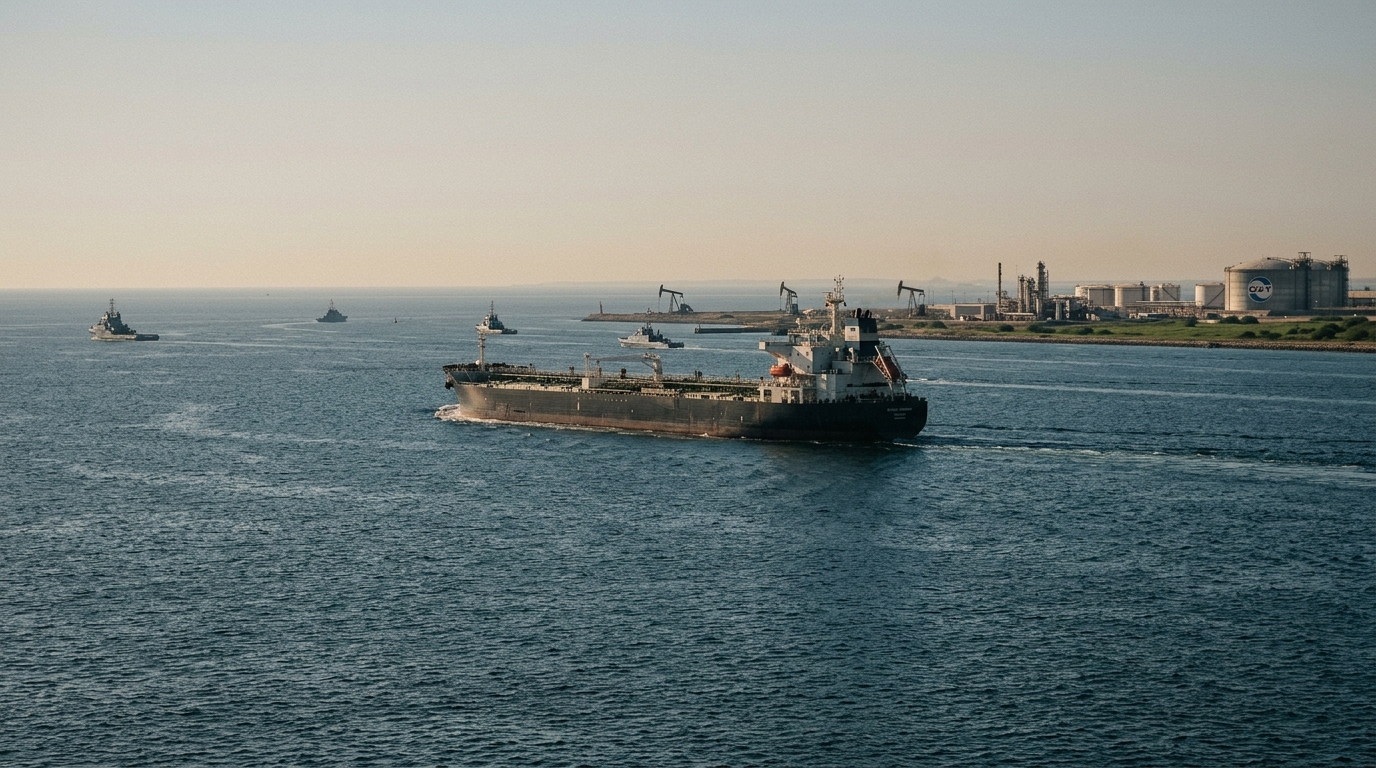
Tuesday opened with renewed fighting tied to shipping security in and around the Strait of Hormuz, crude oil closing back above $90, and energy stocks leading the tape before most desks finished their morning coffee. Another round of U.S. strikes connected to the Strait of Hormuz helped push WTI crude up about 5% to $90.22. The 10-year Treasury yield ended the day at 4.79%. Energy has been the clearest winner of 2026. The question is whether that trade still has legs.
Why This Stock Now
Among the U.S. producers, Occidental Petroleum is one of the more operationally leveraged names at current crude prices, has one of the fastest-improving balance sheets in the group, and sits roughly 9% below its 52-week high with a new CEO who has explicitly committed to returning capital to shareholders. OXY stands out with a roughly 48% year-to-date gain versus peers. It has done that while carrying more debt than Exxon or Chevron. The debt story, not the production story, is what changes the risk-reward calculus from here.
The Business
Occidental is an integrated oil and gas company operating primarily in the Permian Basin, the Rockies, and international markets including the Middle East. At about 1.43 million barrels of oil equivalent per day, it is a meaningful U.S. producer with a chemical segment and midstream operations that can add earnings stability when crude is volatile.
Q2 2026 saw production exceeding guidance and free cash flow before working capital from continuing operations of about $3.0 billion, the highest since Q3 2022. Principal debt was reduced to $11.8 billion, the lowest level since Q2 2019, with net principal debt of $7.6 billion reflecting $4.2 billion of unrestricted cash. The quarterly dividend was raised 8% to $0.28 per share.
Why Wall Street Is Paying Attention
The structural argument for crude is not subtle. Risk around the Strait of Hormuz matters because it is a key energy chokepoint: in 2025, about a quarter of the world’s seaborne oil trade transited the Strait. Tuesday’s renewed strikes are the kind of catalyst that can keep a geopolitical premium in the curve longer than the market expects.
Occidental’s cash flow sensitivity is unusually direct. The company has pegged its oil-price sensitivity at roughly $260 million of annualized cash flow per $1 per barrel change in oil prices. At $90 WTI versus the mid-$60s average it realized in 2025, that is a meaningful annualized tailwind before efficiency gains. The company has outlined a path to add over $4 billion in annual sustainable cash flow by 2030, with about 85% achievable even at lower oil prices. Wells Fargo holds an Overweight rating with a price target of $79.
What Could Go Wrong
Occidental has a higher breakeven on parts of its remaining inventory than some major North American peers, which means a sharp reversal in crude can cut free cash flow faster here than at Exxon or Chevron. Capital spending for 2027 has been discussed as starting around $5.9 billion, which may pressure near-term free cash flow. The new CEO, Richard Jackson, who took over from Vicki Hollub on June 1, 2026, has yet to be tested through a down cycle.
The geopolitical risk cuts both ways. A ceasefire or diplomatic resolution that stabilizes shipping through the Strait would remove part of the crude premium supporting the stock.
The Bottom Line
Occidental has the operating leverage, the improving balance sheet, and the sector momentum to be the single most compelling energy name today. The balance sheet transformation is real: principal debt at its lowest since 2019, the dividend raised twice in 2026, and a CFO-outlined path to more sustainable cash flow by 2030. Tuesday’s move back above $90 is a reminder of why the market is not ready to rotate out of this sector. At roughly $61, OXY is not cheap in an absolute sense, but relative to where its cash generation is heading at current oil prices, it may be the energy trade that still earns its position.