Arm spent this week doing something it has never done in 35 years of business: releasing its own silicon and defending that decision to the investors who own it. The AGI CPU got a full architectural reveal at Hot Chips 2026. Neoverse CSS N4 launched September 8, adding up to 128 cores per die, LPDDR6, and PCIe Gen 7 to Arm’s design toolkit for custom-chip partners. Shareholders approved all board proposals at the September 9 AGM. The week looked like a victory lap. The stock dropped 3.67% that same day.
The gap between those two facts is the entire investment question.
The Business
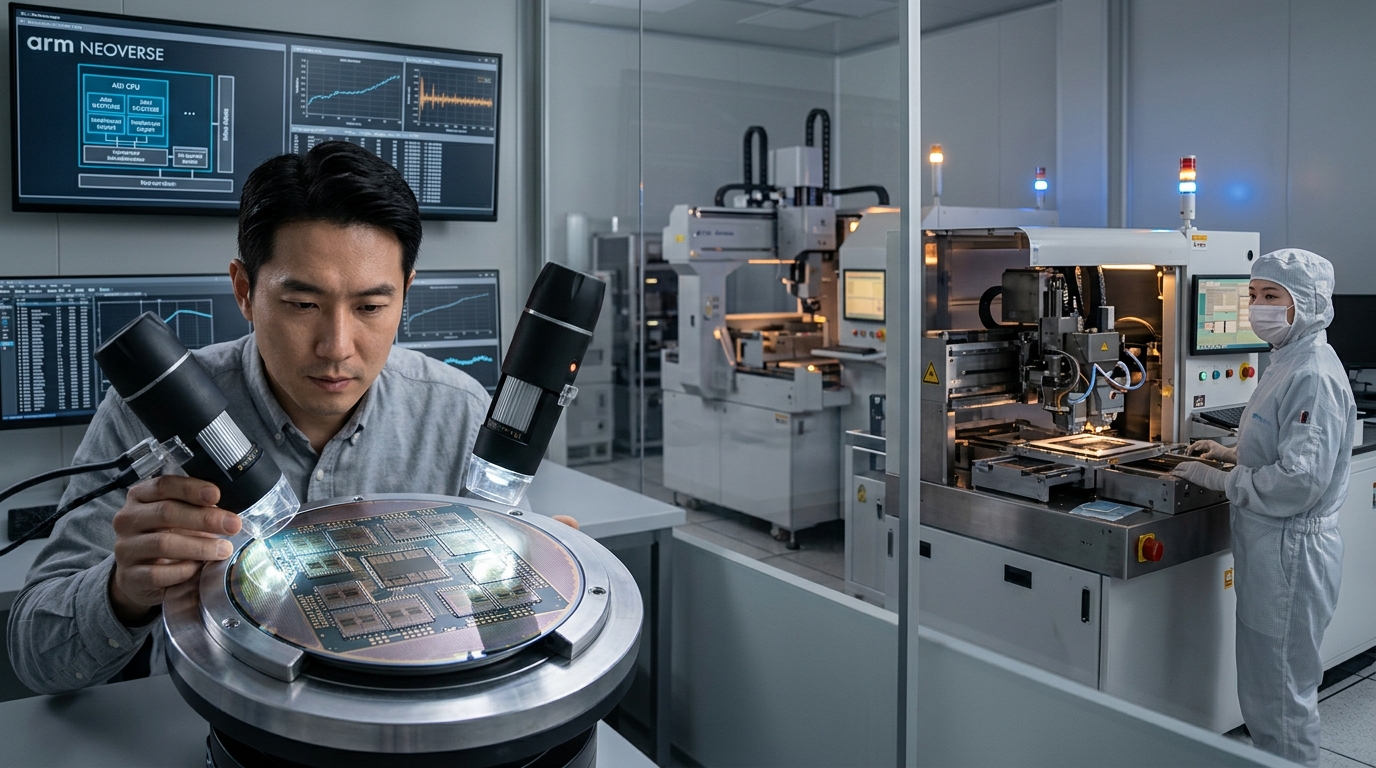
The AGI CPU is production silicon for customers that want to deploy an Arm-designed processor directly. That gives Arm two routes into AI infrastructure: a configurable platform for companies designing their own chips, and complete Arm silicon for operators that want a deployable CPU platform. The AGI CPU itself is a 136-core, TSMC 3nm design built around Arm Neoverse V3-class cores, positioned in a 300W power envelope with PCIe Gen 6, CXL 3.0, DDR5, and sub-100ns memory latency targets, with production expected by the end of calendar 2026.
By shipping finished silicon, Arm now captures dollars per chip in direct margin on top of the royalties it already collects from every licensee. This dual-revenue model addresses a data center CPU market that Futurum projects will reach $76.6 billion by 2029, with growth accelerating at 34.9%, outpacing both GPUs and XPU.
Why Wall Street Is Paying Attention
Arm has cited ecosystem activity involving OpenAI, Meta, Cloudflare, Oracle, SAP, Lenovo, Supermicro, and many others. That customer list is not a rumor. For customers like Meta and OpenAI, the pitch is speed: deploying a ready CPU platform can compress time-to-market versus building a custom CPU from scratch.
Piper Sandler initiated coverage on seven major semiconductor stocks on September 10 with most receiving strong ratings, describing the AI market as “starving for more compute capacity.” Arm was upgraded to a strong-buy rating in that report. Morgan Stanley had already lifted its price target to $212 from $202 in late July. The analyst community is broadly constructive. The stock, trading around $255 Friday morning, tells a more complicated story at roughly 103 times forward earnings.
What’s Driving the Opportunity
TrendForce analysis published in 2026 argues that agentic AI can compress the traditional CPU-to-GPU ratio and, in some scenarios, move it toward parity, a structural increase in CPU core demand that requires a different kind of server chip from high-performance designs focused on raw inference. That tailwind is real and it is accelerating.
Arm argues agentic AI will sharply raise CPU demand and has framed the move into finished CPUs as expanding its Cloud AI opportunity well beyond a royalty-only model.
What Could Go Wrong
The single biggest risk is not competitive. Arm’s expansion from asset-light IP licensing into finished data center processors is putting the company into direct competition for wafer, memory, and packaging capacity, just as it says customer demand for the AGI CPU exceeds $2 billion across fiscal 2027 and fiscal 2028. That is the constraint that actually matters: not whether OpenAI wants the chip, but whether foundry and advanced packaging allocation can deliver it at scale before the end of 2026.
The financial transformation implied by silicon revenue is not cosmetic. Arm’s reported gross margin has been about 98% on its licensing-and-royalty model. Chip manufacturing is structurally different: wafer costs, packaging, supply chain exposure, and competition with AMD and Intel, who have decades of manufacturing relationships. Analysts are already asking what AGI CPU supply constraints mean for the forward multiple.
Arm has referenced performance by saying AGI offers “more than 2x the performance per rack compared to the latest x86 systems,” though those claims are based on internal estimates, not independent benchmarks. Until independent benchmarks land, buyers are paying a premium on projections.
The Bottom Line
Arm earns serious consideration, but not at any price. The company has done something genuinely rare: pivoted from neutral IP licensor to chip vendor and kept the most important hyperscalers on the customer list rather than pushing them to rivals. The demand thesis is closed. Arm reported $4.9 billion in revenue and $904 million in net income for FY2026. The growth engine is intact.
The open question is supply, not demand. Foundry and advanced packaging allocation is the binding constraint on how quickly AGI CPU demand converts into royalty-plus-silicon cash flow. Investors buying ARM today are betting that constraint resolves faster than the current valuation implies. That is a reasonable bet with a meaningful margin for error on the downside. Position size accordingly.