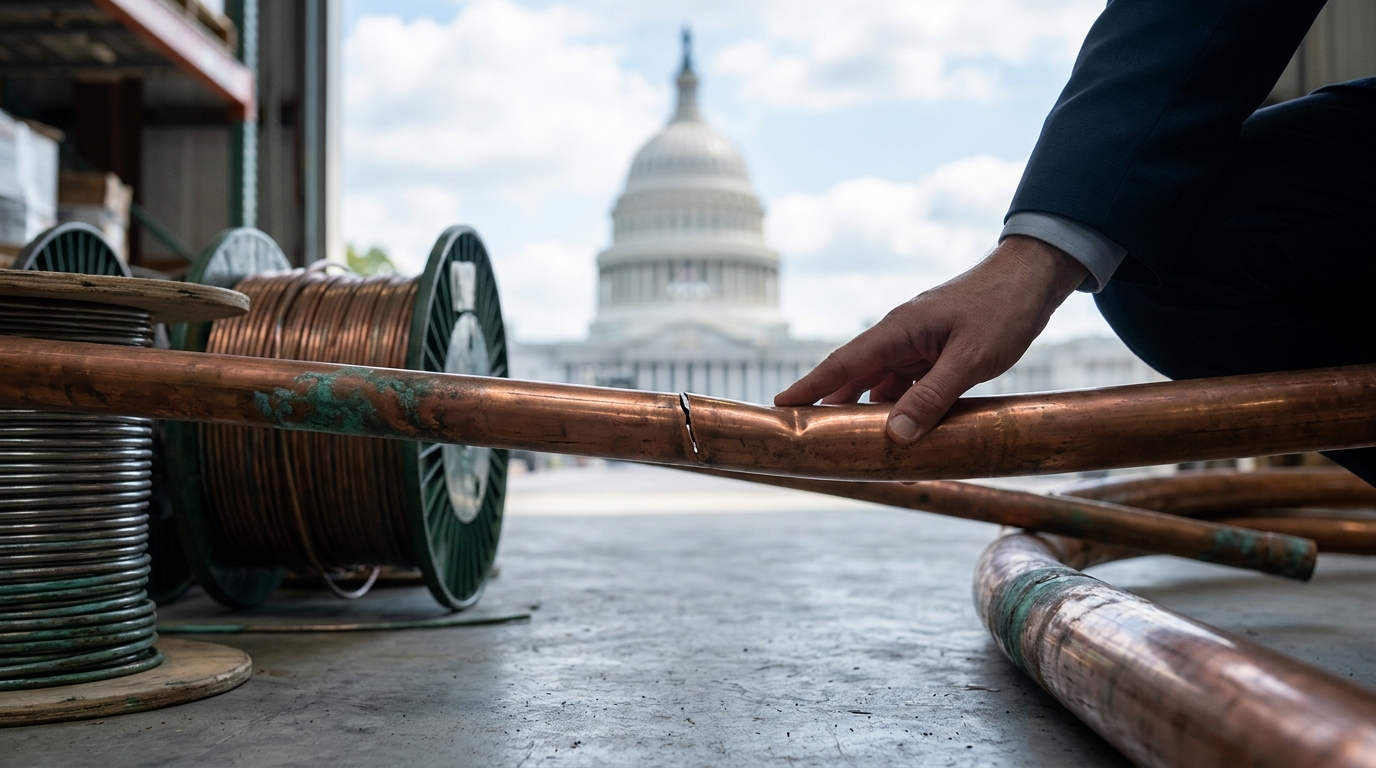
Copper gave traders the clearest read of the week: a metal that can set an all-time high and then shed nearly 4% of its value in the same session has a structural problem hiding inside a structural bull market. The question is how to position while Washington is still deciding which version of reality to announce.
What Actually Happened
Three-month copper on the London Metal Exchange touched a record $14,858.50 per tonne on September 10, taking its 2026 rise to about 19% and its one-year gain to roughly 48%. Hours later, copper futures fell more than 4% after Reuters reported that the White House had not decided whether to extend tariffs to refined copper. Reuters reported the administration is weighing concerns that higher copper prices could raise manufacturing costs ahead of the November midterm elections.
Copper recovered to about $6.47 per pound on September 11 but remains down nearly 2% over the past month, even as it sits 41% above where it traded a year ago. The rally that built through summer was real. So was Thursday’s reversal.
Two Rallies Inside One Price
That sudden reversal is not a side story. It reveals the main point of this rally: copper has a genuine long-term supply problem, but its latest price spike also contains a large and fragile tariff premium.
The underlying fundamentals are not in dispute. Mined supply has weakened, with major producers including Codelco and Freeport-McMoRan posting double-digit declines, shortly after International Copper Study Group data showed a 1.1% drop in global output during the first half of 2026. On the demand side, copper is becoming an essential part of the AI and EV trade, necessary for wiring, data centers, next-generation power transmission, renewable energy, and power grids. Those drivers do not disappear because a Reuters dispatch lands on a Thursday morning.
What does disappear is the tariff premium. Expectations that the U.S. would extend its copper trade actions to refined copper have helped pull metal into North America and widen regional price spreads. Strip that expectation out and copper’s price is still historically elevated, but not at $14,858.
The Miners: Punished, Not Broken
Shares of Freeport-McMoRan slid early Thursday as the record rally in copper reversed inside a single session, with FCX down 8% to $70.43 after reports cast doubt on the refined-copper tariffs that had powered the metal to fresh highs. Southern Copper fell 7% to $195.66, and Teck Resources dropped 7% to $65.08.
Freeport-McMoRan is the largest U.S.-based copper producer and the most copper-levered name in the peer set, so it moves furthest in both directions when the metal moves. That is why FCX climbed sharply into Tuesday’s records and gave the most back on Thursday. The operational context matters too: the name still carries an overhang from the September 2025 external mud rush incident at its Indonesia unit, with production rates expected to run well below full capacity through the second half of 2026.
Despite the slide, FCX, SCCO, and TECK remain up 40%, 42%, and 36% year to date, so the trend has not broken. That matters. Three stocks absorbing a combined 7-8% single-session loss and still holding those year-to-date gains signals underlying institutional conviction.
Trader’s Action Plan
The trade here is asymmetric and binary in the near term. If Washington signals it will proceed with tariffs on refined imports, the metal and the miners gap higher fast. If the administration formally walks away, expect another leg down that tests the summer breakout levels.
The structural investment thesis for copper, driven by electrification, AI infrastructure buildout, and the green energy transition, remains intact. Near-term price action, however, will be driven by tariff policy signals from Washington and the pace at which industrial demand absorbs a market that had, until September 8, been reaching unprecedented levels.
For traders with a multi-week horizon, the pullback in FCX and SCCO is the more controlled entry the summer’s vertical move never offered. The risk is clear: hold nothing sized for a tariff-in outcome going into a weekend where Washington could go either direction. Watch the LME three-month curve and the CME-LME spread for the first signal that physical flows are reacting to the decision before any official announcement arrives.