
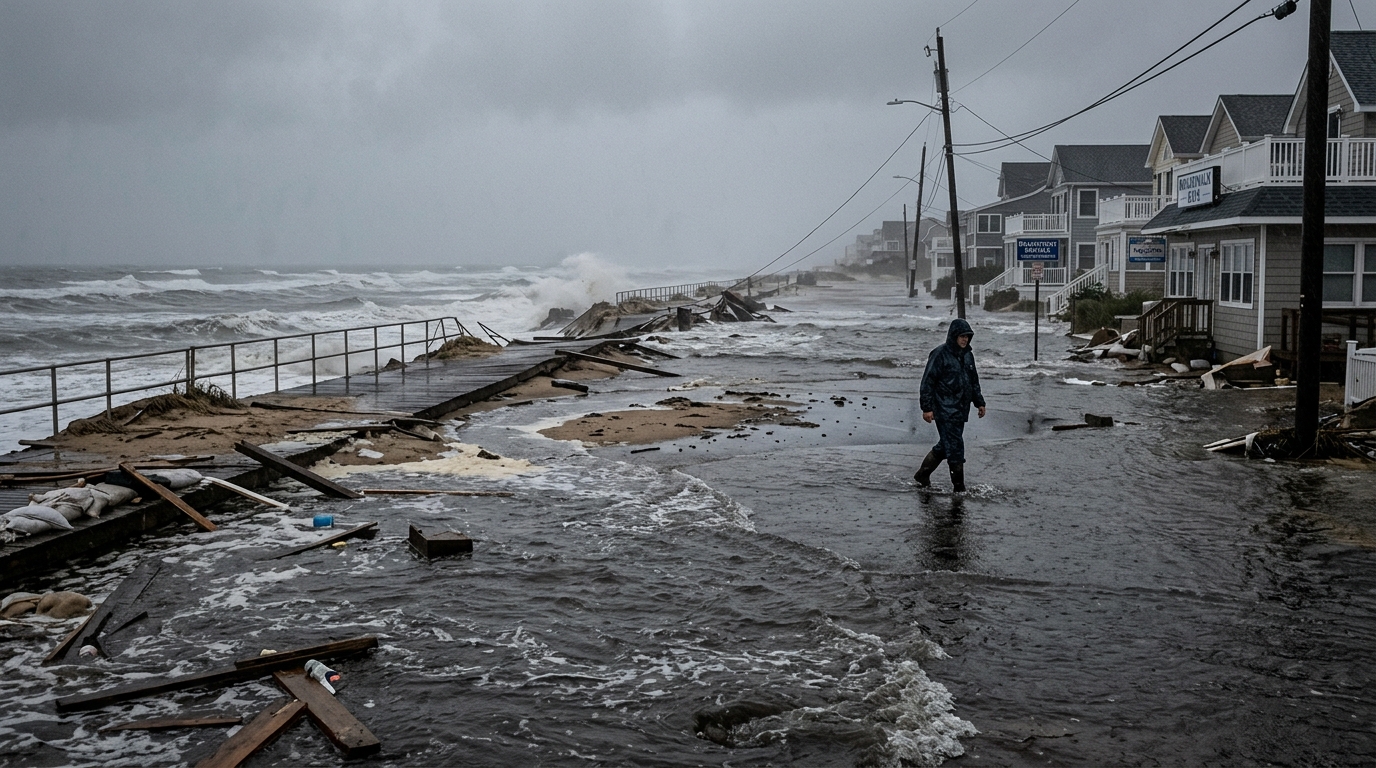
The storm is still there this morning. A rare September nor’easter has been grinding along the East Coast since Friday, flooding streets in New Jersey and New York, eroding beaches along the Jersey Shore, and leaving more than 80,000 customers without power across five Northeast states. Forecasters expect the system to finally ease its grip today before moving off into the Atlantic.
Only about 1% of nor’easters form in September. Trees still fully leafed made the wind more destructive, increasing downed limbs and property damage well beyond what a winter storm of equivalent strength would cause. Local leaders in New Jersey compared the flooding to Sandy. That is not hyperbole for insurance purposes. It is a claims signal.
Why This Stock Now
When a major catastrophe event hits the Northeast in late September, one name absorbs more of the insured damage than any other publicly traded property and casualty carrier: The Travelers Companies (TRV). Its commercial and personal lines are concentrated in the mid-Atlantic and Northeast, precisely the geography that spent the weekend underwater. And its Q3 earnings call is scheduled for October 16, 2026. Whatever this storm costs, it will be on the balance sheet when Alan Schnitzer opens that call.
The stock was trading near $363 before the weekend, down roughly 9% from its 52-week high of $398.70 reached on July 28. That pullback, modest as it is, has reignited a question that most analysts have been sitting on for months: is Travelers cheap enough to buy into a known cat event?
The Business
Travelers operates through three segments: Business Insurance, Bond and Specialty Insurance, and Personal Insurance. The commercial book is the engine, serving midsize businesses across liability, property, and workers’ compensation lines. The personal book, covering homeowners and auto, posted a combined ratio of 79.5% in Q2. That is a number most insurers would display in their lobby.
The underwriting machine has been firing at high efficiency. In Q2 2026, Travelers reported net income of $2.21 billion, up 46% year over year, with core earnings per share of $10.04. The consolidated combined ratio improved to 83.6%, catastrophe losses fell to $518 million from $927 million a year earlier, and after-tax net investment income rose 14% to $883 million. The company returned about $1.58 billion to shareholders in the quarter, including $1.31 billion in share buybacks.
Why Wall Street Is Paying Attention
The nor’easter lands at an awkward moment for Travelers and for the broader property and casualty sector. Swiss Re Institute estimated first-half 2026 global insured natural catastrophe losses at $42 billion, with high-frequency perils driving much of the damage. Allstate disclosed August catastrophe losses of $748 million across 21 events, bringing its July-August total to $1.43 billion. The industry had been enjoying a relatively light catastrophe year through midyear. That cushion is now thinner.
For Travelers specifically, Wall Street had already dialed back Q3 expectations sharply from the blowout Q2. The current consensus EPS estimate for Q3 is $6.84, a 32% sequential decline from Q2’s $10.04. That reset already bakes in a more normalized catastrophe quarter. The question is how much this nor’easter adds to the bill on top of whatever August cost the company.
Morningstar rates TRV as trading at a premium to fair value. Evercore ISI has a $342 price target with an In Line rating. Mizuho sits at $348 with a Hold. The majority of the 32 analysts covering the stock are in the Hold camp. None of these are aggressive sell signals, but they signal that Travelers’ strong execution is already widely understood and priced in at these levels.
What’s Driving the Opportunity
The contrarian argument is straightforward. Travelers has beaten estimates for four consecutive quarters. Its underlying combined ratio has been improving for two years. Net investment income is growing as higher yields compound into a fixed-income portfolio that benefits directly from the current rate environment. The stock’s low beta of roughly 0.05 means it barely moves with the broader market, providing a degree of portfolio stability that few large-cap financials offer.
The nor’easter, paradoxically, could create the entry point that cautious buyers have been waiting for. If Q3 results disappoint due to elevated catastrophe losses, and if the stock sells off another 5% to 8% ahead of or immediately after the October 16 report, Travelers would be trading meaningfully below where analysts already consider it fully valued. The business quality does not change with one storm.
What Could Go Wrong
The risk is timing. Buying before October 16 means buying before the full Q3 damage is disclosed. Allstate’s heavy August losses suggest the industry is not having a quiet third quarter, and this nor’easter will not improve that picture. Travelers has significant exposure to natural catastrophes and weather-related losses, which Morningstar identifies as a source of material earnings volatility. The storm may prove more expensive than early estimates suggest; coastal flooding damage is notoriously difficult to assess until water recedes and adjusters reach affected properties.
There is also a valuation ceiling worth acknowledging. The stock’s year-to-date gain of roughly 27% entering this week means a lot of the good news from the first half of 2026 is already in the price. Analysts note that softening commercial property and casualty pricing could pressure margins into 2027, even if Travelers executes well.
The Bottom Line
Travelers is the highest-quality name in the property and casualty space, and this nor’easter has put it in focus for the right reasons. The storm adds real cost to Q3, the earnings date is close, and the stock has already pulled back from its highs. That combination is not a buy signal today. It is a watch signal. Investors willing to absorb a potentially difficult October 16 report, and who believe Travelers will reset its catastrophe estimate conservatively as it has in the past, are looking at a company that has earned its reputation for resilience. The best entry, if history holds, arrives after the damage is fully disclosed, not before.