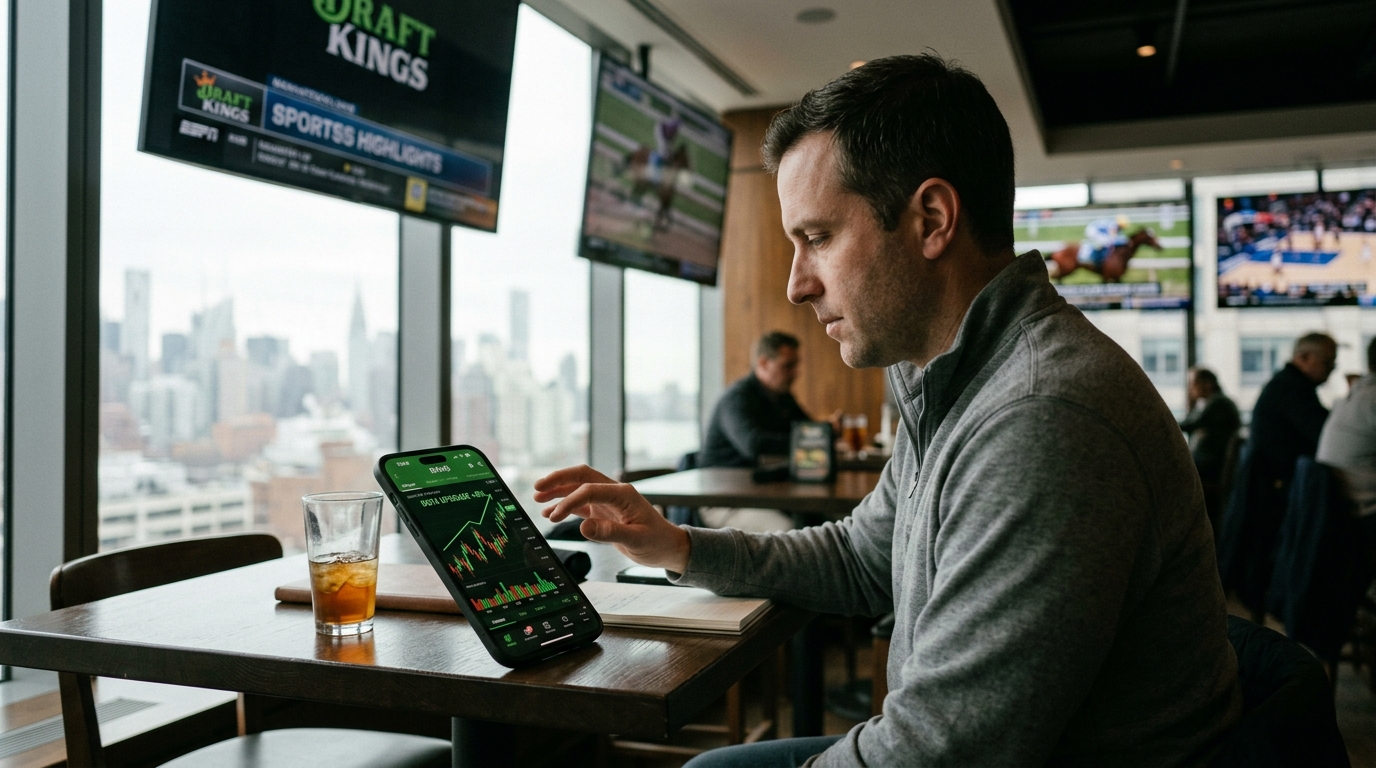
Monday’s Bank of America upgrade handed DraftKings (DKNG) an 8% single-session move on top of a stock that had already shed nearly half its value over the prior year. That kind of gap-and-go rewards the people who held through the pain. For everyone else, the question is whether this is a turn or a dead-cat bounce in a stock whose core controversy is still very much open.
Why the Upgrade Landed Hard
Bank of America upgraded DraftKings to Buy from Neutral and kept its $27 price target, citing improving prospects for prediction markets and a more attractive risk-reward after the stock’s 47% decline over the past year. The bank’s bull case rests on a specific revenue build: prediction markets could generate about $400 million in fees for DraftKings in 2027, with a further $200 million to $400 million potentially coming from market-making activities. That is the $800 million ceiling the market is now pricing in. The $27 price target is based on a 12-times multiple of 2027 enterprise value to adjusted EBITDA.
BofA also argued that traditional sportsbooks have grown faster than prediction markets since the start of the football season, reducing concerns that the newer products will materially weaken DraftKings’ core business. Crucially, the analyst also said DraftKings would benefit if prediction markets were ultimately restricted, because removing regulatory uncertainty would eliminate an overhang on the company’s valuation. Heads you win, tails you also win, that framing is what triggered the re-rating.
The Argument That Is Not Settled
The problem is that BofA’s case rests on a debate the data has not resolved. DraftKings shares fell 7.6% on September 17, 2026, after data showed Kalshi captured 76% of NFL Week One prediction market volume, while DraftKings’ own exchange, DKeX, took approximately 3%. The company’s response: DraftKings says it is seeing “no discernible impact” from prediction markets on its traditional sportsbook business.
DraftKings sells sports event contracts in the 18 states where it has no online sportsbook, and in none of the 27 where it does, a structural design that lets it tell investors the products barely touch. Whether that geographic wall holds legally is a separate question still winding toward resolution. BofA noted concerns peaked during the 2026 FIFA World Cup, when trading volumes on platforms such as Kalshi and Polymarket surged. NFL Week 1 data brought those fears back. One strong upgrade note does not settle them permanently.
Meanwhile, DraftKings has pointed to continued acceleration in its event contracts business, including a recent Sunday it described as record trading volume. The direction is clear. Whether that volume pulls from sportsbook handle or expands the addressable pool is the exact question Q3 earnings must answer.
Options Perspective: Own the Catalyst, Not the Pop
DraftKings’ next earnings date is estimated around November 5, 2026. That is the event that will either validate the BofA thesis or reignite the cannibalization debate. After August earnings, DKNG shares gained 8.4% the following day, then gave most of it back over the subsequent weeks. The pattern is familiar: DKNG moves big off earnings, then drifts on the underlying uncertainty.
With the stock now trading near $19.80 after the upgrade pop, chasing here means buying into a one-day catalyst already spent. A bull call spread targeting the November earnings window structures the trade around the event that actually tests the thesis. BofA raised its 2027 adjusted EBITDA estimate to $1.15 billion from $1.05 billion, reflecting stronger core trends and expected contributions from market-making. If Q3 results confirm that trajectory, the November reaction could be as sharp as August’s. A debit spread defines the risk to the premium paid while keeping full participation if the move materializes.
Risk Management
What invalidates the thesis: Q3 sportsbook handle shows measurable decline against rising prediction market volume, or regulatory action targets DraftKings specifically rather than pure-play platforms like Kalshi. BofA also flagged that stronger cost discipline will be needed to support higher margins beyond 2027. The bank also cut its 2026 adjusted EBITDA forecast to $500 million from $625 million because of higher investment in prediction markets. The near-term earnings power is already impaired. Position size accordingly.
The Beast Verdict
DraftKings is not a clean story. It is a company straddling two business models in a regulatory grey zone, with a stock that has been punished for exactly that ambiguity. BofA’s upgrade makes a coherent case, but the cannibalization question will not be answered until November earnings land. That is the real catalyst. A defined-risk call structure into that date keeps the upside from a bullish Q3 report while capping the loss to the debit if the data turns the other way. Own the uncertainty. Do not chase the pop.