
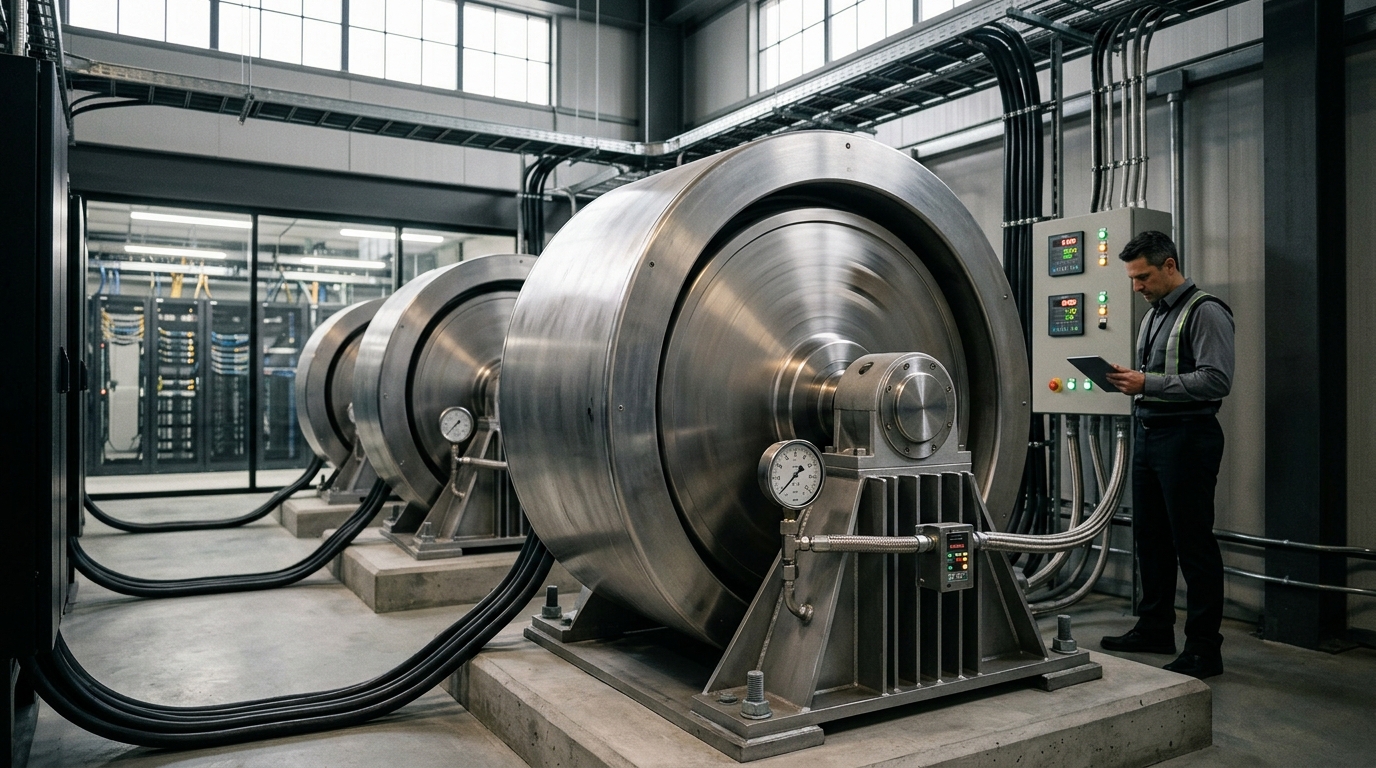
The problem is not a power outage. Outages are almost manageable: generators start, transfer switches close, the critical load survives. The problem is the millisecond-scale voltage sag that no one sees coming and that no diesel engine can counter. That is the gap where AI infrastructure dies, and it is the gap that flywheel vendors are now being paid to own.
AI data center developers and operators are being forced to confront not only how much power their facilities draw, but how quickly that demand can surge and collapse. In technical briefings summarized by Uptime Institute, even moderately sized AI clusters can drive millisecond-speed power changes, with worst-case load swings reaching 150%.
The modern grid was designed for predictability. Morning and evening peaks are forecastable, giving grid operators time to bring generation online. Some turbines can synchronize within minutes, while others require 30 or more. That cadence is not compatible with AI workloads, which can spike and subside in seconds or even milliseconds.
Standard battery UPS systems absorb the first hit, but repeated sub-second excursions can accelerate wear in chemical cells. That is where kinetic storage enters the conversation with a durable structural argument.
The Physics, Briefly
A flywheel UPS floats a massive steel rotor on bearings inside a vacuum chamber. When grid power drops, the spinning rotor acts as a generator, instantly releasing kinetic energy to support the IT load while diesel generators crank up. Active Power, for example, describes its CleanSource flywheel systems as vacuum-assisted and designed for long operating life, with an estimated 20-year design life.
One caution: not every flywheel UPS spins at extreme RPM. Active Power’s CleanSource designs are commonly described as operating in the thousands of RPM range, not 36,000 RPM, and rotor weights vary by model.
As Beacon Power’s project development director Rex Roehl put it: “There is the risk of AI ramping up where the workloads can go up and down in tens of megawatts within milliseconds, which is an incredibly fast ramp rate that reciprocating engines and turbines aren’t able to deal with directly.” Flywheels respond before any control signal can travel to a generator. That is not a feature. It is a physics constraint working in the operator’s favor.
Where the Market Stands
The global flywheel energy storage systems market was valued at $527.8 million in 2025 and is projected to grow from $580.8 million in 2026 to $1.15 billion by 2033, expanding at a CAGR of 10.3%, according to Grand View Research. The data center application segment is forecast to grow at about a 7% CAGR over the same period in that report.
The leading commercial hardware remains Active Power’s CleanSource line, deployed across hyperscale and colocation sites globally. Active Power says it operates as part of the Piller Power Systems group, which acquired Active Power in November 2016.
On the emerging side, Qnetic is building the Q500, a roughly 20-foot-tall kinetic battery targeting grid and AI data center customers. Qnetic has publicly described non-binding letters of intent totaling $110 million or more. More recently, Qnetic has also described $150 million in non-binding letters of intent signed by nine customers. The design is positioned as eliminating thermal runaway risk, and the company has said its levelized cost of storage can be about half that of lithium-ion in some cases.
Those letters of intent are non-binding, and for a hardware company, Qnetic’s financing to date is relatively limited at $9.2 million raised since inception, according to the company’s own investor materials. Hardware timelines almost always slip. The technology is sound; the commercial execution is the open question.
The Real Competitive Frame
This is not a story about flywheels replacing lithium-ion across data center infrastructure. The landscape is shifting toward integrated energy resilience ecosystems where flywheels perform targeted, high-value grid and facility functions. Kinetic systems own the millisecond-to-30-second window. Batteries own the minutes. Generators own the hours. Operators who wire all three correctly stop caring which technology gets credit.
Uptime Institute’s reporting on AI power behavior is the cleanest statement of the operational pressure: sudden, millisecond-speed load changes can stress electrical infrastructure, and worst-case swings can reach 150%. Flywheel systems can deliver instant power, endure frequent cycling, and reduce some safety and maintenance burdens associated with large chemical battery banks. That layered logic is why the underground vault is not an engineering curiosity. It is where the uptime guarantee actually lives.
Action Checklist
- Identify which data center operators in your coverage universe are upgrading power infrastructure ahead of next rack density expansion.
- Track Active Power (Piller) deployment cadence as the current market benchmark for steel-rotor flywheel UPS systems.
- Watch Qnetic’s 2027 pilot results: independent EPRI validation and National Lab of the Rockies involvement will determine whether LOIs convert to binding contracts.
- Monitor grid frequency regulation procurement trends at ERCOT, PJM, and MISO as AI load growth pressures ancillary service markets where flywheel response time is a structural advantage.