
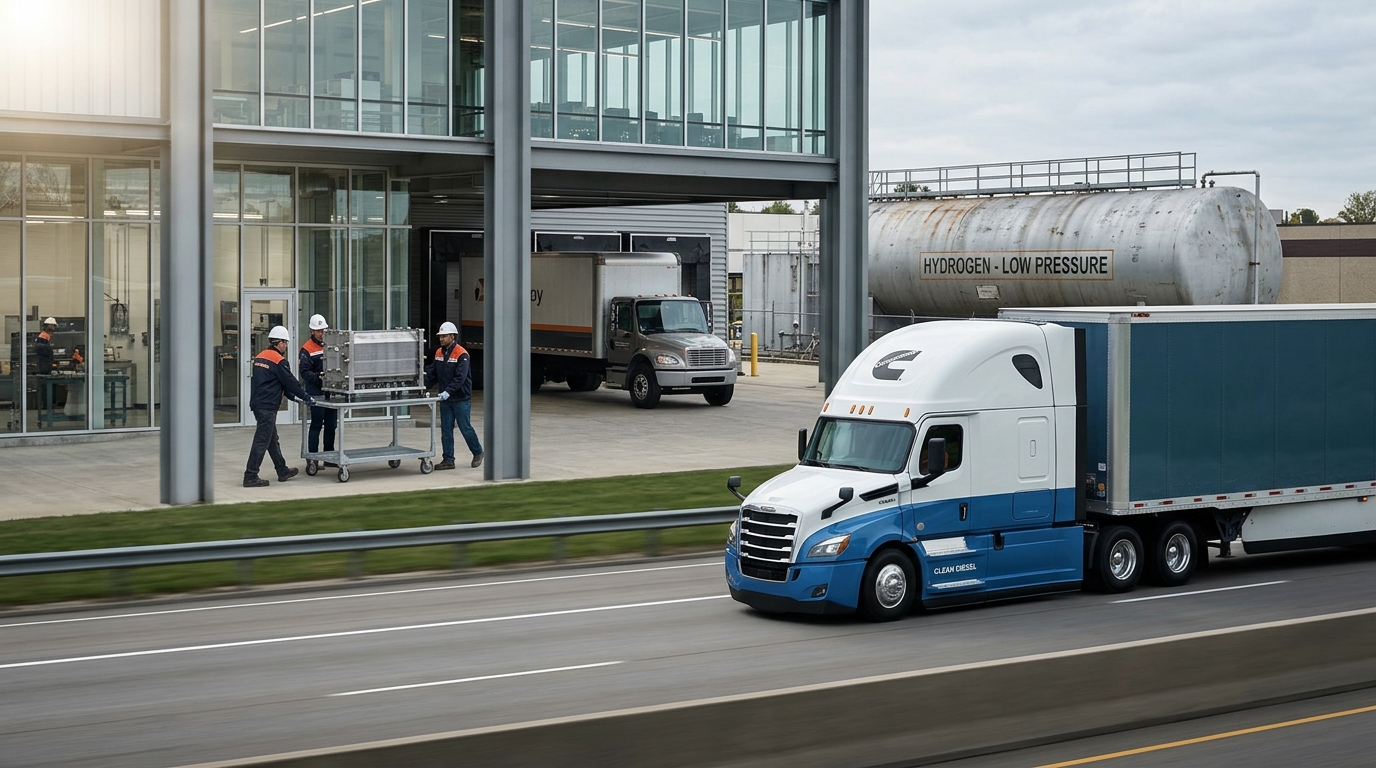
On March 31, 2026, Cummins quietly completed one of the more revealing moves in the clean-energy powertrain space: it sold its low-pressure fuel cell business to a customer, cancelled future commitments and resolved certain claims, resulting in a net payment by Cummins of $175 million. The total damage to Q1 earnings was a $199 million charge, or $1.44 per diluted share. Most headlines called it a retreat. The more useful read is a triage.
What Cummins kept matters more than what it sold. The divested unit served rail customers and operated at low pressure, a niche that never translated to the economics of long-haul freight. What remained inside Accelera, the company’s zero-emission segment, is the high-pressure fuel cell stack technology capable of powering Class 8 trucks across routes that battery-electric vehicles cannot touch. Powered by a Cummins Accelera fuel cell engine and a 250-kilowatt traction motor, a demonstration truck carried 175 kilograms of hydrogen and completed 1,806 miles, emitting zero pounds of carbon dioxide, compared with 664 pounds a standard diesel would have produced over the same distance. That Guinness World Record run was attempted on October 25, 2024, and highlighted publicly by the Department of Energy in December 2024, with federal funding support. It is not a concept. It is a proven duty cycle.
The commercial logic behind hydrogen in heavy freight is simple and structural. A fuel cell electric vehicle replaces the diesel engine with a fuel cell and adds an electric motor, often delivering longer range and faster refueling than battery-electric options on some long-haul duty cycles, albeit in a market where battery ranges are improving. For long-haul routes exceeding 450 miles daily, hydrogen starts to compete, but only with hydrogen prices low enough to support total-cost parity. The DOE’s Hydrogen Shot target is $1 per kilogram by 2031, and DOE program targets include $2 per kilogram by 2026 and $7 per kilogram dispensed for heavy-duty vehicles by 2028.
This is precisely why Cummins’ operational performance right now deserves more attention than its hydrogen headline. The company posted record second-quarter revenues of $9.5 billion, with GAAP net income of $932 million and EBITDA at 17.5% of sales. Management raised its 2026 revenue outlook to up 10% to 13% and EBITDA margin to 18.0% to 18.5%. The diesel engine franchise is generating the cash that funds whatever hydrogen strategy survives internal scrutiny.
What Could Go Wrong
Despite subsidies, the initial purchase price of a fuel cell heavy-duty truck can be materially higher than a comparable diesel unit, constraining adoption among cost-sensitive carriers. Infrastructure remains the deeper problem. Hydrogen dispensing networks outside California are thin, and fleet operators won’t commit to a powertrain their drivers can’t refuel on I-80. In its first-quarter 2026 release, CEO Jennifer Rumsey cited lower hydrogen adoption expectations when explaining the low-pressure fuel cell sale. That candor is not reassuring for anyone betting on a near-term volume ramp.
The Bottom Line
CMI recently traded in the low-$500s. Q3 earnings are due November 5, with the company scheduling its earnings conference call for 10:00 a.m. ET. The stock is not priced for a hydrogen breakout. It is priced as a diesel powertrain company with a side bet on zero-emission freight. The argument for owning it today is that the side bet costs shareholders nothing while the core business keeps compounding, and the fuel cell technology that survived the triage is the one actually capable of replacing diesel at scale. That asymmetry is worth watching closely on November 5.