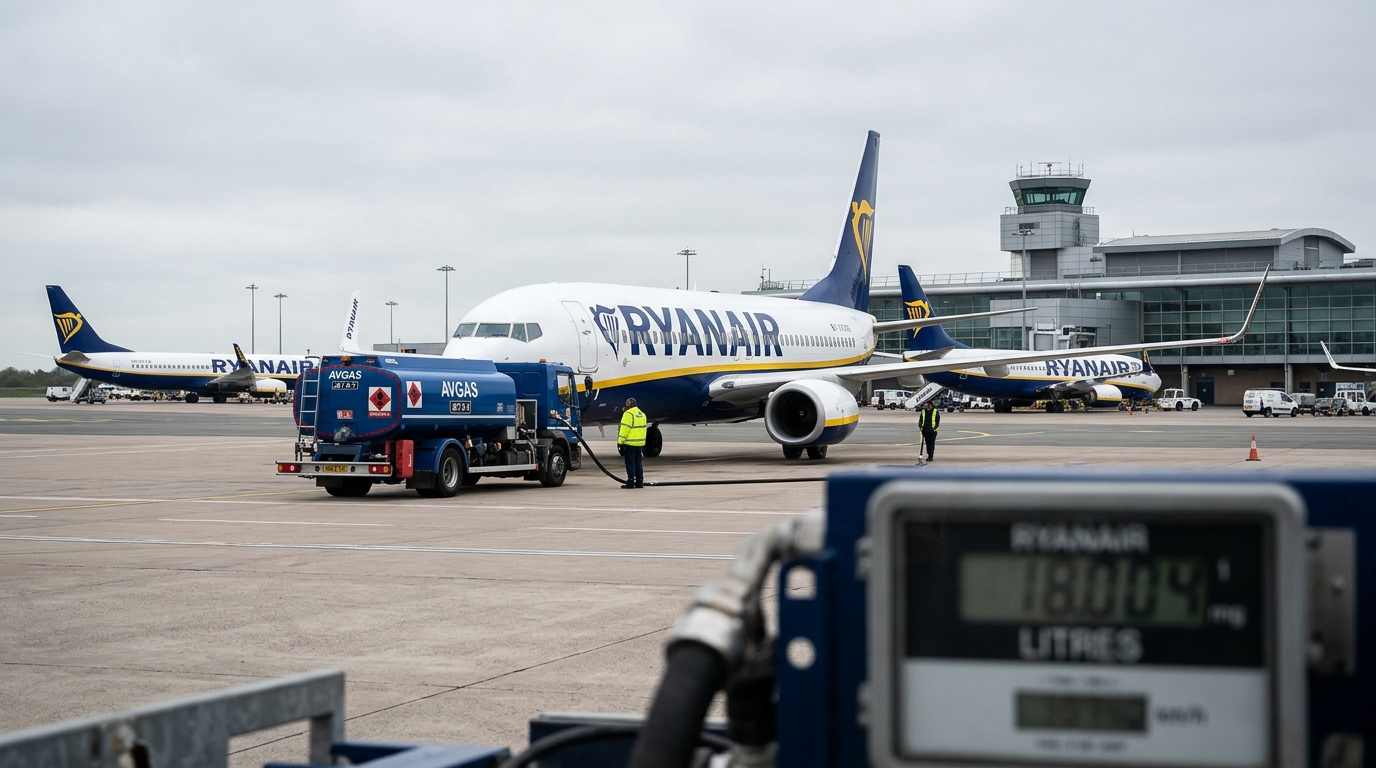
Ryanair has spent the past year as the envy of European aviation: 80% of its jet fuel contracted at about $67 a barrel while spot prices surged around it. That advantage runs only through March 2027. What comes next is the story investors need to understand today.
H1 profit fell 15% to €2.15 billion from €2.54 billion a year earlier, as the price of the 20% of its jet fuel that is not hedged doubled and average fares fell 4%. Even partially exposed to the market, the numbers deteriorated sharply. Operating costs rose 10% to €7.69 billion as the price of unhedged fuel doubled, with fuel and oil costs alone up 15% to €3.40 billion. Revenue still grew 3%, so this is a cost problem, not a demand problem. But the 15% profit drop came while four-fifths of the fuel book was insulated.
Why April 2027 Is the Real Test
The company estimated that its FY28 fuel bill could increase by approximately €2 billion based on current forward prices, with only 25% of fuel currently hedged at about $95 per barrel. To put that in context: the hedges that shielded this half-year’s results cost about $67 a barrel. That gap is where the €2 billion comes from.
CEO Michael O’Leary described it plainly as “a very significant cost cliff we’re all facing next year,” adding that he expects European airfares to rise by 10%, maybe even 20%. He was equally candid about whether fares will cover the damage. Ryanair expects higher fares and cuts in competitors’ capacity to fall short of fully covering its extra fuel costs.
The Competitive Lens
Ryanair entered this fuel shock with a deeper hedge book than many rivals. That gap has been a genuine earnings advantage. The problem is that it narrows considerably from April onward, when every carrier faces a version of the same fuel bill. Ryanair’s scale and lower unit costs still matter, but the moat that hedging provided for FY27 will not repeat itself.
Ryanair said it does not expect airfares to fully offset the estimated €2 billion fuel increase, and has raised the possibility of cost actions that include measures like pay restraint and more use of AI to drive efficiencies. Management also pointed to the Boeing 737 MAX-10 as a longer-term cost lever, a fuel-efficient aircraft that would reduce burn per seat once deliveries begin.
Bull vs. Bear
The bull case rests on three pillars. First, Ryanair still carries the lowest unit costs of any major European carrier, which means even a painful fuel year hurts it less in absolute margin terms than it hurts Lufthansa or IAG. Second, first-half passenger traffic increased 6% to 125.8 million, with the load factor holding at 95%, confirming that demand is not the constraint. Third, if O’Leary is right that competitors face capacity cuts and higher fares, Ryanair picks up share while charging more.
The bear case is straightforward: with only 25% of FY28 fuel covered at about $95 a barrel, the airline is largely unhedged into the summer of 2027. If fuel stays elevated and fare increases disappoint, the €2 billion estimate looks conservative rather than cautious. Management declined to give full-year FY27 profit guidance, citing too many variables in the second half.
What to Watch
Three signals will tell investors whether the thesis is playing out. Watch Ryanair’s FY28 hedging disclosures each quarter: any material increase above 25% coverage at tolerable prices would reduce the exposure significantly. Watch European short-haul fares for the spring 2027 booking cycle, which will show whether O’Leary’s 10–20% fare increase prediction has any basis in real demand. And watch competitors: if smaller carriers fail or cut routes, Ryanair gains pricing power precisely when it needs it most.
The hedge roll-off is not a surprise. Ryanair has flagged it for months. What today’s H1 results confirmed is how quickly costs accelerate even before the main exposure arrives. Investors have until April to decide whether the lowest-cost carrier in Europe can absorb a €2 billion fuel shock that even its own CEO says fares will not fully cover.