The shrink number is enormous. U.S. retailers lost roughly $90 billion to inventory shrinkage in 2025, of which around $66 billion was preventable, according to Appriss Retail’s 2026 Total Retail Loss Benchmark Report. That gap between what is happening and what can be stopped is exactly what is funding a wave of multi-million-dollar enterprise contracts for computer vision platforms. The investment angle, though, is not quite the one being marketed.
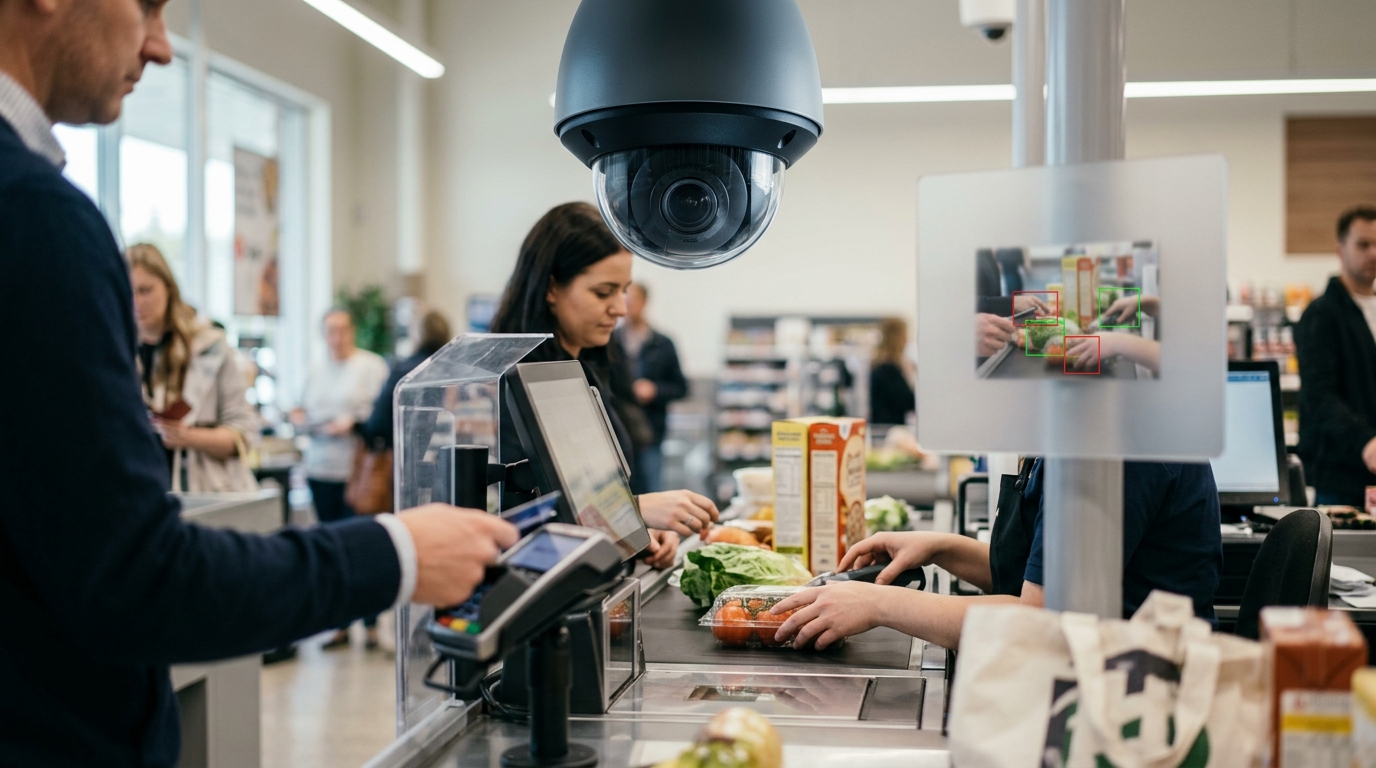
IDC predicts that by 2028, half of large retailers will expand computer vision for store monitoring, reducing shrinkage by 40%. The computer vision AI in retail market was estimated at about $1.7 billion in 2024 and is projected to reach about $12.6 billion by 2033, implying a compound annual growth rate near 25%, according to Grand View Research. Most of that growth runs through a handful of enterprise vendors: Everseen is one of the best-known names in self-checkout monitoring, while Sensormatic Solutions, a Johnson Controls portfolio brand, bundles EAS hardware with its Sensormatic IQ analytics platform.
The commercial logic is compelling at scale. A September 2024 Forrester Total Economic Impact study commissioned by Everseen models its Evercheck fees at roughly $936 per lane per year for a composite enterprise organization, alongside substantial upfront hardware and implementation costs. The company says it recovers over $500 million in sales annually across 10,000+ stores worldwide and works with 11 of the world’s top 20 grocery retailers. At those volumes, contracts can aggregate quickly into nine-figure revenue visibility for the vendors winning them.
Here is what the contract announcements omit. The architecture now being sold is not purely behavioral anomaly detection. The compliance line falls where a system captures biometric data such as a scan of face geometry that can be used to identify a person. Systems that detect events without capturing biometric identifiers can materially reduce biometric-privacy exposure relative to deployments that collect biometric identifiers.
Illinois BIPA is enforced by the people it protects. Anyone “aggrieved” by a violation can sue directly, and the statute allows liquidated damages of $1,000 for negligent violations and $5,000 for reckless or intentional violations, without requiring proof of actual harm. Illinois enacted amendments effective August 2, 2024, limiting recovery for repeated collection or disclosure of the same biometric identifier from the same person using the same method to a single violation per person, which reduced but did not eliminate the exposure. A national grocery chain deploying facial-template matching across thousands of locations is carrying a liability that does not appear on any vendor’s ROI slide.
The vendors best positioned to win contracts while reducing this exposure include Everseen for self-checkout loss, AiFi and Trigo for cashierless environments, and Nvidia Metropolis for custom enterprise builds. The ones threading the compliance needle are deploying behavioral anomaly models rather than biometric identifiers, because systems that detect events without capturing biometric identifiers can materially reduce biometric-privacy exposure relative to template-based identification. That architectural choice is becoming a procurement prerequisite, not an afterthought.
Investors watching this space should track which vendors can document a privacy-by-design architecture alongside their shrink-reduction claims. The contracts are real. So is the litigation docket waiting behind them.