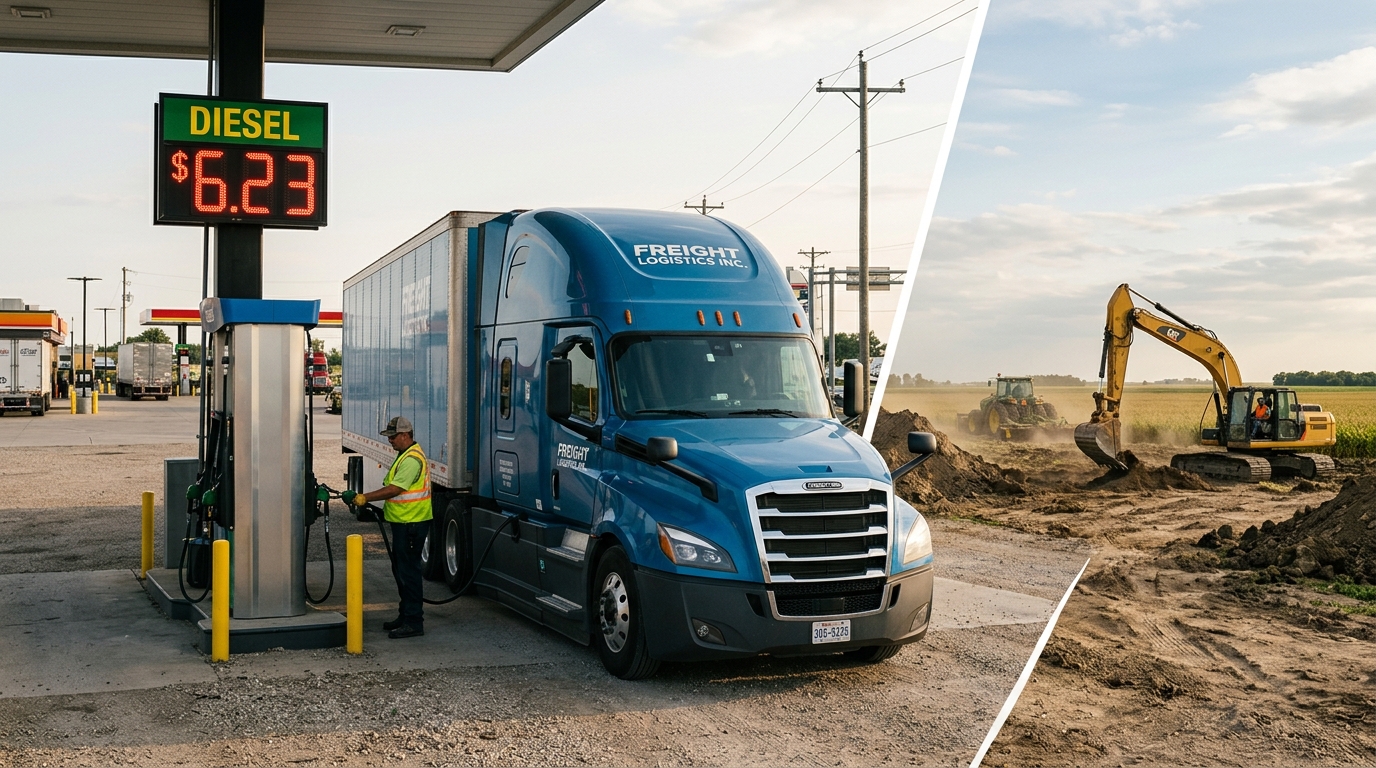
U.S. diesel prices rose above $6 a gallon for the first time ever earlier this month, raising the risk of further energy-driven inflation just ahead of peak demand season for the fuel. The national average hit $6.05 last Friday and has since moved higher; AAA’s most recently published national average for diesel was $6.23 a gallon on September 14, up from $5.85 a week earlier and about $3.71 this time last year. That roughly 60%-plus year-over-year surge is not a seasonal blip. It is a structural reshaping of cost structures across freight, agriculture, and construction, and the divide between who can recapture those costs and who absorbs them is the defining economic question of this moment.
The Bigger Trend
The problem is two-fold: oil futures have surged back above $100 a barrel as the U.S.-Iran war drags on, and there are not enough refineries operating to turn that crude into fuel, with facilities in multiple regions damaged by war. Ukraine’s strikes have disrupted Russia’s refining capacity as Moscow extends a ban on diesel exports to stabilize supplies. In August, Russia exported about 150,000 barrels of diesel per day, 81% below its five-year average as the export ban took effect, according to Vortexa.
Over the weekend, the political dimension shifted sharply. President Donald Trump urged Ukrainian President Volodymyr Zelenskyy to stop targeting Russian oil refineries, saying the attacks are “hurting the world” as fuel supply disruptions propel U.S. diesel prices to a record high. Trump later described a possible pause in attacks on energy targets as something the sides could pursue, but public reporting suggested it was not a firm, fully specified agreement. He did not specify when any arrangement would begin, how long it would remain in effect, or precisely which facilities would be covered. Past efforts to broker ceasefires covering energy targets have not yielded lasting results. Investors should price the diplomatic development as optionality, not certainty.
The Investment Case: Who Has the Surcharge and Who Does Not
The critical distinction for investors is not whether diesel stays at $6 or retreats to $5.50. It is which businesses carry a contractual mechanism to push the cost upstream and which ones eat it directly in their operating margins.
Large freight carriers sit on the protected side of that line. A fuel surcharge in trucking is an adjustable fee added to freight rates to offset diesel price volatility; shippers pay it and carriers receive it, keeping base rates stable while transparently covering fuel costs as prices rise and fall. As of late March 2026, major LTL carriers were already applying fuel surcharges above 40% of line-haul charges. Diesel has climbed meaningfully since then. The surcharge mechanism moves with it, automatically.
Agriculture has no equivalent lever. A study released in July by Democrats on the Joint Economic Committee found that U.S. farmers spent an additional $1.4 billion on diesel fuel during the 2025-2026 planting season compared with the previous year. The surge comes at a time when crop prices remain weak, farm income is under pressure, and producers are already facing higher fertilizer and chemical costs. There is no fuel surcharge index for a tractor. The farmer owns the full exposure.
Construction faces a similar bind. Heavy equipment runs on diesel with no pass-through formula. Fixed-price contracts signed months ago offer no relief at all.
On the downstream side, the refiners themselves sit in an enviable position as long as the current environment holds. Marathon Petroleum, Valero, and Phillips 66 generated $12.6 billion in combined profits during the second quarter of 2026, according to company filings and contemporaneous industry reporting. U.S. refiners have been major beneficiaries of the Iran war as international buyers have clamored for their supplies; Valero’s refining segment operating income rose sharply to $4.5 billion in the quarter.
Building Wealth Around This Idea
The refinery truce proposal is the central risk to that refiner thesis. One energy analyst noted that a stop in attacking refineries would give Russia time to repair and reduce the risk of further outages, but added that if Gulf channels are still blocked, it will not help much. A key bullish case for Marathon and Valero is that strong refining margins may persist even if the Iran war fades, because a wave of refinery closures and conversions in Europe and the United States has reduced global capacity, while fuel demand remains resilient. Even if crude prices normalize, limited refining capacity could continue to support margins.
For long-term investors, Valero (VLO), Marathon Petroleum (MPC), and Phillips 66 (PSX) represent real exposure to a structural product shortage that predates both wars and will outlast a diplomatic truce. Position sizing matters here: these names carry significant geopolitical event risk in both directions. A partial allocation within an energy sleeve, rather than a concentrated position, reflects that reality honestly.
Daily Wealth Takeaway
The most enduring insight from a $6 diesel world is that not all cost shocks are equal. Businesses with contractual pass-through mechanisms convert commodity volatility into a pricing feature rather than a margin threat. Those without one absorb it directly. When evaluating any business in an inflationary environment, the first question is not how exposed it is to rising input costs, but whether it has a legal and commercial mechanism to recover them. That single structural detail separates companies that grow through commodity shocks from those that are quietly hollowed out by them.