
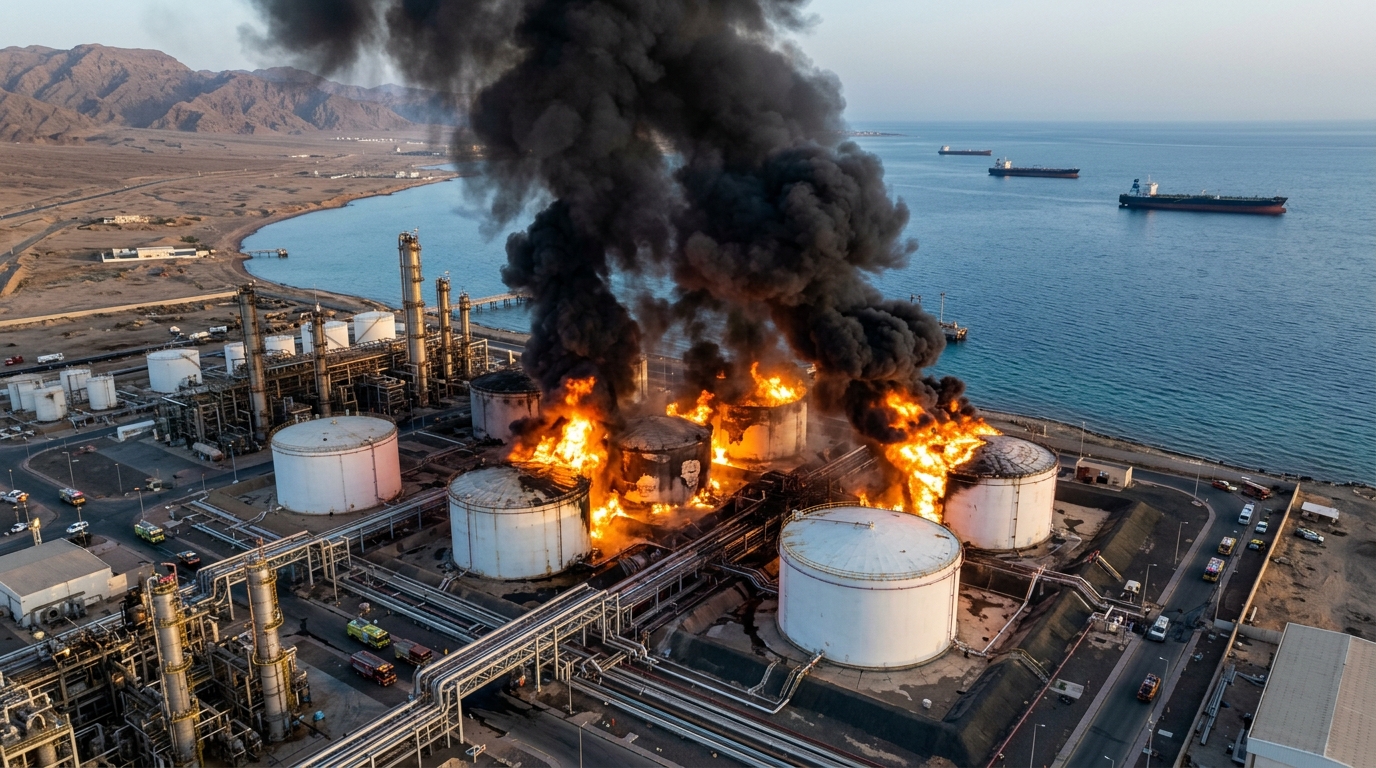
Overnight into Tuesday, Houthi ballistic missiles and drones struck oil facilities at Yanbu on Saudi Arabia’s Red Sea coast. Satellite imagery showed several giant oil storage tanks at the Al-Mu’ajiz terminal ablaze. Brent for November opened near $107 by early Tuesday morning in New York, with WTI near $94. A second straight up day.
The timing makes this strike more damaging than it looks in isolation. Drone attacks had already forced Saudi Arabia to shut its East-West Pipeline on September 11, halting crude loadings at Yanbu, the route the kingdom had been using to move roughly 4 million barrels per day around the Strait of Hormuz disruption. After its restart last week, the pipeline was operating well below normal throughput; reaching just 40% of capacity was expected to take a couple of days, while a full restart was expected to take weeks. Hitting the terminal that sits at the western end of that same pipe, at the very moment Saudi Arabia is rebuilding volume through it, collapses the workaround.
Saudi Arabia can still export some crude and products from remaining stocks and limited alternative routes, but the combination of a shut pipeline, damaged terminals and refineries, Houthi control of the southern Red Sea, and residual Hormuz risk has collapsed volumes far below normal. The Yanbu attack is not a new threat. It is pressure on the only exit still functioning.
Where the Trade Goes
Integrated majors are the reflexive bid. XOM and CVX carry upstream assets that benefit directly from higher crude prices, and the Q2 data already showed the leverage: ExxonMobil posted $14.5 billion in Q2 earnings despite a temporary loss of about 10% of its upstream production during Middle East disruptions. A sustained $107 Brent adds another layer to that.
Refiners face the opposite dynamic. Valero converts about 3 million barrels per day of crude and other feedstocks into gasoline, diesel, jet fuel, and petrochemicals, and its earnings are driven not by crude price but by the spread between crude input costs and refined product prices. That spread, the crack, surged to a record high of about $75 per barrel in September 2026 for a widely followed U.S. crack-spread benchmark. But a Yanbu disruption that tightens crude feedstock while product prices are already stretched creates compression risk for VLO and MPC, not expansion. When the input cost jumps faster than product prices, the spread narrows. Refiners running in the mid-90s percent utilization range have limited room to absorb that through volume.
Tankers are the cleanest long. When geopolitical tensions disrupt normal shipping routes, tankers must travel longer distances to deliver crude oil, more days at sea means higher utilization rates, and higher oil prices increase the value of cargo, supporting stronger charter rate negotiations. Frontline already posted record Q2 profit of $659 million, with average daily VLCC spot rates reaching $152,700. DHT locked in a three-year charter for the DHT Panther at $100,000 per day commencing October 2026, providing floor income regardless of near-term volatility. Both names move on exactly the kind of routing dislocation tonight’s strike creates.
Broader Market Read
Crude at $107 is a tax on growth. Treasury yields face competing pressure: the inflation bid pushes them higher, but a genuine supply shock that slows activity pulls the other way. Watch the 10-year real yield for direction. If it holds flat while nominals tick up, the market is pricing inflation, not recession. That read favors energy and commodities over tech and rate-sensitive sectors.
France committed troops and air defense systems to guard Yanbu before this strike. Saudi officials have also been meeting with counterparts from Pakistan and Turkiye, while French President Macron confirmed Paris is sending soldiers, radars, and defense systems to the Red Sea port. None of that deterred last night’s attack. Doubt persists over what action Turkiye and Pakistan might take under the mutual defence pact, which is yet to be officially triggered. The diplomatic calendar matters for timing the risk premium, but it is not the trade today.
Action Plan
Highest conviction: FRO and DHT long as the primary beneficiaries of route disruption. XOM and CVX as secondary crude-price leverage. Avoid adding to VLO and MPC until the feedstock picture clarifies. Watch Brent $110 as the next technical resistance; a close above that level extends the energy sector leadership into Wednesday. The key risk to the whole thesis is a credible Hormuz reopening deal, which would pull $10 to $15 out of Brent quickly. Until that headline lands, the direction is set.