
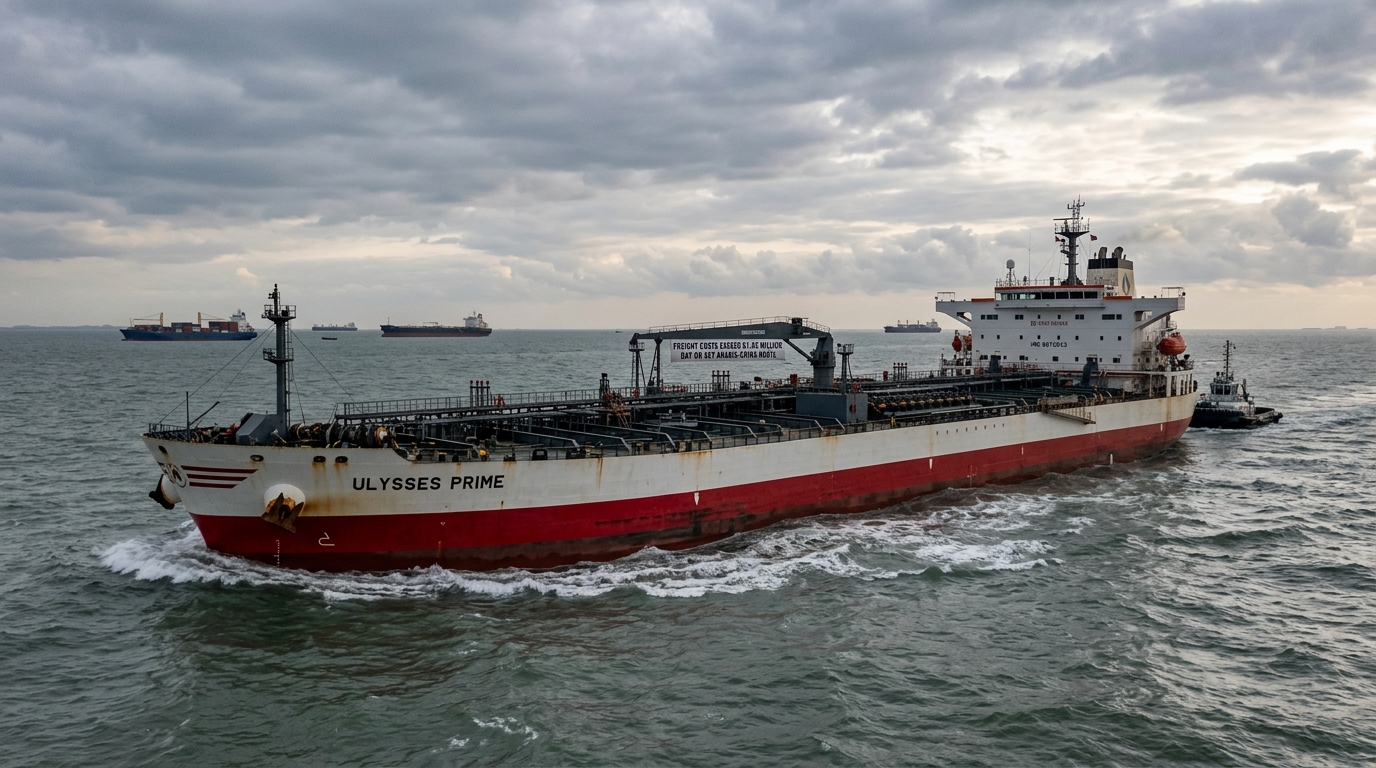
The question circulating among energy portfolio managers this week is not whether oil is expensive. It is whether the right way to own the energy trade right now is to own the ships rather than the crude.
The cost of hiring an oil tanker on the benchmark Saudi Arabia–China trade route has reached $1.33 million a day, the most expensive level on record. That number arrived this week and immediately reset the conversation. It followed an earlier milestone in mid-September, when the same benchmark crossed $1 million a day for the first time.
The structural reason behind this is not simply war risk. A mid-September attack disrupted Saudi export flows through the East-West pipeline and slowed shipments from Yanbu on the Red Sea, forcing Saudi Arabia to reroute more crude through the Strait of Hormuz and transfer it from smaller vessels to VLCCs near Oman. As of October 4, commercial transit through the strait reached just 5 percent of the pre-crisis vessel count, four ships against a typical 85 per day. Saudi Arabia is moving its oil through a bottleneck it does not control, and the ships that brave that route are capturing the spread.
The Bull Case
Record spot VLCC freight is forcing the market to re-learn an old lesson: when a chokepoint becomes a rationing mechanism, shipping can become the marginal price setter for delivered crude. As more barrels are pushed back through Hormuz and into Gulf of Oman ship-to-ship transfer chains, the constraint is not only vessel count. It is the on-the-water logistics that turn a cargo into a deliverable barrel.
Saudi crude exports through Hormuz were on track to average 3.6 million barrels per day in September, against roughly 900,000 barrels per day in August, and estimates indicate 36 to 40 additional VLCCs are needed to handle the higher flows.
VLCC earnings approached $200,000 a day during the final stages of the shipping supercycle in July 2008 and again during the floating storage boom in April 2020. Today’s Gulf numbers are around five times those previous peaks.
The Bear Case
The term market does not believe it lasts. One-year time charter rates are around the low-$200,000s per day and three-year rates are around $100,000 per day, versus recent TD3C spot earnings north of $1 million per day. If the Strait normalizes or ship-to-ship transfer inefficiencies unwind faster than expected, the descent could be sharper than priced.
The Evidence No One Is Disputing
Aramco’s pricing sheet is the clearest confirmation that freight has become a genuine cost that producers must absorb. Saudi Aramco cut the price of its flagship Arab Light crude for Asian buyers to its lowest discount in six years, pricing it at $5 a barrel below the Oman/Dubai benchmark for November, widening the discount from $2 in October. The cut was a major surprise: traders and refiners surveyed by Bloomberg expected the Saudi producer to raise the price by as much as $5 a barrel.
A VLCC traveling from the Gulf to China now costs around $1.2 million a day to hire, compared with levels that were closer to five figures a day before the Middle East conflict and its shipping disruptions. At current rates, shipping a Gulf cargo to Asia can add roughly $30 a barrel to the delivered cost. Brent was trading around $100 this week. The freight bill alone is roughly a quarter to nearly a third of the cargo’s market value.
What Investors Are Missing
The conversation has focused on how long rates stay elevated. The underappreciated angle is what this does to Aramco’s competitive position in Asia permanently, not just while the strait is disrupted. Every barrel Aramco prices at a $5 discount to move product through Oman ship-to-ship transfers is a barrel it is partly surrendering to competitors with shorter, cheaper routes. If the conflict extends through the fourth quarter, as the EIA’s October 6 forecast assumes, with Brent averaging $105 per barrel in Q4 2026 and Middle East shut-in production averaging 4.5 million barrels per day, Aramco’s market share in Asia could structurally shift toward Atlantic Basin and West African suppliers who face no comparable freight penalty.
Stocks to Watch
Frontline (FRO) is the scale play. Frontline reported record Q2 2026 net profit of $659.2 million, or $2.96 per share, beating estimates on revenue of about $753 million. Spot exposure means Q3 earnings, reported later this quarter, should reflect the full September rate surge.
DHT Holdings (DHT) is the balance sheet story. DHT’s VLCCs carry some of the lowest cash breakevens in the industry, and the company has run a relatively conservative capital structure for a tanker operator. DHT posted roughly 134 percent year-over-year revenue growth in Q1 2026.
International Seaways (INSW) offers the most diversified risk profile. The company declared a then-record quarterly dividend of $2.15 per share in early 2026, and with a spot cash breakeven below $15,000 per day, its cash flow generation potential remains substantial. Where FRO and DHT are pure VLCC bets, INSW’s mix of vessel classes provides partial insulation if the spot market corrects sharply.
Teekay Tankers (TNK) is the momentum name. The stock has traded roughly between $47 and just above $103 over the past year, and recent filings highlight a market environment shaped by the disruption around the Strait of Hormuz. The risk is that TNK has the thinnest liquidity of the group and the sharpest drawdowns when rates turn.
The core argument for owning tankers over barrels right now is straightforward: Aramco is discounting its product to compensate for a cost it cannot control. The ships carrying those barrels face no such obligation. They simply charge what the market will bear, and right now, the market will bear $1.33 million a day.