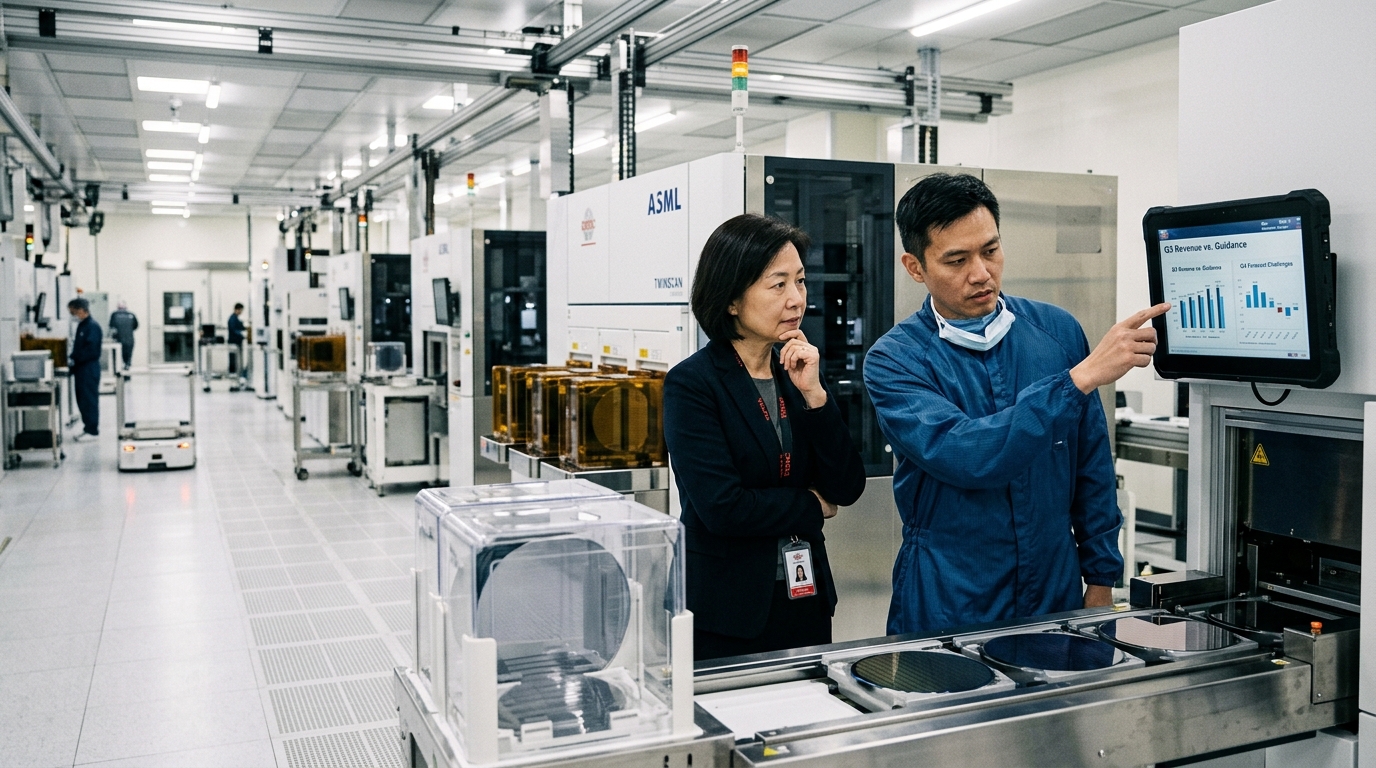
A sequential dip of 0.6% sounds like a problem. It isn’t. TSMC reported September 2026 consolidated revenue of NT$511.86 billion, down 0.6% month-over-month but up 54.6% year-over-year, and that completed a third quarter totaling about NT$1.49 trillion, up about 51% on the year and setting a new quarterly high, based on press reports and Bloomberg’s calculations. The real story is what that quarterly number means against the bar management set for itself.
At approximately $46.7 billion in U.S. dollar terms, Q3 revenue exceeded TSMC’s own guided ceiling of $45.8 billion, issued at the second-quarter call in July. Claims about beating analyst consensus vary by source and estimate, so the clean comparison is guidance versus actual. TSMC has landed at or above the top of its guidance range for four consecutive quarters is not something the company itself states in its guidance tables, so the takeaway here is narrower: this quarter cleared the top end of the company’s own range by roughly $0.9 billion.
Why the Sequential Slip Deserves Scrutiny
August was the month that reset expectations. Revenue for August 2026 came in at approximately NT$514.81 billion, an increase of 10.1% from July and 53.3% from August 2025, according to the company’s monthly disclosure filed with U.S. regulators. September could not match it, and that 0.6% month-over-month decline is the one number bears will point to ahead of the October 15 earnings call. The question is whether it reflects any softening in order flow or simply the calendar-driven lumpiness that routinely characterizes foundry revenue.
Context matters here. September’s 54.6% year-over-year growth rate runs well ahead of the year-to-date pace, which TSMC put at 41.1% for the first nine months of 2026 in its monthly release. And high-performance computing was 66% of revenue in the most recently reported quarter (Q2 2026), according to TSMC’s Q2 investor presentation. A single soft month inside a record quarter does not change that mix.
The Business Behind the Numbers
TSMC counts Nvidia and Apple among its customers, which makes its monthly figures a proxy for demand across the entire advanced-chip ecosystem. When TSMC posts a 54.6% year-over-year gain in September, it is telling you demand remains strong for the mix of chips that run through its leading-edge nodes. It does not, on its own, prove that any one customer’s supply constraints have or have not eased.
U.S.-based sell-side analysts have been pushing up long-range capital-spending forecasts amid AI-driven demand, but the specific claim that they raised TSMC’s 2027 and 2028 capital expenditure estimates to $85 billion and $98 billion is not something TSMC has announced, and it is not a broadly published consensus figure. The grounded point is the company’s own plan: in July, TSMC raised its 2026 capital expenditure guidance to $60 billion to $64 billion.
What the October 15 Call Will Actually Settle
TSMC’s third-quarter 2026 earnings conference is scheduled for Thursday, October 15, 2026. Revenue is already known. What investors don’t yet have is management’s guidance on fourth-quarter margins, any update to the full-year capital spending plan, and, most critically, commentary on 2-nanometer ramp costs.
Gross margin guidance for Q3 was 65% to 67%, per the company’s July outlook, and analysts will be watching closely for margin pressure from the 2nm ramp and overseas fab dilution. TSMC already raised its 2026 capital spending guidance to $60 billion to $64 billion, and any further upward revision would be a signal that demand visibility extends well into 2027.
Bull Case, Bear Case
The bull argument is straightforward: earnings estimate upgrades can follow if AI-related demand continues to broaden across compute, networking, and custom silicon, and if the N2 ramp stays on track. Every month above NT$500 billion reinforces that TSMC is operating at an extremely high demand level for its current capacity.
The bear case centers on valuation and margin trajectory. Risks include margin pressure from the rapid 2nm ramp and overseas fab dilution, potential supply-demand imbalances, and inflationary pressures on capital expenditure. A company spending up to $64 billion in a single year needs demand to stay elevated long enough for those fabs to pay off.
Bottom Line
September sales were reported at about $16.03 billion, and the company said revenue for the first nine months of 2026 rose 41.1% year-over-year to about NT$3.90 trillion. The quarter beat guidance and set a record. The sequential dip in September is worth monitoring but does not change the thesis heading into October 15. What changes the thesis is whatever management says about the 2nm margin hit and Q4 demand. Until then, the revenue data argues the AI buildout remains on track, not rolling over.