There is a particular frustration in owning a business that keeps winning strategic arguments and never gets credit for it. Toyota is living that frustration in public, and the numbers released this morning make the case impossible to ignore.
Japan’s largest automaker reported that fiscal second-quarter net profit fell 19% year over year, dropping to 759.4 billion yen from 932 billion yen in the same period a year ago. That is the number markets led with. It is also the least interesting number in the filing.
For the full first fiscal half, Toyota produced a 2.2 trillion yen profit, up from nearly 1.8 trillion yen a year earlier, on 26.96 trillion yen in sales. The company now projects 3.57 trillion yen in profit for the full fiscal year through March 2027, up from an earlier forecast of 3.25 trillion yen. Management raised guidance while absorbing U.S. tariff headwinds, Middle East supply disruptions, and continued weakness in China. Toyota sold 4.76 million vehicles in the first fiscal half, essentially flat with the 4.78 million sold in the same period a year prior, and targets 9.7 million globally for the full year.
The strategic context here is what disciplined investors should study. For years, Toyota absorbed criticism for refusing to abandon hybrids and chase battery-electric volume. The industry consensus was that it was behind. That consensus was wrong.
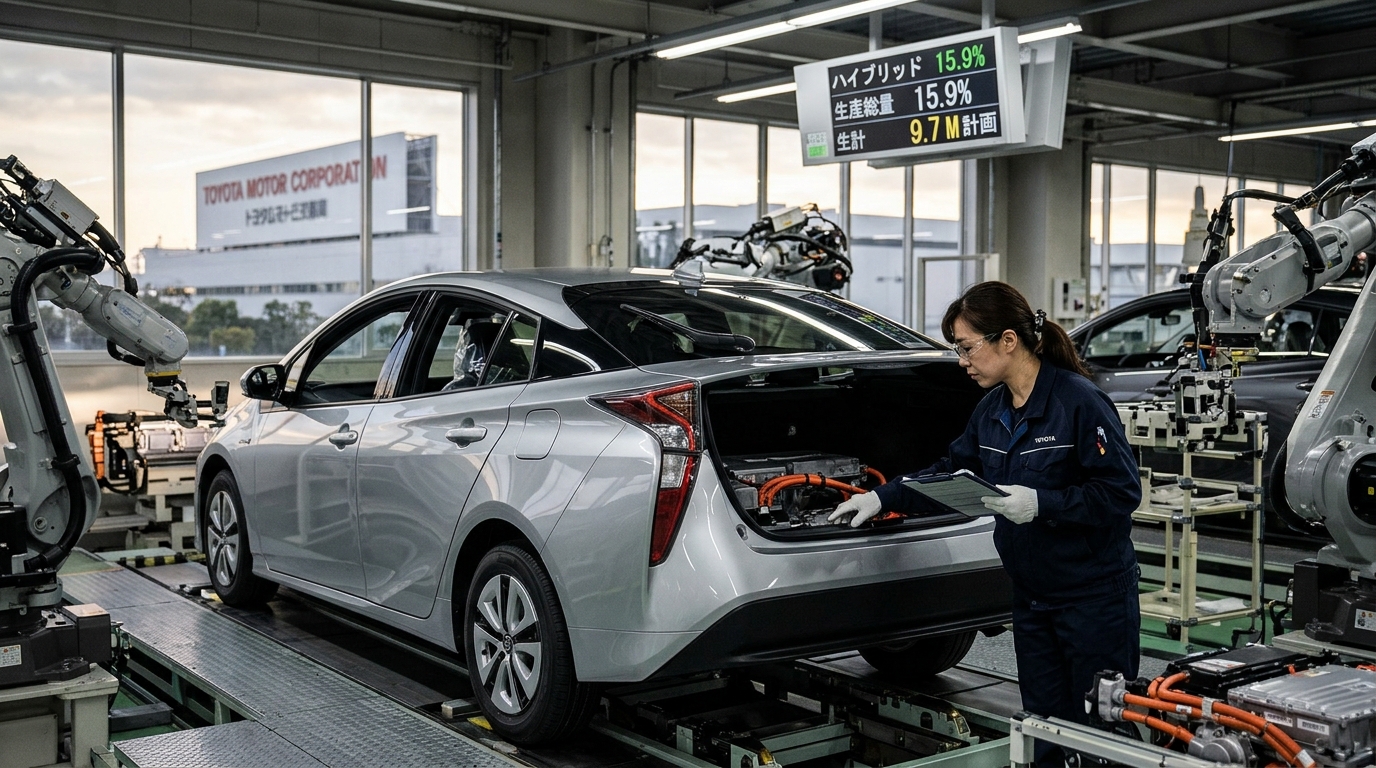
In July 2026, hybrid vehicles captured 15.9% of new vehicle retail sales in the U.S., up 2.5 percentage points from a year earlier. EV share sat at 7.0%, down 3.3 percentage points from July 2025. Toyota commands roughly 43% of all hybrid sales in the U.S. market, with Honda a distant second at around 16%. That is not a bridge technology. That is a dominant market position in the fastest-growing powertrain category in the country.
Toyota attributed its positive earnings trajectory to a weaker yen and robust demand for hybrid vehicles, which helped offset declines in China and the Middle East. The company has said it expects to sell more than 5 million hybrid vehicles in calendar year 2026, building on what Toyota and some auto industry forecasters have described as a leading position in the global hybrid market. Toyota largely avoided costly restructuring by keeping hybrids at the center of its volume strategy rather than rapidly forcing customers into fully electric vehicles.
Now consider what the stock reflects. Toyota’s trailing price-to-earnings ratio stands at roughly 8.6 times earnings. At the industry average multiple of 11.6 times, the implied share price would be approximately $252, representing about 36% upside from recent levels. The market is pricing Toyota as though its strategic bets are still unproven, even as the evidence accumulates quarter after quarter.
The honest counterargument is worth stating plainly. Toyota’s China vehicle sales have suffered, partly due to surging gasoline prices there, while domestic Chinese EV brands continue to squeeze foreign automakers on price. Currency tailwinds will not last forever, and a strengthening yen could pressure reported profits sharply. The 19% quarterly profit decline is real, even if the full-year picture is improving.
There is also the competitive question. The rest of the industry, having cooled on pure EV timelines, is coming for Toyota’s dominant share of the hybrid market. Honda and Hyundai are already gaining ground. The moat is wide, but it is not unchallenged.
Still, the core question for long-term investors is simpler than the debate around it. Toyota is the world’s largest automaker, sits at the center of a U.S. market that is clearly tilting toward hybrids, raised full-year guidance after a difficult quarter, and trades below 9 times earnings. The market’s refusal to rate this business more highly is not evidence that something is wrong. It is an opportunity that requires patience to collect.