
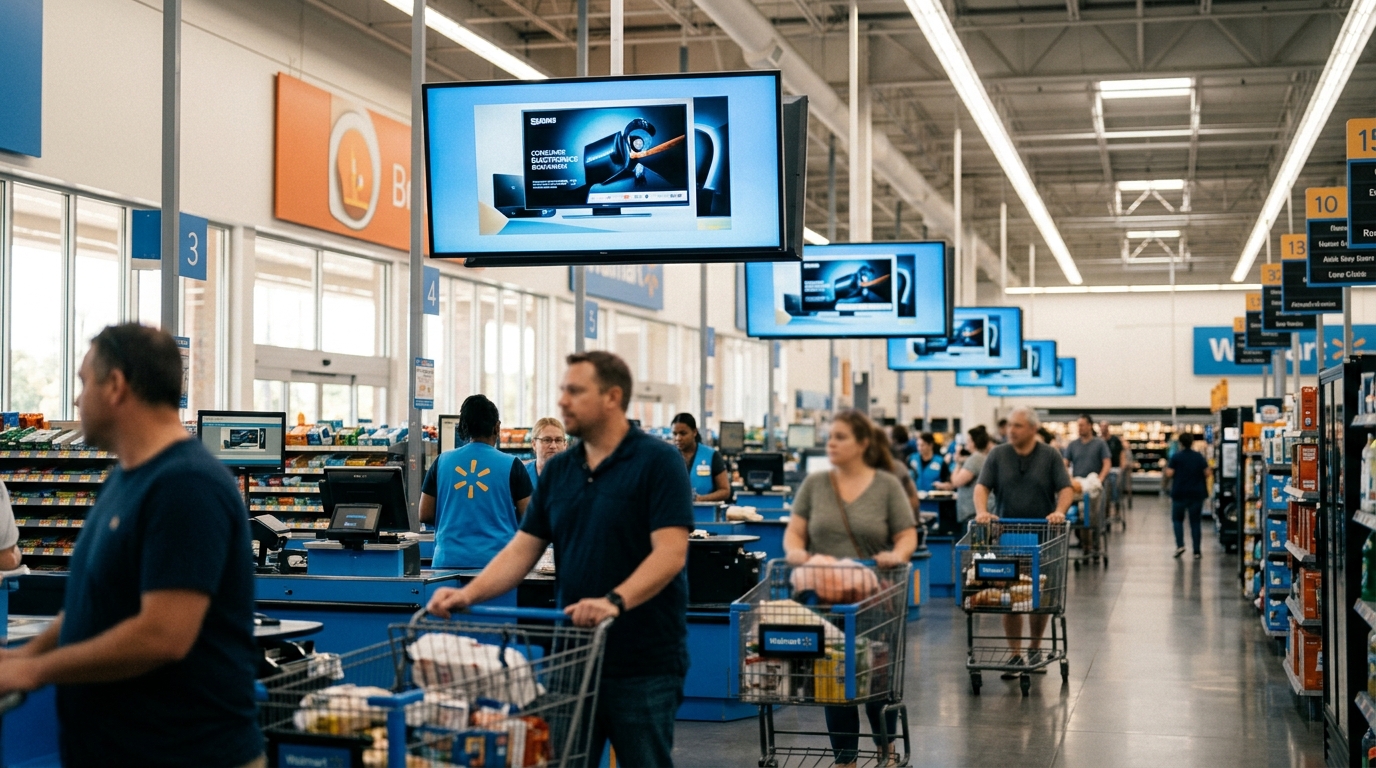
Walmart runs about 4,600 stores and serves more than 150 million customers every week. That commerce machine is enormous. The advertising business riding on top of it is growing far faster.
Walmart Connect, the company’s U.S. advertising arm, grew revenue 41% year over year in Q4 FY2026 (excluding VIZIO), and Walmart said its global advertising business grew 46% for the full fiscal year to nearly $6.4 billion (including VIZIO). Those are not retail growth numbers. They are tech-sector growth numbers, produced by a company most people still think of as a grocery chain.
The Business
Walmart Connect is the company’s retail media network, letting marketplace sellers and brands promote products across Walmart.com, the app, and physical stores, while giving advertisers access to first-party shopper signals tied to more than 150 million weekly customers. That data asset, built from actual purchase transactions rather than browsing behavior, is what makes the advertising valuable. Brands do not guess whether a campaign drove a sale. They know.
Walmart has highlighted improving eCommerce economics, but the claim that Walmart U.S. eCommerce was profitable in every single quarter in fiscal 2026, and that advertising revenue is now over a fifth of Walmart’s operating income, is not something Walmart reports as a verified, company-wide figure in its public financial statements. A more defensible takeaway is that advertising is a high-margin contributor and, alongside membership, has been a meaningful driver of operating income in certain quarters.
Why Wall Street Is Paying Attention
The strategy shift in 2026 is the part that matters most for the stock. Walmart is loosening its walled-garden approach. In late May 2026, Walmart Connect said it would expand access to its first-party data through partners, with Yahoo DSP as an initial launch partner, starting with VIZIO inventory made available via Magnite.
Then, on June 11, 2026, Walmart Connect partnered with Google Display & Video 360 to let advertisers activate Walmart audiences with YouTube campaigns and use closed-loop measurement to see how video affects sales at Walmart. Reports in 2025 also indicated Walmart and The Trade Desk revised their relationship to end exclusivity, opening the door to broader platform distribution.
What’s Driving the Opportunity
Walmart has argued it still has room to grow advertising relative to the commerce volume flowing through its ecosystem. But specific claims about Walmart Connect advertising revenue as a percentage of gross merchandise value being in the mid to low single digits, and that Walmart’s CFO characterized it as “middle of the pack,” are not consistently disclosed in Walmart’s public filings and are difficult to verify precisely. The bigger point still holds: Walmart’s ad business is much smaller, as a share of total company revenue, than Amazon’s advertising business is relative to Amazon, which implies runway if Walmart continues to scale.
What Could Go Wrong
Expanding across third-party DSPs introduces pricing competition that could pressure Walmart’s ad rates over time. VIZIO’s contribution remains on a relatively small base. And while executives have talked about advertising and membership as higher-margin streams that help diversify profits, it is also true that those streams can help offset margin pressure from the core retail business during periods of cost inflation, tariffs, or higher operating expenses.
The Bottom Line
Walmart is not becoming an ad company. It already is one. The broader distribution model, pairing 150 million weekly shoppers with platforms like Google and Yahoo, is the kind of structural shift that compounds quietly until it doesn’t. At current multiples, the market is still valuing WMT as a retailer. The ad business deserves a second look.