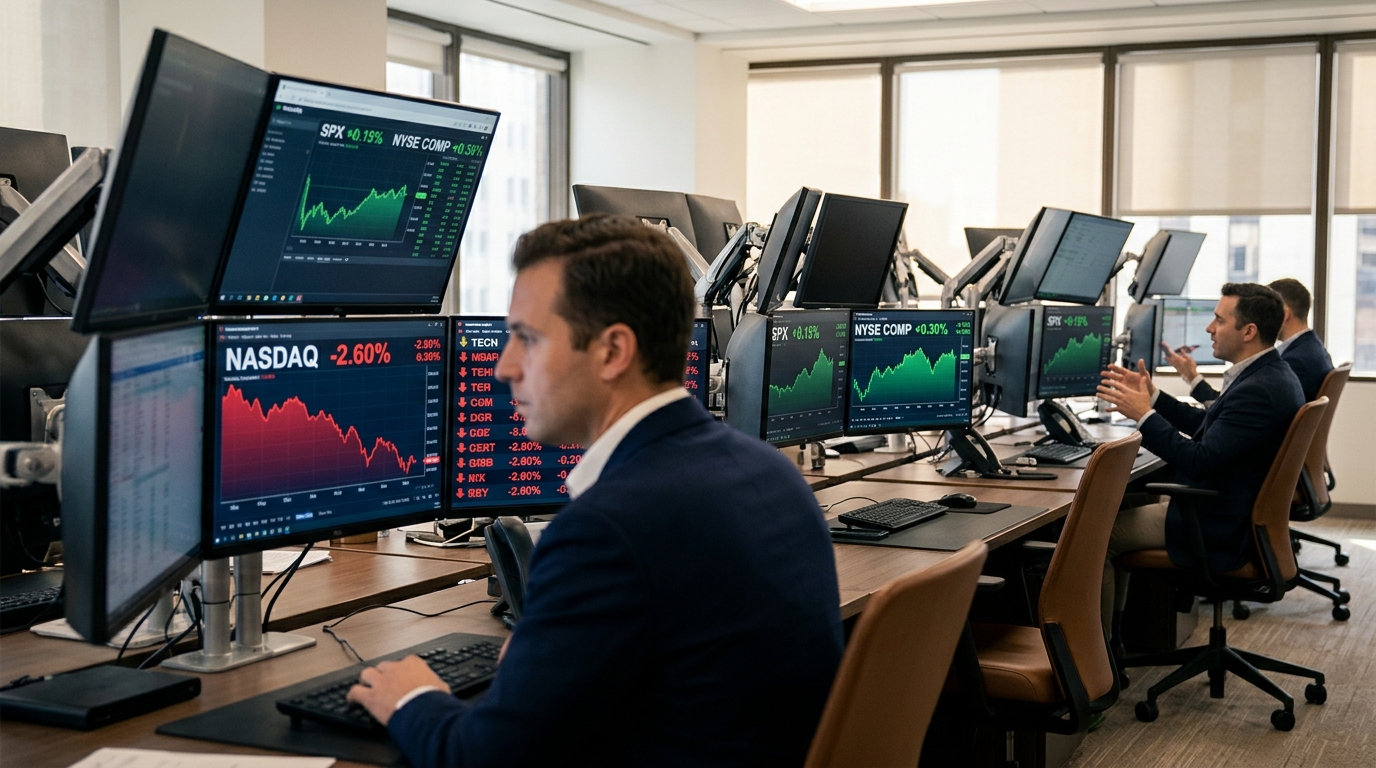
Thursday’s headline was brutal: the Nasdaq Composite fell 2.60% to 26,008.86, its worst session since June, while the S&P 500 shed 1.21% to 7,663.43, its worst day since July. The Philadelphia Semiconductor Index lost 6.72%, with all 30 of its members closing in the red, erasing roughly $200 billion in sector market value.
If you only read that far, you missed the actual story.
The weakness in tech was so overwhelming that it masked strength for the rest of the market, where the majority of S&P 500 stocks actually rose. The Invesco S&P 500 Equal Weight ETF gained 0.73%, beating the cap-weighted index by nearly two points. The Dow edged up less than 0.1%. That is not a market in panic. That is a market reshuffling its deck.
What Set It Off
Two catalysts combined to concentrate the pain in semiconductors and mega-cap tech. Meta reported negative free cash flow of $2.12 billion on $34.91 billion of quarterly capex, and narrowed its 2026 capital spending range to $135 billion to $145 billion from $130 billion to $145 billion. The guidance trend is impossible to miss: $125 billion to $145 billion in April, $130 billion to $145 billion in July, $135 billion to $145 billion now. Every quarter, the floor rises. Meta fell 6.98%.
Then Lam Research piled on. The trigger came from Lam, which makes the equipment chipmakers use to build semiconductors. On its October 21 earnings call, CFO Doug Bettinger said the company’s quarterly revenue guidance would have been a bit higher if not for near-term supply chain constraints that it is actively managing. Bettinger also warned that the whole industry is going to have to work through similar constraints. Lam fell 11.76%.
The damage then radiated outward: Arm tumbled 7.28%, AMD dropped 8.10%, ASML fell 6.93%, Intel and Marvell each shed more than 8%, Applied Materials lost 8.2%, and KLA fell at least 10%. Nvidia, despite CEO Jensen Huang declaring AI demand extraordinary at an event in Berlin, fell 4.40% after Huang said neoclouds lack the working capital to fund growth.
What the Market May Be Missing
The crowd heard “AI selloff” and stopped reading. The scoreboard tells a different story. Technology and communication services were both down more than 2.5%, while consumer staples gained roughly 2.5% and value held up far better than growth. That is important evidence of rotation rather than a uniform withdrawal from risk.
Consumer staples, health care, utilities, and energy have all risen in recent weeks, while technology has fallen, leaving a wide gap between the leaders and laggards in a single month. That kind of divergence within a single month belongs to sector rotation, not capitulation.
Credit confirms it. The high-yield bond ETF HYG was up about 0.2% on the session, which did not confirm fresh broad-credit deterioration. The 10-year Treasury yield fell about 19 basis points to roughly 4.95%, its biggest single-day drop in more than three years. Treasuries rallied because investors wanted safety, not because the credit market is pricing in defaults across the economy.
The distinction matters. When credit spreads blow out alongside equities, capital is leaving the system. When Treasuries rally while high-yield holds and the average stock rises, capital is rotating between sectors. Thursday was the latter.
Where It Shows Up
Thursday was an AI financing scare more than an earnings problem, since most reports beat estimates and stocks fell anyway. The companies carrying real risk into next week are the ones whose capex disclosures will either validate or detonate the spending concern. Microsoft reports October 28. Alphabet also reports October 28, while Amazon delivers results October 29. All three are hyperscalers whose capital spending levels sit at the center of what rattled the market Thursday.
If other hyperscalers show similar cash flow strain next week, the market may conclude that the AI capex cycle is burning cash faster than it can generate it, a conclusion that would weigh hardest on the chipmakers whose order books depend on that spending continuing.
Risks and Counterpoints
The bull case rests on Thursday’s breadth. If this were a genuine crisis of confidence, high-yield spreads would have moved, and they did not. Staples and utilities do not rally 2.5% in a market pricing systemic risk.
The bear case is more specific. Large, highly profitable companies can continue investing despite restrictive financial conditions. Smaller companies dependent on new financing face less favorable economics. Meta’s credit default swaps hit record highs this week, a detail easy to miss beneath the equal-weight resilience. And Lam’s supply warning was explicit: management said the whole industry is going to have to work through very similar things, a line that extends the warning well beyond equipment makers.
What to Watch Next
The three readings that will settle Thursday’s question: capex guidance from Microsoft, Alphabet, and Amazon on October 28 and 29; whether the Philadelphia Semiconductor Index can stabilize after October’s 15% decline; and whether the 10-year yield’s move below 5% holds or reverses, since a sustained drop would shift the market’s concern from a tech reset to a broader growth scare.