Start with the bond market, because that is where Wednesday’s real verdict landed.
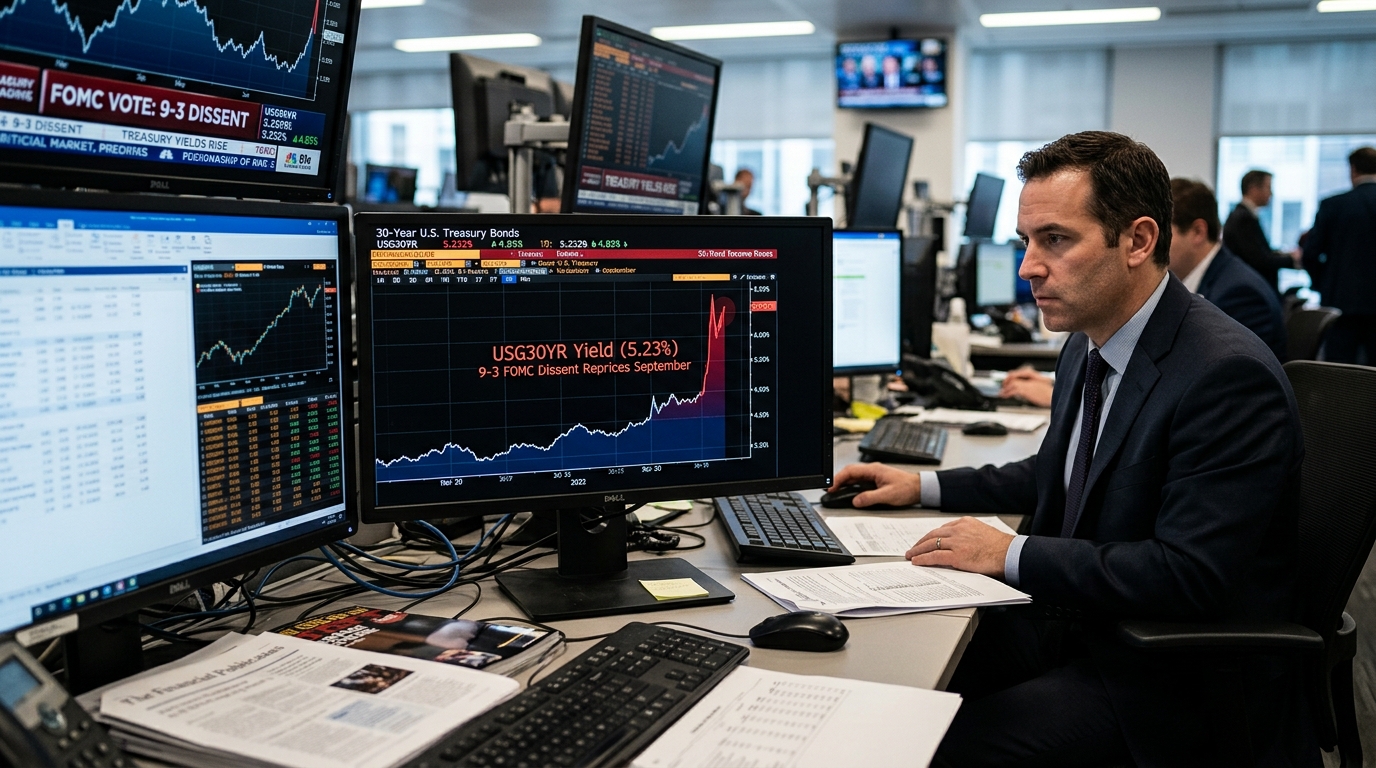
After the Fed kept interest rates unchanged for a seventh consecutive meeting, investors dumped 30-year Treasury bonds, sending the yield shooting up as much as 14 basis points to nearly 5.23% — a 19-year high. That is not the reaction you get after a reassuring hold. That is the reaction you get when the market looks past the decision and decides the committee is running out of time.
So what actually happened in that room?
The Signal
The Federal Open Market Committee voted 9 to 3 to keep the federal funds rate in a target range of 3.50% to 3.75%, marking the fifth consecutive meeting without a move. The headline reads “hold.” The subtext reads something else entirely.
What set this dissent apart was not just its size but its unity: Hammack, Kashkari, and Logan all wanted to move in the same direction, at the same meeting, after the same weeks of public statements signaling hawkish urgency. Three dissenters. One direction. No ambiguity.
The post-meeting statement noted that the three dissenters “preferred to raise the target range for the federal funds rate by ¼ percentage point at this meeting.” This is the first time since September 2016 that three policymakers dissented with a unified view of which direction rates should head.
The options market had been under-positioned for this. TLT’s IV rank of approximately 22 placed current implied volatility in the lower portion of its one-year range, despite one of the most consequential FOMC meetings in recent years approaching. The IV high for TLT over the past year was 16.29% on March 27, 2026, compared to a reading of 10.29% heading into the meeting. Historical realized volatility for TLT was 9.26% — meaning implied volatility was only modestly above realized heading into a genuinely uncertain binary event. When volatility is priced that cheaply around a catalyst that ends up moving markets, the asymmetry favors whoever owned the options.
Why It Matters
The 2016 parallel is worth sitting with for a moment. The September 2016 parallel is instructive: in that meeting, the committee held despite three hawkish dissents — and then raised rates at the December 2016 meeting, not at the immediately following gathering.
That history suggests September pricing may be overcooked in terms of urgency. But it does not make September irrelevant. “A hike in September is finely balanced, with any further action likely dependent on a combination of developments in the Middle East and the next two CPI prints.”
Immediately after Warsh’s press conference, the market saw a 60.1% chance of a hike in September according to the FedWatch Tool, down from 78.8% on Wednesday morning. So the press conference itself actually cooled things down somewhat. That is the Warsh paradox: he vowed inflation discipline, then declined to signal what acting on that discipline actually looks like.
In a post-meeting media conference, Fed Chair Kevin Warsh vowed to contain inflation but declined to offer any guidance on what action would be needed by the central bank. Warsh’s refusal to provide clear road signs on where monetary policy is headed led to an unusually high level of uncertainty heading into the meeting. And uncertainty after a hawkish shock is almost always bad for long-duration assets.
The Backdrop Behind the Vote
This dissent did not emerge in a vacuum. The macro backdrop explains why three presidents felt compelled to formally break with the chair.
Officials favoring tighter policy argued inflation has been a burden on households and is not showing clear signs of abating. Recent price pressures have reflected both tariffs imposed by President Donald Trump and higher energy costs tied to the Iran conflict. The Personal Consumption Expenditures Price Index increased 3.7% in the 12 months through June, matching expectations, after advancing by an unrevised 4.1% in May. That is not a Fed anywhere close to its 2% mandate.
Slight tangent, but it matters here: oil prices have been volatile recently amid on-again, off-again fighting between the U.S. and Iran. Crude futures were up more than 20% for July, which is likely to keep headline inflation readings hot in the near term. Two more CPI reports between now and September 16 will carry enormous weight. If energy stays elevated, the hawkish camp gets louder.
The Fed’s dot plot from its June meeting showed nine members projecting at least one hike in 2026, while eight others projected rates to remain unchanged. Three public dissenters on top of that is not a fringe movement. It is the committee’s center of gravity beginning to shift.
Market Expectations
The yield curve reaction told an interesting story on its own. The two-year yield, which tracks expectations for Fed policy, fell four basis points to 4.24%. Meanwhile, the 10-year yield surged eight basis points to 4.68%. The 30-year yield surged 12 basis points to 5.21%, its highest level since 2007.
Short end fell, long end exploded higher. That is not a market pricing in a tidy, credibility-restoring hike in September. That is a market saying it does not fully trust this Fed to get ahead of inflation. Bank of America economist Aditya Bhave said markets responded to Warsh’s press conference by “questioning the Fed’s credibility,” and that “the need to re-establish credibility increases the probability that the Fed will hike in September.”
Bank of America remains comfortable with its forecast for 25 basis points at each of the Fed’s remaining three meetings this year. Bank of America forecasts three 25-basis-point rate hikes in 2026, projected for September, October, and December. Deutsche Bank expects two additional hikes in September and December. If either of those forecasts proves accurate, the current rate environment is just the beginning of the repricing, not the end.
As of July 29, real yields accounted for roughly 93% of the gain in the 30-year since June 17. That is the part people tend to skip. It is not inflation expectations driving the long end. It is real yields. Real yields rising means the market is pricing in a structurally higher cost of capital, not just a temporary energy shock. That is a different and harder problem for rate-sensitive equities.
Strategic Considerations
What is the options market actually offering here? A few angles worth thinking through carefully.
The long end of Treasuries. During the 2022 hiking cycle, TLT implied volatility regularly exceeded 20% in the weeks surrounding FOMC decisions. Current readings near 10% suggest the market still has not fully normalized its volatility expectations to a regime where hikes are live. If September becomes a genuine coin-flip, IV on TLT should move significantly higher between now and then. A long straddle or long strangle on TLT positions for that repricing without requiring a directional view on whether Warsh actually pulls the trigger.
Rate-sensitive sectors. Rate-sensitive sectors including technology, real estate, and utilities face renewed pressure, while financial stocks stand to benefit from improved net interest margins. That creates a fairly clear sector skew worth expressing through options. Utilities run on heavy debt and pay steady dividends. When the 10-year offers 4.6% risk-free, a utility yielding 3.8% looks weaker on a risk-adjusted basis. Names with refinancing walls in 2026 and 2027 face the worst squeeze. Long puts on rate-sensitive ETFs, or debit spreads if you want defined risk, allow for directional expression without outright shorting a sector that could still bounce on any dovish data surprise.
The financials side of the trade. Financial stocks, particularly banks and insurance companies, typically benefit from rising rates through expanded net interest margins and improved investment returns. For readers who think September is a real possibility, call spreads on bank ETFs into the September 15-16 meeting offer defined-risk upside on the one sector that genuinely benefits from higher-for-longer.
One risk to all of this: “It is folly to hike rates in the face of a supply-shock bout of inflation. Cooler heads prevailed, but they may get nervous if we don’t see core inflation make some progress by the September meeting.” Supply-shock inflation does not necessarily respond to rate hikes the way demand-driven inflation does. If the hawks win and then the economy slows, they own that outcome.
What to Watch
The data between now and September 16 is the only thing that matters. The Fed’s next meeting is scheduled for September 15 to 16, 2026. With three officials already pushing for a hike, that meeting will be closely watched for whether the hawkish camp grows, or whether cooling data gives the committee room to hold steady again.
Two CPI reports. The July jobs number. And whatever happens in the Middle East between now and then. “The Fed meets again in mid-September, and six weeks is a lifetime as it concerns geopolitical risk and its impact on monetary policy. All eyes should remain on the Middle East and the price of oil between now and then.”
Governor Christopher Waller is worth watching specifically. Governor Christopher Waller also voiced worries recently over inflation, saying higher rates could be necessary if more progress isn’t made. He voted with the majority to hold on Wednesday. If he flips, the dissent becomes four. At that point, Warsh is leading a committee that is actively breaking against him — and markets will force the question.
The vote was 9 to 3. The question is whether that ratio holds for six more weeks, or whether it starts looking more like 8 to 4. That is what the options market needs to price. Right now, it is not fully doing so.