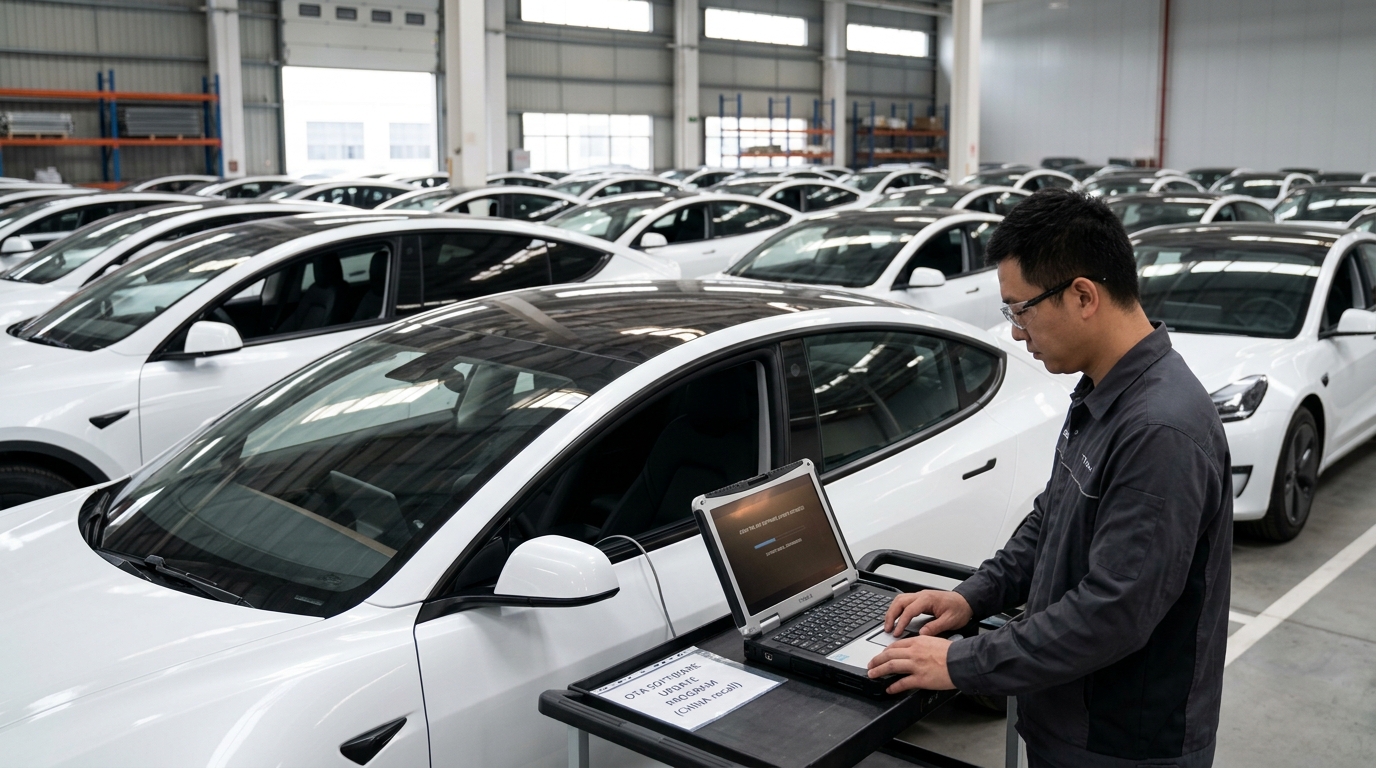
China’s regulators announced one of the largest automotive recall campaigns in the country’s history last week, and Tesla sits at the center of it. About 2.98 million Model 3, Model Y, Model S, and Model X vehicles are being recalled over concealed door handles that can hinder escape and rescue in extreme situations, such as a severe collision that disables the low-voltage system. Other automakers, including Xiaomi, Leapmotor, and Xpeng, are recalling additional vehicles for similar concerns. The combined total: more than 4 million cars.
That number is genuinely large. The market reaction was not.
TSLA opened lower on Monday and was trading down in late morning, pressured alongside the broader auto sector by a separate Trump tariff escalation targeting Canadian vehicles and parts. The China recall contributed, but it was not the lead story for the stock. That distinction matters.
Why the Numbers Deceive
The scale of a recall and the cost of a recall are two different things. Tesla’s remedy involves adding labels and guidance to help occupants locate the emergency mechanical door releases, and deploying an over-the-air software update that can automatically lower the windows after a collision. No service center visits required in most cases. No parts replacement. No logistics operation across 2.98 million households.
As AutoForecast Solutions vice president Sam Fiorani noted, modern over-the-air updates sharply reduce the cost and downtime traditionally associated with major recalls. Tesla has run this playbook before. The company has used remote software updates to address compliance issues in China going back years, and regulators there have accepted the approach repeatedly.
Meanwhile, China’s underlying regulatory posture hardened. Beijing announced in February that hidden, electronically actuated door handles will be banned starting January 1, 2027, making it the first country to phase out a design Tesla popularized and domestic EV makers widely adopted. The recall is essentially an accelerated transition to a standard that was already coming.
What Professional Traders Likely Watched
Experienced traders reading Monday’s open had to separate two distinct signals. The first was the recall itself, which carried real headline risk but limited cash impact given the software remedy. The second was TSLA’s broader technical position. The stock had recovered from a late-July low near $304 back toward the mid-$300s after a difficult stretch, and Monday’s weakness was shared by Ford, GM, and Stellantis on the Canadian tariff news. When an entire sector moves together, the stock-specific headline is rarely the primary driver.
The lesson is about parsing news by its economic consequence rather than its surface magnitude. A 2.98 million-vehicle recall resolved by a software push can cost Tesla far less than a 200,000-vehicle recall requiring physical part replacement. Volume without context is noise.
What to Watch Next
Keep attention on two things. First, the September 3 Cybercab event in Austin, which the market has begun pricing as the next meaningful catalyst. Second, whether Chinese domestic rivals use the recall period to press their relative standing in China’s EV market. Xpeng reported results and guidance that disappointed investors today, falling about 7%, while NIO dropped about 4%. Relative weakness across the Chinese EV group may matter more than the recall itself for positioning in the weeks ahead.
The Trader’s Lesson
Headline scale and financial impact are not the same variable. Before sizing a position around a recall announcement, ask how the fix gets delivered. Software is not a recall in the traditional economic sense. The traders who sold TSLA hard on headline volume on Monday confused a number with a bill.